Stand Therefore · The Armor of God · The Ordinary Means
What Scripture, the Catechism and the Church's exorcists agree on about the devil — and what an ordinary Catholic is actually supposed to do about him.
Sandro Botticelli, The Temptations of Christ (1481–1482, Sistine Chapel, Vatican City)
Five things, in the order they belong: put the armor on, be fed, live it, study the field, and keep your eyes where they belong.
Almost everything a Catholic needs against the devil he already has and mostly already does. That is not a consolation prize; it is the teaching of Scripture, of the Catechism, and of the priests the Church appoints to this work. The order of this page is Saint Paul's order, and the five parts that follow are the whole of the layman's part in the fight. The reference sections after them are for when you need a name for something: the kinds of attack, the powers the devil does not have, how to tell one spirit from another, who is on your side, how doors open, what a father owes his household, and what to do if something seems wrong.
Read it once through, then keep it for the section you need. Nothing here replaces your parish priest.
The armor is not a metaphor for courage. Each piece is named, and each is something you already have access to.
| Piece | What it is | How you put it on |
|---|---|---|
| Belt of truth | Honesty with God about yourself. The devil works by deception first (Genesis 3; Fr. Lampert's "four D's" begin with it). | Examination of conscience; regular confession. |
| Breastplate of justice | A life in a state of grace; the virtue of giving God and neighbour their due. | The sacraments; the cardinal virtues (Part III). |
| Shoes of the gospel of peace | Readiness; knowing the faith well enough to walk on it. | Catechesis. Lampert: the failure today "is that catechesis is just not good." |
| Shield of faith | "The key ingredient in defeating the devil is faith… a fortress" (Lampert, quoting Suenens). Curses "are only effective when we are weak in our faith." | Prayer, Mass, the Creed said and meant. |
| Helmet of salvation | Baptism and the hope it gives; the mind guarded from despair. | Renew the baptismal promises; holy water recalls them. |
| Sword of the Spirit | The word of God. Our Lord answered every temptation in the desert with Scripture (Matthew 4). | Read the Bible. Fr. Reehil: memorise five verses for a crisis. |
| Prayer at all times | The piece that holds the rest on. | A daily rule (Part V). |
The Church's own reading is the same: the armor is the virtues and the sacraments. The Liber Christo method calls the sacraments the "base armor" and everything else an addition to it. So the order of this page is Saint Paul's order — put the armor on, then be fed, then live it, then study the field, then keep your eyes where they belong.
Every exorcist in this library says the same thing first: confession, then Communion. Exorcism is for the rare case; the sacraments are for everyone, every week.
Reconciliation first
"When it comes to the sacraments and defeating the devil, the number one weapon in our arsenal is the Sacrament of Penance."
Fr. Vincent Lampert, exorcist of Indianapolis · Exorcism, p. 39
"Nothing I do is any good if you haven't gone to confession first."
Fr. John Farao, OFM Conv., exorcist of Monterey · 2021 interview
The Blessed Sacrament
Baptism, remembered
Every exorcism begins with holy water, "which recalls the Sacrament of Baptism" and says to the devil, in Lampert's words, "this person does not belong to you. They belong to God." At Baptism you — or your godparents for you — renounced Satan. Holy water at the door, the sign of the cross, the Creed on Sunday: these are how a Catholic keeps saying it.
"A virtue is an habitual and firm disposition to do the good" (CCC 1803). The demons attack where the virtue is missing; you cannot guard a gap you cannot name.
| Prudence | Right reason in action: seeing what the true good is and choosing the means to it (CCC 1806). |
| Justice | The constant will to give God and neighbour their due (CCC 1807). Ripperger: fifteen minutes' daily prayer is "the most elementary obligation of justice to God." |
| Fortitude | Firmness in difficulties and constancy in pursuing the good (CCC 1808). Reehil: "Catholic courage is called fortitude; pray for more if you need it." |
| Temperance | Moderation of the appetites (CCC 1809). Ripperger's rule, taken from the demons' own strategy: "anything but moderation," because "the virtue is a mean between extremes." |
| Faith | Belief in God and all he has revealed (CCC 1814). The shield of Ephesians 6. |
| Hope | Desire for heaven and trust in Christ's promises (CCC 1817). Its enemy is acedia, the "noonday devil" of Psalm 90, which Lampert names as the last stage of the devil's ordinary attack: discouragement. |
| Charity | Love of God above all and neighbour for his sake (CCC 1822). "Perfect charity casteth out fear" (1 John 4:18); Lampert: "The devil fears people who love." |
They are "infused by God into the souls of the faithful" (CCC 1813). You ask for them; you do not manufacture them.
Where it all hangs
Saint Augustine said the whole story of the world is two loves: love of self to the point of despising God, and love of God to the point of despising self — and the Catechism uses that sentence to define sin (CCC 1850). Saint Thomas says every sin comes from a self-love turned away from God, and that the devil's own sin was wanting his happiness from himself. So the whole armor comes down to one word, obedience, which is the outward shape of where your love points. Lampert puts it for parishioners: "Freedom and obedience to God go hand in hand… when we believe that freedom means we can do whatever we want, then we end up becoming slaves to our own passions and desires."
"If you know the enemy and know yourself, you need not fear the result of a hundred battles" (Sun Tzu, The Art of War III.18). Know him well enough to stop being surprised, and no better than that.
What he is
How he works
Two modes, and the proportion matters. Ordinary activity is temptation, aimed at everyone including Christ; Reehil estimates it at "about 98% of the attacks," and it is the mode that actually damns. Extraordinary activity — infestation, vexation, obsession, possession — is real, rare, and the exorcist's business. The full list, with what each one looks like, is in the kinds of attack below. Lampert's four stages of the ordinary attack, from Fr. Louis Cameli, are worth memorising because you will recognise them: deception (his lie taken as truth), division (from God, from others, from yourself), diversion (busyness and addiction to fill the gap), discouragement (acedia). Then a fork: death, or discipleship.
And now stop
"The devil is far less to be feared in so-called manifestations than in the underground influence he exerts in souls that are not sufficiently instructed."
Jean Lhermitte, quoted by Lampert · Exorcism, p. 76
Saint Teresa of Avila, quoted by Lampert: "I don't understand those fears that make us cry, the devil, the devil, when we can say God, God!"
Everything above is defence. This is the point of the defence. Worship is owed to God alone, and the whole war is over who gets it.
A daily rule that every exorcist here would sign
"We don't have to do anything extraordinary to defeat the devil. It's the very ordinary aspects of our faith that will always keep the devil at bay. We go to Mass, we pray, we read the Bible, we celebrate the sacramental life of the Church, we know and live out our faith… the devil is already on the run."
The names below are the working vocabulary of the Church's exorcists, not dogma. Fr. Driscoll notes that the middle categories "are not part of Church teaching; rather, they are acceptable Catholic opinions." But they let you say what is happening, which is the first step in not being afraid of it. Saint Thomas draws the deepest line: attacks from without, answered by holy water and the sacramentals, and attacks from within, answered by exorcism.
| Kind | What it is | What it looks like | The remedy |
|---|---|---|---|
| Temptation | The ordinary attack, aimed at everyone. The devil can suggest to the imagination and stir the appetites; he cannot touch the will (Aquinas, I-II q. 80). | A thought that is not yours, at the moment you are weakest. Ripperger: he "put[s] the perspective on the image," so a wife's "when are you getting up?" is heard as "she thinks I'm lazy." | Refuse it early; Scripture; confession; the ordinary means. Not an exorcist's matter. |
| Vexationphysical attack; Amorth's "external pain," Ripperger's "dolor" | Blows, scratches, bruises, sleep disturbed, unexplained illness — from outside the body. | Marks that appear and vanish; a pattern of accidents beyond coincidence (Martins). God has permitted it on the innocent for purification: Job, Saint Paul's thorn, the Curé of Ars, Padre Pio, whom the devil threw out of bed. | Prayer and blessing; a curse declared null by a priest; for the holy, patience. "There has never been the need for an exorcism, only for prayers" (Amorth). |
| Oppressiona word with three usages | Amorth and Ripperger: attack on a person's externals — health, work, finances, relationships. Martins: the bodily assault above. Lampert: the God-permitted trial of the innocent. | A life that unravels in every department at once after a curse or an occult contact; the bent woman of Luke 13. | Faith first ("curses are only effective when we are weak in our faith"), then the priest's prayers. |
| Obsession | The internal attack on the mind: "a besieging." Not the psychiatric word. | Obsessive thoughts the person cannot shake, blasphemies, urges, nightmares. Ripperger's diagnostic: it "switches on and… switches off," crisis then lucidity, where a psychological condition is steady. | Mental-health care and a priest, together; Lampert calls it the hardest to assess. |
| Infestation | Evil attached to a place, object or animal; it touches people only indirectly. The Gerasene swine. | Noises, footsteps, doors, objects moved, cold, dread in one room — after an occult act there or a cursed object brought in. Lampert: 99.9 per cent of "ghosts" are this; the rest are souls asking for a Mass, and they do not frighten. | Have the house blessed; destroy occult objects (blessed, burned, ashes to running water); Masses for the dead if the presence is a soul. |
| Possession | A demon takes control of the body, never the soul; the person "is morally blameless" for what the demon does (Amorth). "The gravest and most spectacular form," and the rarest. | The four signs the Church requires: an unknown language, strength beyond condition, hidden knowledge, aversion to the sacred. Lampert: perhaps one in five thousand who ask; Amorth: 93 in 30,000. "Perfect" possession shows no sign at all, because the will collaborates. | The major exorcism, by a priest with the bishop's mandate, after doctors and psychologists, in sessions of thirty to sixty minutes, sometimes for months. Every session helps even without full liberation. |
| Cursemalefice, spell, hex | Harm to another with the devil's help; "the opposite of a blessing" (Lampert). Real, and the commonest cause Amorth met. | Vexation or oppression with a history: a psychic, a rival, a jilted partner, an object given. | A life in grace makes it ineffective; a priest declares it null; the object is destroyed. Farao: never curse back; it rebounds. |
| Pactsubjugation | A person gives himself to a demon for a favour. Ripperger: the contract is invalid, "demons can't guarantee… the terms"; Christ alone sets who may cross the threshold. | Power, then a life that unravels; Lampert's young man who "declared Satan to be his father." | Renounce it, in confession and in words; the same free will that gave can withdraw. |
| Generational | An opening or curse that runs in a family line, most often through an ancestor's occult act, Freemasonry, or a promise of descendants (Farao, Ripperger, Liber Christo). | The same stubborn vice or misfortune in each generation, resisting ordinary effort. | Prayers to break generational spirits; Masses for the ancestors; Baptism and confession for the living. |
Saint Athanasius, in the Life of Saint Anthony (about 360), gives the oldest ladder of escalation, and it still holds: evil thoughts first, then foul pleasures, then terrifying apparitions, then false prophecy and pretended angels, then bodily blows. Almost nobody climbs past the first two rungs — and the first two are answered by confession.
Half the fear people bring to an exorcist is about powers the devil does not have. Lampert: "It amazes me what people believe demons are capable of… Their so-called powers and abilities need to be debunked."
Not every dark day is the devil, and not every warm feeling is God. The Church has rules for this, older than any exorcist on this page.
"Those who are with us are more than those who are with them" (2 Kings 6:16). Lampert counts "be not afraid" 365 times in the Bible — once for every day of the year.
"From its beginning until death, human life is surrounded by their watchful care" (CCC 336). Lampert, following Saint Thomas: a guardian angel, having both natural and beatific knowledge, "is more powerful than the devil himself." Saint Bonaventure's list of what he does includes rebuking your faults, constraining the demons that afflict you, mitigating temptation, and carrying your prayers to God. Ask him daily: Angel of God, my guardian dear…
The archangel who cast Satan down (Apocalypse 12:7). Leo XIII's short prayer, still said after Mass in many parishes: Saint Michael the Archangel, defend us in battle; be our protection against the wickedness and snares of the devil. May God rebuke him, we humbly pray; and do thou, O Prince of the heavenly host, by the power of God, cast into hell Satan and all the evil spirits who prowl about the world seeking the ruin of souls. Amen.
Amorth records a fellow exorcist asking the devil why Mary made him so angry. The answer: she is the purest and he the filthiest; the humblest and he the most rebellious; the obedient one and he who never obeys. The rosary is the layman's weapon of first resort; Reehil carries his everywhere "and so should you." Her last words in Scripture are the whole programme: "Whatsoever he shall say to you, do ye."
Every exorcism calls the litany of the saints, because the Church fights as a body. Ripperger says each demon has a saint who defeated him and is now his "nemesis"; that is his session material, but the litany is the Church's. The Church's authority is itself a weapon: the demons recognise the bishop, the priest he sends, and the father over his household — and they know when someone stands outside his authority.
"The demonic doesn't have any power over us that we don't give to it, either directly or indirectly" (Lampert). From eighteen years of cases he lists the ways people "play the devil's game." Farao and Ripperger give the same list in their own words.
| Opening | What it looks like | What closes it |
|---|---|---|
| The occult | Psychics, mediums, tarot, Ouija, crystals, Reiki, "energy" work, charms. "Its basic principle is that people want to bypass God" (Lampert). CCC 2116–2117 forbids all of it. | Renounce it by name in confession; destroy the objects (blessed, burned, ashes to running water: Amorth). |
| Entertainment | Screens full of demons, games that teach a child to command spirits, horoscopes, ghost hunting, glorified Halloween. | Filter it through the faith; parents decide, and explain why. |
| Curses | Real, but "only effective when we are weak in our faith" (Lampert). | A life in grace; a priest's blessing declaring them null. |
| Dedication or abuse | A child consecrated to a demon, or abuse that breaks a person and sends her to "healers" who break her more. Half of Ripperger's arrivals have this history. | The Church's prayer; forgiveness of the abuser, without resuming common life until he changes (Ripperger). |
| Habitual sin | Pornography, addiction, "the loss of the sense of sin." Ripperger: what is stored in memory is matter the demons can use. | Confession; Consecration to Saint Joseph for purity (Reehil's confessional prescription). |
| Inviting a demon | Deliberately, or in a misguided act of charity ("whatever is in you, come into me"). | The same free will that invited can renounce (Lampert's Leviathan case). |
| Unhealed relationships | The Gerasene demoniac is sent home, not with Jesus: "it is the unhealed broken relationships… in his home that brought about the demonic possession" (Lampert). | Forgive: "letting loose of the debt" (Ripperger); "a decision of the will, not a feeling" (Reehil). |
Ripperger adds the one the others assume: "You can't have an attachment for anything that's created whatsoever" (after Saint John of the Cross). A door is anything you would not hand over to God.
Parents have real spiritual authority. All four exorcists say so, and the Church's own prayers for the laity assume it.
Before she will call anything possession: speaking or understanding a language unknown to the person; strength beyond the person's condition; knowledge of hidden things; and violent aversion to the sacred. Not nightmares, not bad luck, not a feeling of being watched. Those are matters for confession, counsel and prayer.
They agree on everything above. On a few points of practice they do not, and a page that pretended otherwise would be less useful.
Ripperger: yes; his Deliverance Prayers for Use by the Laity and the Auxilium Christianorum are built for daily use by fathers over their households. Lampert: no; "like a prescription," for a season, or the focus drifts to the devil. Both agree the daily rule is Mass, confession, Scripture, rosary. Take the daily rule from both and decide the rest with your pastor.
Amorth and Farao are strict. Lampert, in his book, calls Halloween "a trap," but tells parents in conversation that costumes and candy are fine "without glorifying evil," and that a child who reads Harry Potter "through their Catholic faith" can learn from it. His test: "Which books can your children more readily recite, the books of the Bible or the books of Harry Potter?"
Fr. Ripperger builds a good deal of teaching on what demons have said under exorcism — the angels' fall, Our Lady's interior life, who is behind what in the world. The Rite forbids taking a demon's word as evidence, and he says himself that "the demon saying it has no weight." This page uses his practice and leaves his session material aside.
Everything on this page was checked against the texts below. Scripture is the Douay-Rheims (Challoner). Exorcists are cited for practice; doctrine is cited to Scripture, the Catechism and Saint Thomas.
Related Reading
Compiled by William F. Leach Jr., a layman and catechist, for the faithful of The Layman's Lantern.
Quotations are brief and attributed; consult the works themselves. Nothing here replaces your parish priest.
Ad majorem Dei gloriam.
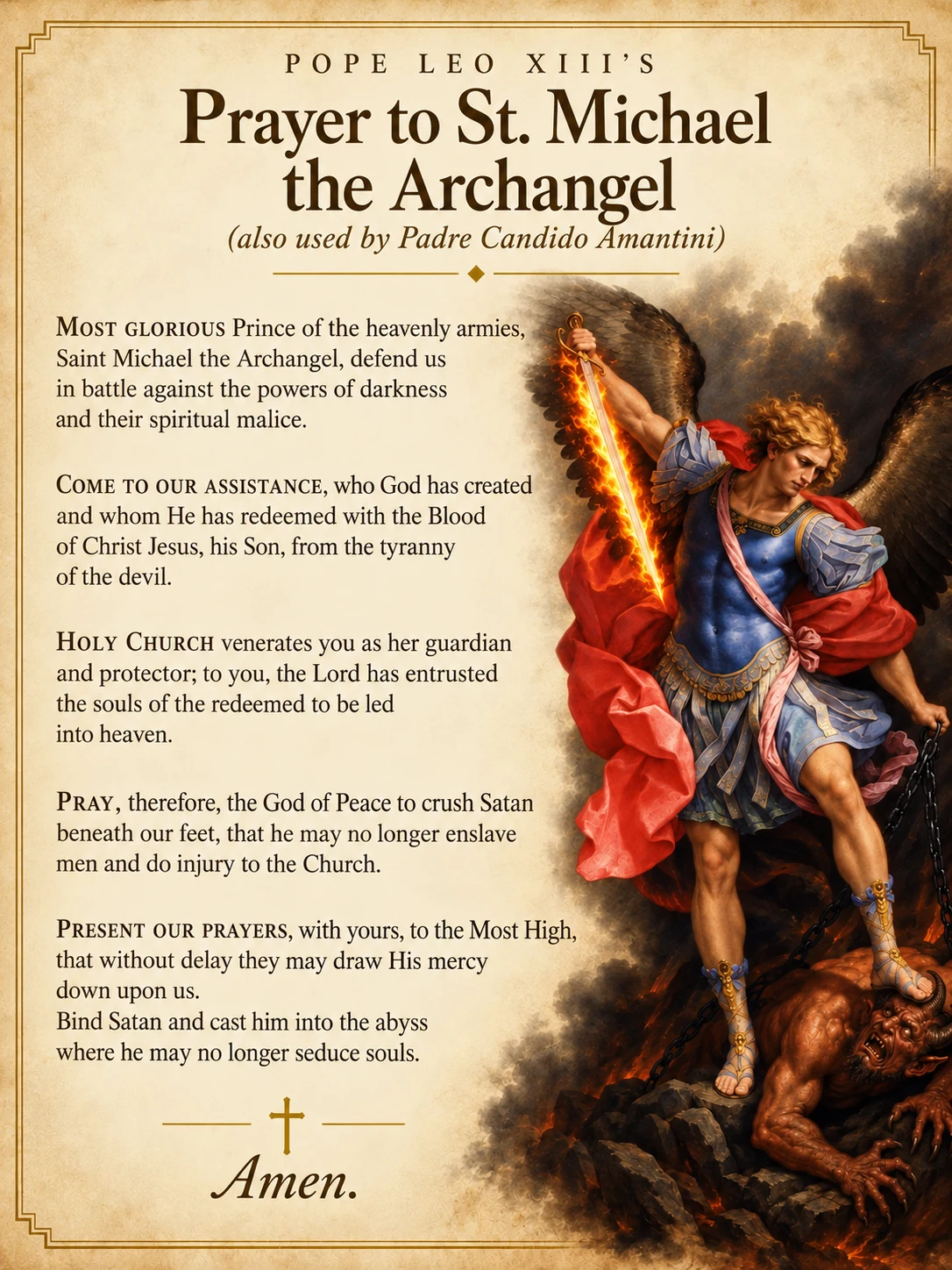
Most glorious Prince of the heavenly armies, Saint Michael the Archangel, defend us in battle against the powers of darkness and their spiritual malice.
Come to our assistance, who God has created and whom He has redeemed with the Blood of Christ Jesus, his Son, from the tyranny of the devil.
Holy Church venerates you as her guardian and protector; to you, the Lord has entrusted the souls of the redeemed to be led into heaven.
Pray, therefore, the God of Peace to crush Satan beneath our feet, that he may no longer enslave men and do injury to the Church.
Present our prayers, with yours, to the Most High, that without delay they may draw His mercy down upon us. Bind Satan and cast him into the abyss where he may no longer seduce souls. Amen.
Prints as a single page. Choose Save as PDF as the destination to keep a copy.