
The Nine Choirs · The Three Archangels · The Guardian Angel
Pure spirits created by God to know, love, and serve Him.
The angels are pure spirits — non-corporeal (bodiless) created beings possessing intellect and will. They are personal and immortal, and in the perfection of their nature they surpass all the visible creation. As spirits they have no material parts that can decay, and so an angel cannot die (CCC 328–330).
The very word angel names an office, not a nature. It comes from the Greek angelos and the Hebrew mal'akh, both meaning messenger. St. Augustine put it crisply: "'Angel' is the name of their office, not of their nature. If you seek the name of their nature, it is 'spirit'; if you seek the name of their office, it is 'angel.'"
Because angels are pure spirits, they do not possess bodies by nature. Yet Scripture often shows them appearing under a visible form when God sends them on a mission: they visit Abraham, rescue Lot, guide Tobias, speak to Joseph, and announce the Resurrection. Such appearances are not angelic bodies in the ordinary sense, but signs suited to the message God commands them to bear.
God created the angels good, and He created them for Himself: to know, love, serve, and glorify Him, and to carry out His will (CCC 329, 350). They belong wholly to Christ, who is the centre of the angelic world — "they are his angels" (CCC 331; cf. Colossians 1:16). All things were created through Him and for Him, the things in heaven and the things on earth, the visible and the invisible.
Scripture
"For in him were all things created in heaven and on earth, visible and invisible, whether thrones, or dominations, or principalities, or powers: all things were created by him and in him." — Colossians 1:16
"Who maketh his angels spirits: and his ministers a burning fire." — Psalm 103:4
"Are they not all ministering spirits, sent to minister for them, who shall receive the inheritance of salvation?" — Hebrews 1:14
Christ above the angels
Catholic devotion to the angels is never angel-centered. The opening chapter of Hebrews insists that the Son is above the angels: He has inherited a name more excellent than theirs, the angels worship Him, and they are sent as ministering spirits in service of the salvation He gives (Hebrews 1:4–14).
A note on the psalms: this page follows the Douay-Rheims and Vulgate numbering. Readers using most modern translations will find the psalms cited here as Psalm 103 and Psalm 90 listed instead as Psalm 104 and Psalm 91.
The existence of the angels is not a pious opinion but a truth of faith. As the Catechism teaches, the witness of Scripture is as clear as is the unanimity of Tradition (CCC 328). The Church's doctrine on the angels is set out chiefly in CCC 325–336 (the angels), 350–352 (the angels in the life of the Church), and 391–395 (the fall of the angels).
The solemn teaching of the councils stands behind this. The Fourth Lateran Council (1215) defined that God, from the beginning of time, created out of nothing both orders of creatures — the spiritual, or angelic, and the corporeal — and afterward the human creature, who shares in both. The First Vatican Council (1869–70) reaffirmed this same teaching of God as Creator of "the visible and the invisible," the angelic and the earthly.
And Scripture bears witness from beginning to end. The angels appear at the creation, at the gates of Eden, with the patriarchs, in the Exodus, among the prophets, at the Annunciation and the Nativity, in the Agony in the Garden, at the empty tomb, at the Ascension, and at the Last Judgement.
Sources
Catechism of the Catholic Church §§ 325–336, 350–352, 391–395.
Fourth Lateran Council (1215), Firmiter credimus.
First Vatican Council (1869–70), Dei Filius.
St. Thomas Aquinas (1225–1274) earned the title Doctor Angelicus — the Angelic Doctor — in part for the depth and clarity of his teaching on the angels. His systematic treatment, the Treatise on Angels, stands in the Summa Theologiae, First Part, Questions 50–64.
Each angel is its own species
This is Aquinas's most famous and distinctive claim. Angels are subsistent forms without matter — entirely actual, simple spirits (ST I, q.50). Now it is matter that multiplies many individuals within a single species. Since the angels have no matter, there are not "many of a kind": every angel differs from every other as one whole species differs from another. Each angel is utterly unique — its own kind, its own species (ST I, q.50, a.4).
Angelic knowledge is intuitive, not learned
Angels do not reason step by step or abstract ideas from the senses as we do. God endows them at their creation with infused intelligible species, so that they grasp truth directly and at once (ST I, qq.55–58). Borrowing from St. Augustine, Aquinas distinguishes their morning knowledge (cognitio matutina) — the knowledge of things in the Word of God — from their evening knowledge (cognitio vespertina) — the knowledge of things in their own created natures (ST I, q.58).
Angels and place; angelic speech
An angel is not in a place as a body is, by filling space. An angel is present where it acts — it is "in a place" by the application of its power to that place (ST I, q.52). (The popular jibe about angels dancing on the head of a pin is a much later parody; Aquinas never posed it.) Angels "speak," moreover, by an act of the will, one ordering its thought to be made known to another (ST I, q.107).
The fall of the angels
The first sin of an angel could only be pride — or the envy that follows from it — the desire to attain beatitude by its own power rather than by the grace of God (ST I, q.63). Because the angelic intellect grasps fully and chooses definitively, the choice was instantaneous and irrevocable. For a fallen angel there is no repentance.
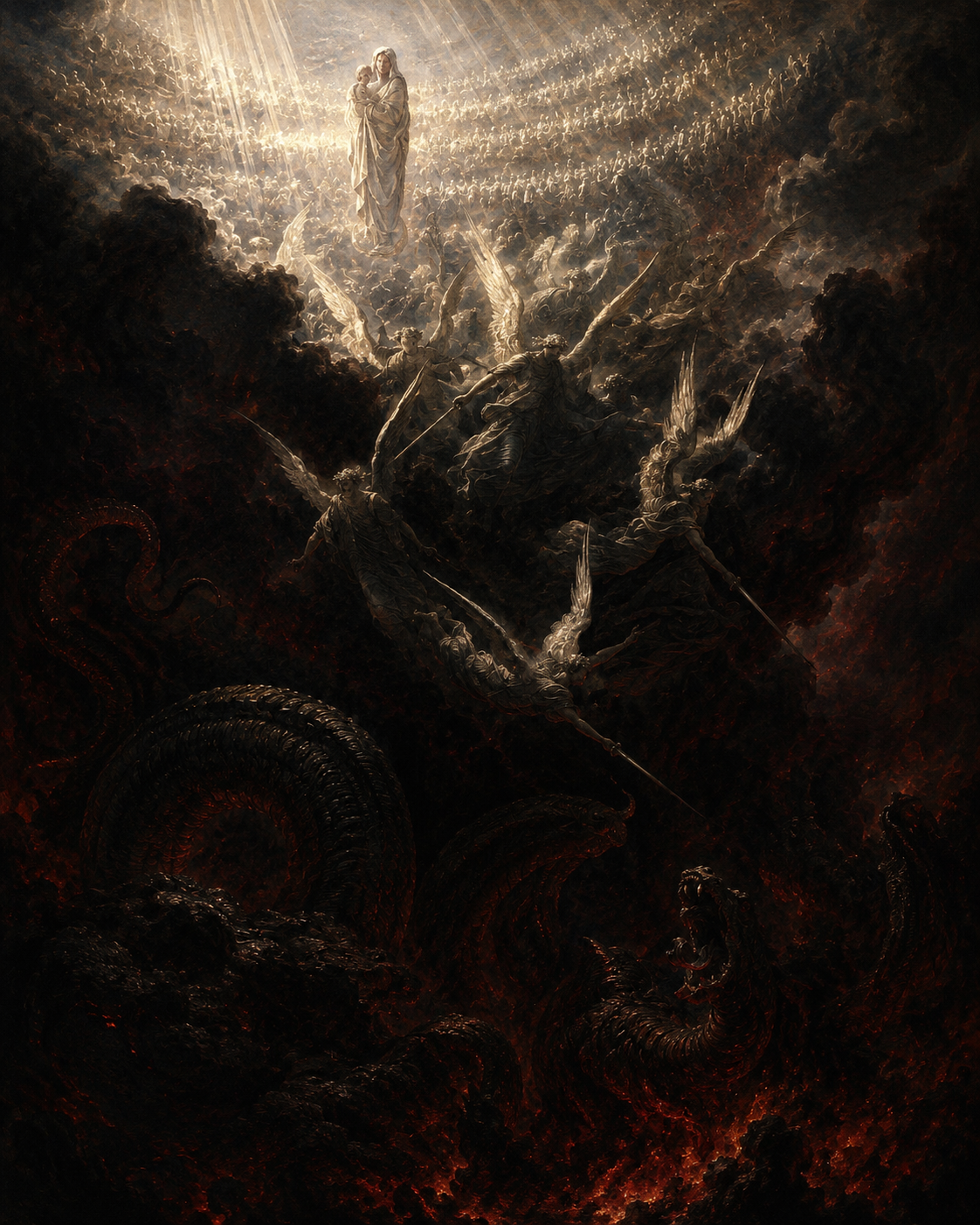
The traditional ordering comes from Pseudo-Dionysius the Areopagite (The Celestial Hierarchy, c. 5th–6th century) and was taken up by St. Gregory the Great and St. Thomas Aquinas. The nine choirs are grouped into three hierarchies, ranked by their nearness to God. Each angel, recall, is a species unto itself.
The scheme of nine choirs is itself a theological synthesis. Scripture names several ranks of angelic beings, but the Pauline lists (Colossians 1:16; Ephesians 1:21) do not set out a fixed enumeration of nine. The scriptural references given for each choir below are therefore illustrative anchors for these names, not strict definitions of a settled order.
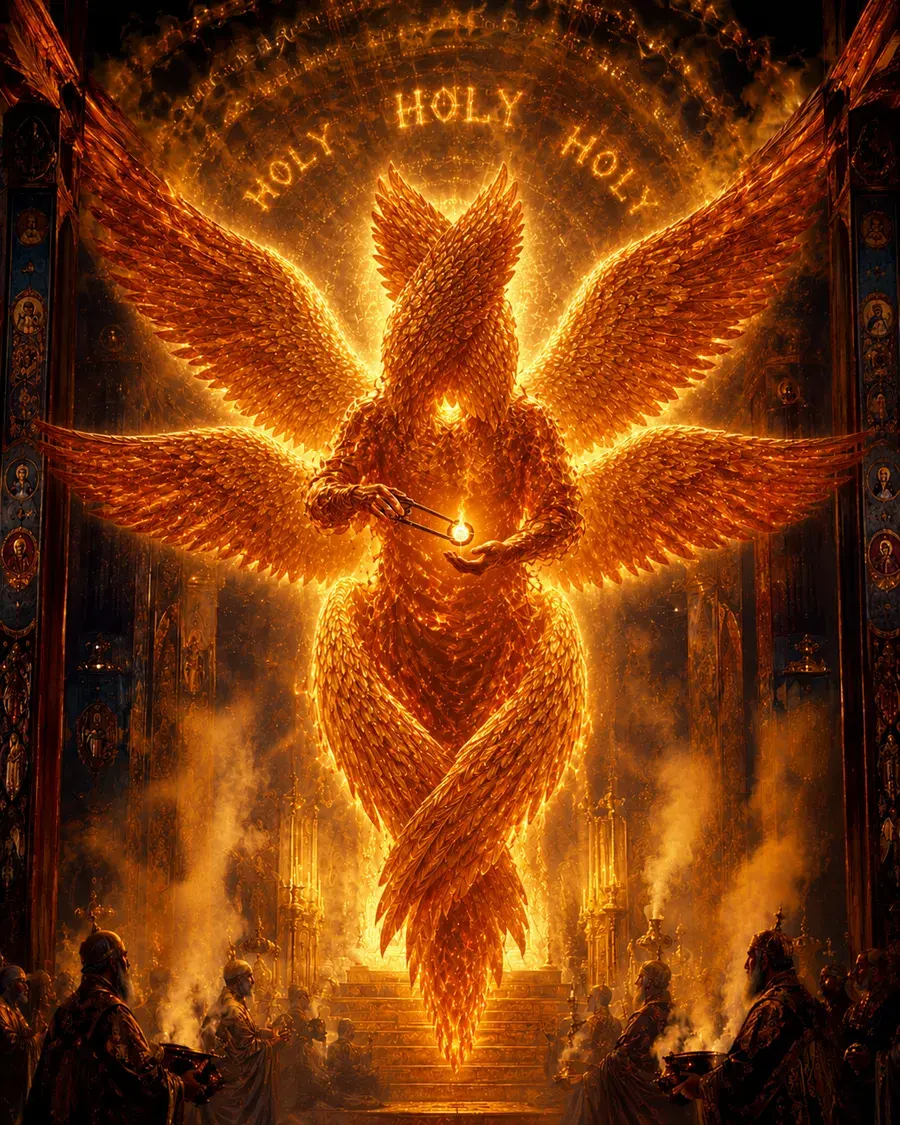
"the burning ones"
Aflame with love, they stand nearest to God and cry without ceasing: "Holy, Holy, Holy."
Isaiah 6
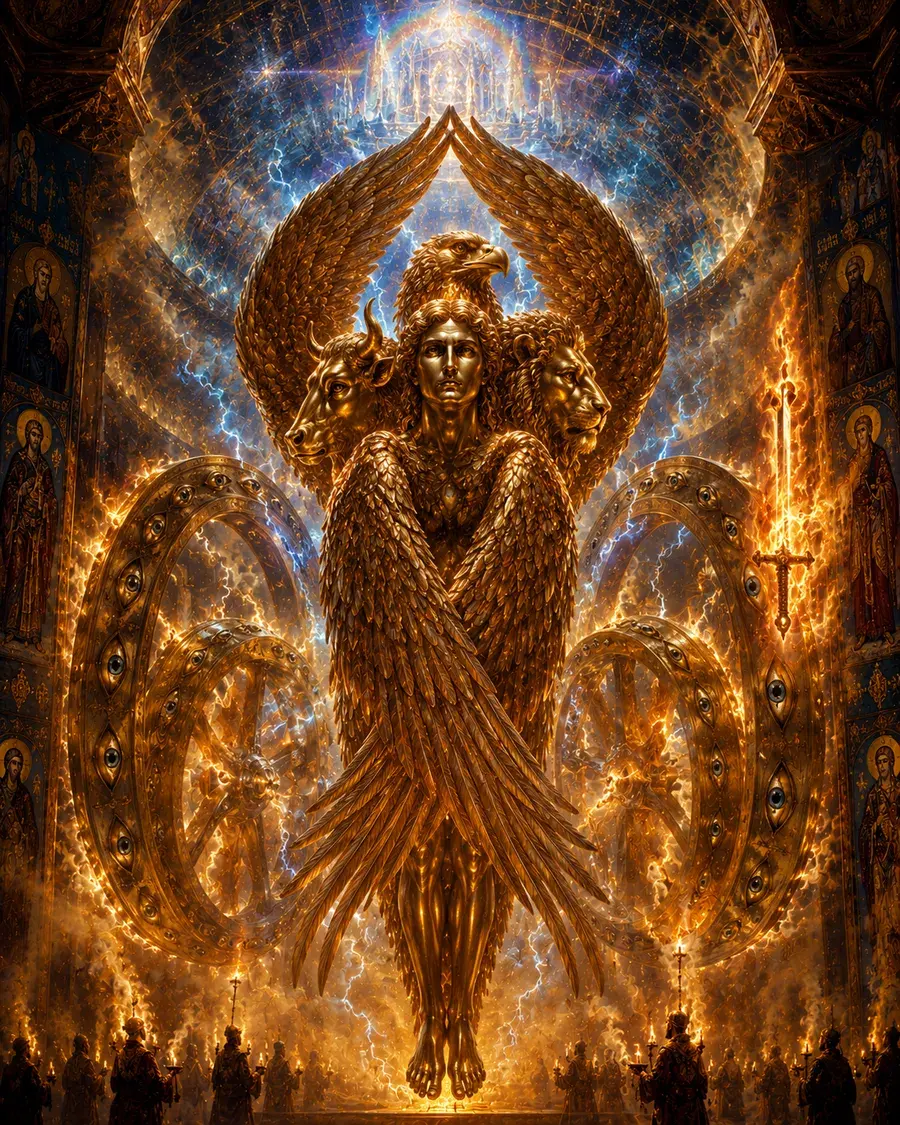
fullness of knowledge
They guard the gate of Eden and overshadow the Ark of the Covenant with their wings.
Genesis 3:24 · Ezekiel 10
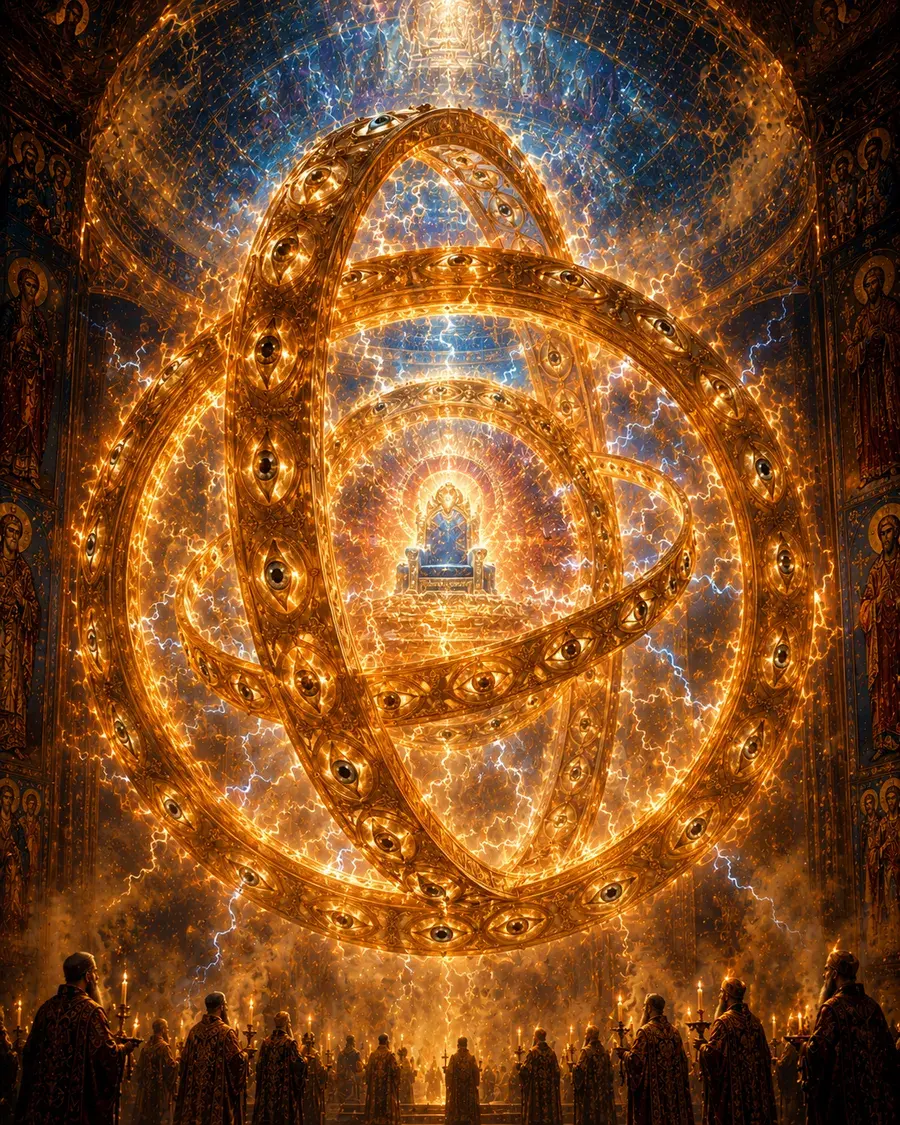
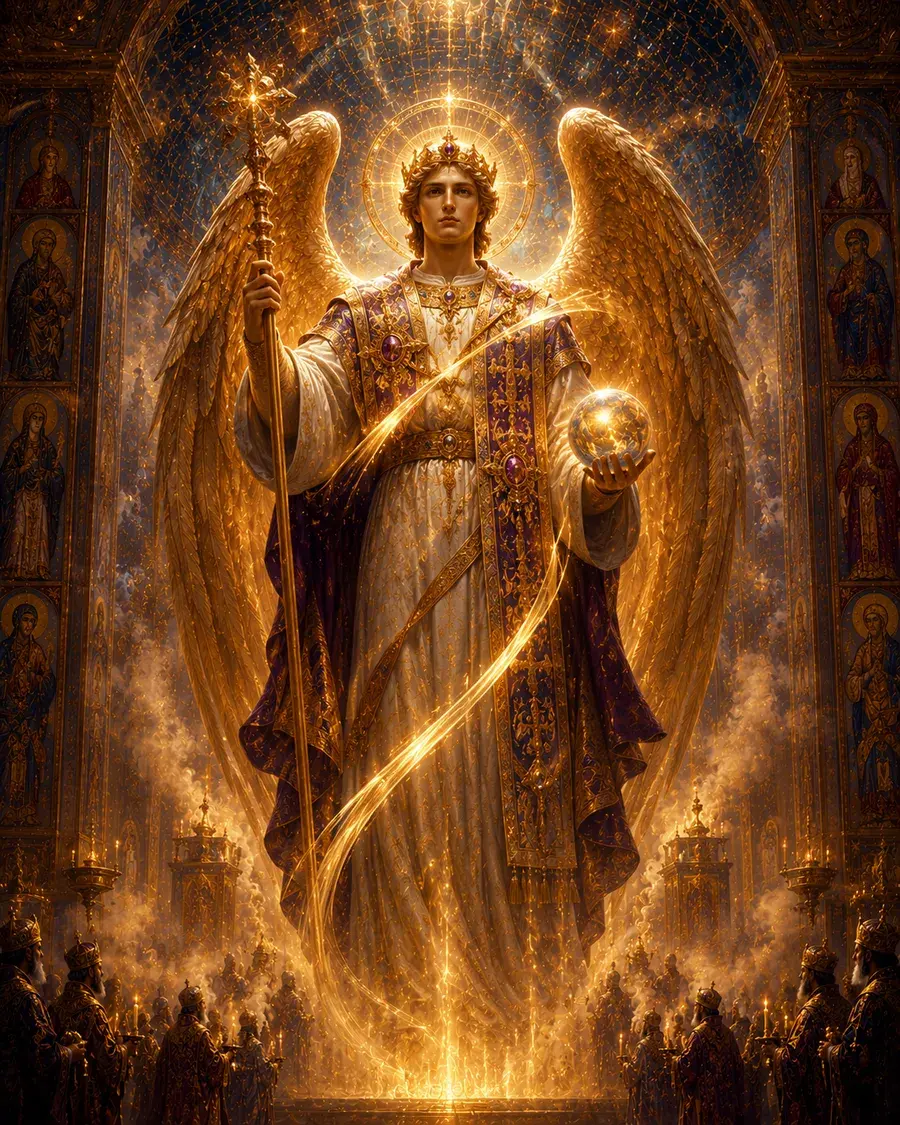
justice and majesty
They are the symbols and bearers of God's justice and the majesty of His judgements.
Colossians 1:16
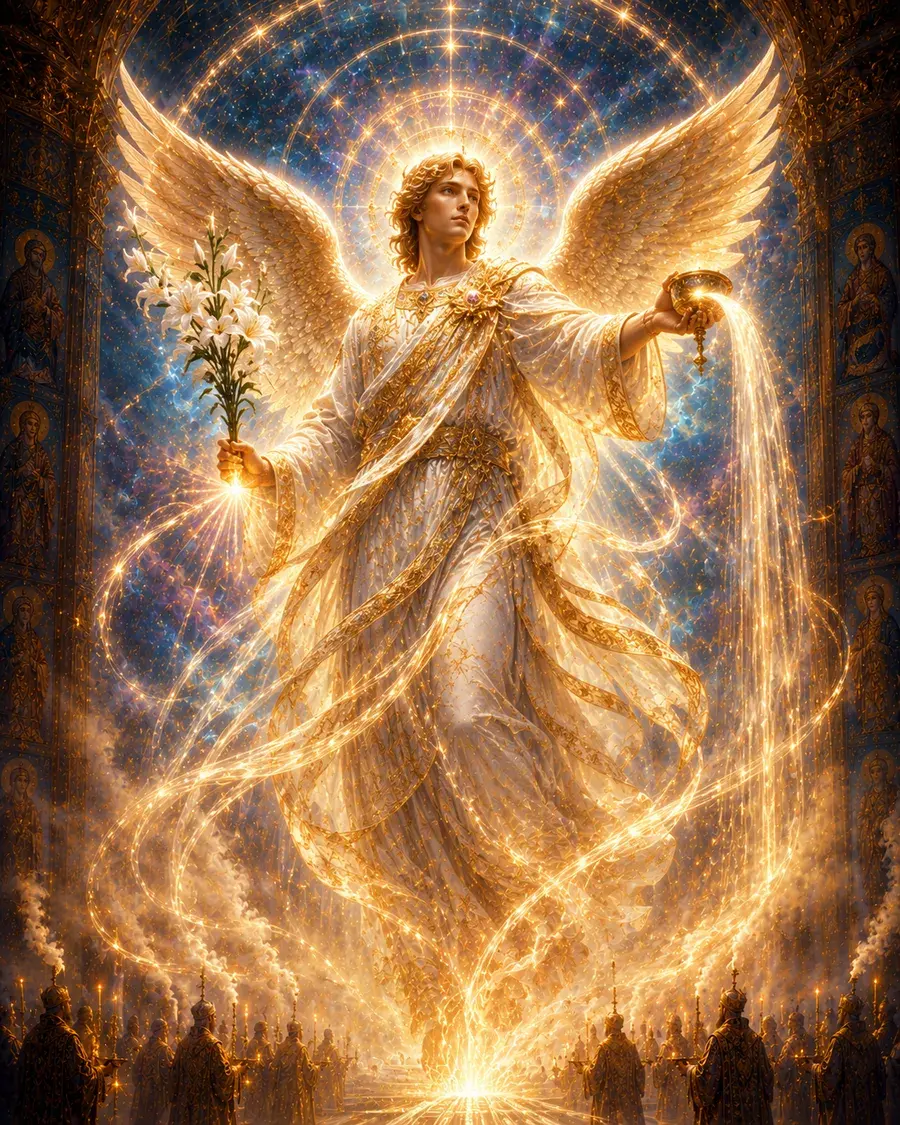
also Dominations
They regulate the duties of the lower angels and make known the commands of God.
Ephesians 1:21 · Colossians 1:16
strength and grace
They bestow grace and govern the heavens and the elements that the will of God may be done.
1 Peter 3:22
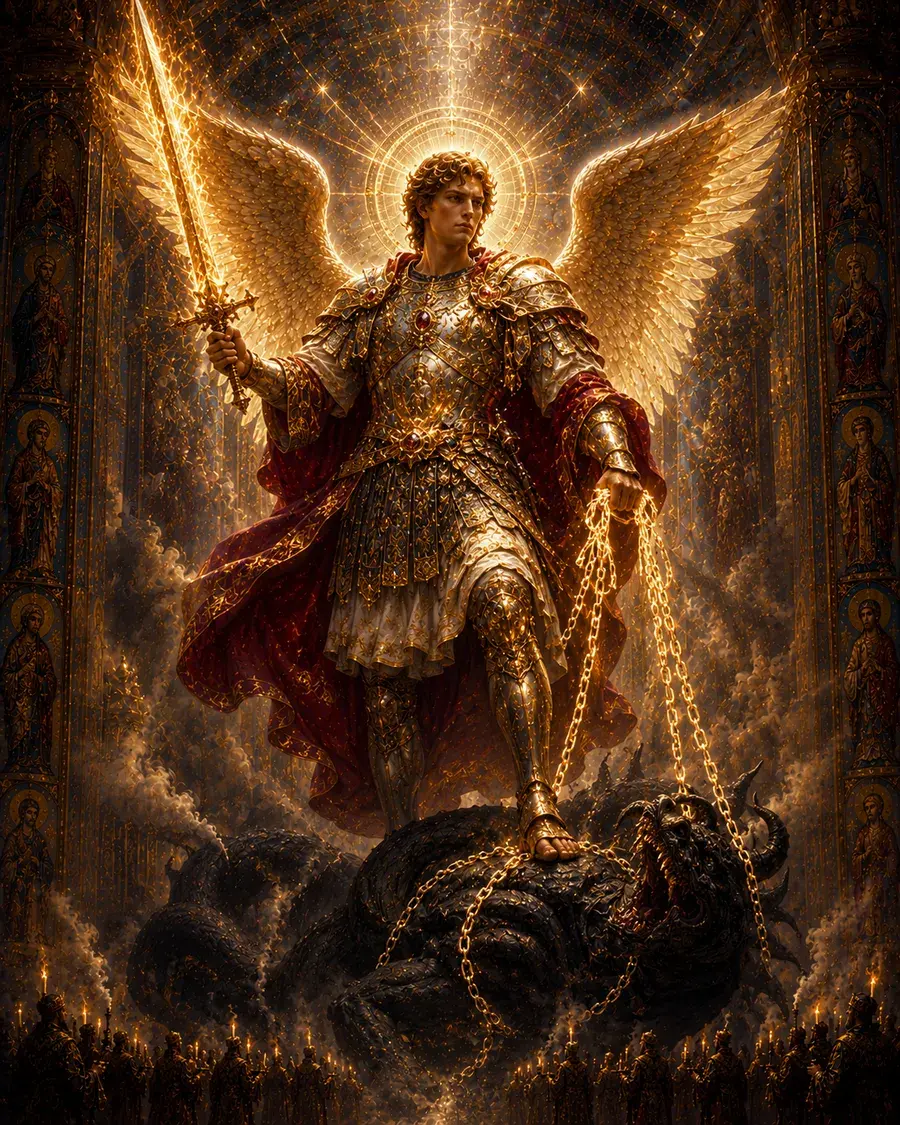
guardians of order
They restrain the forces of evil and keep the powers of darkness from working ruin.
Romans 8:38 · Ephesians 1:21
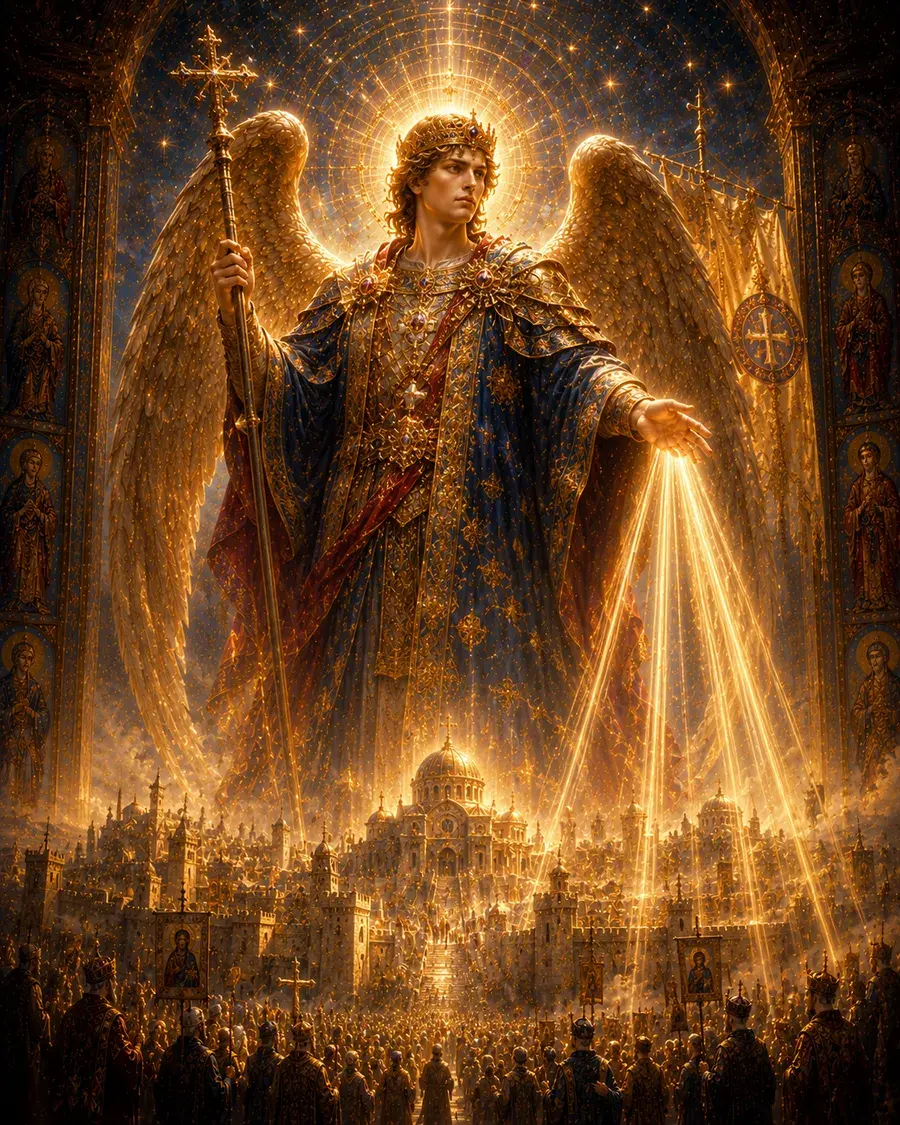
guardians of peoples
They guide and watch over nations, cities, and the institutions of men.
Ephesians 1:21 · Colossians 1:16
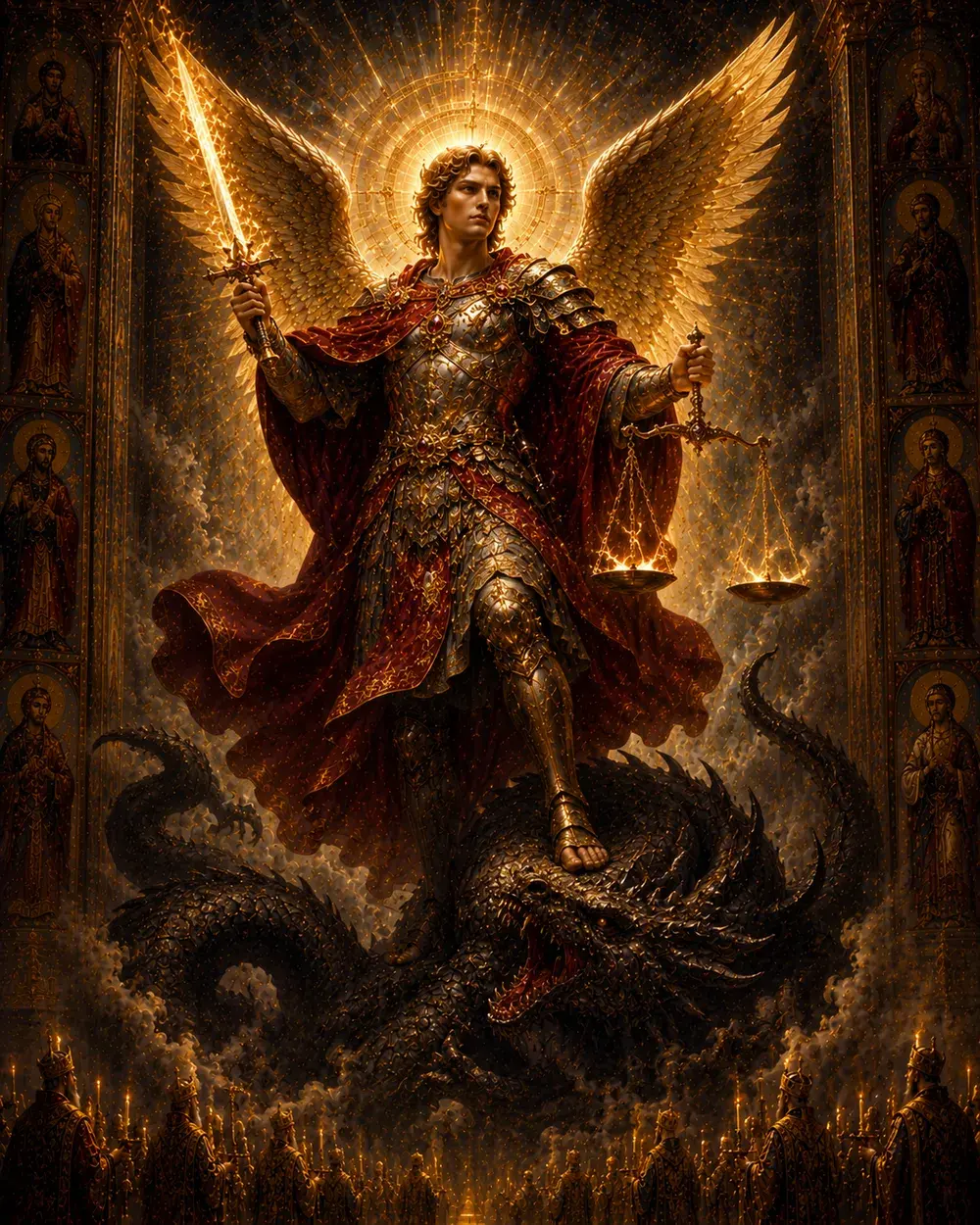
"chief angels"
Bearers of God's most important messages — the rank of Michael, Gabriel, and Raphael.
1 Thessalonians 4:16 · Jude 9
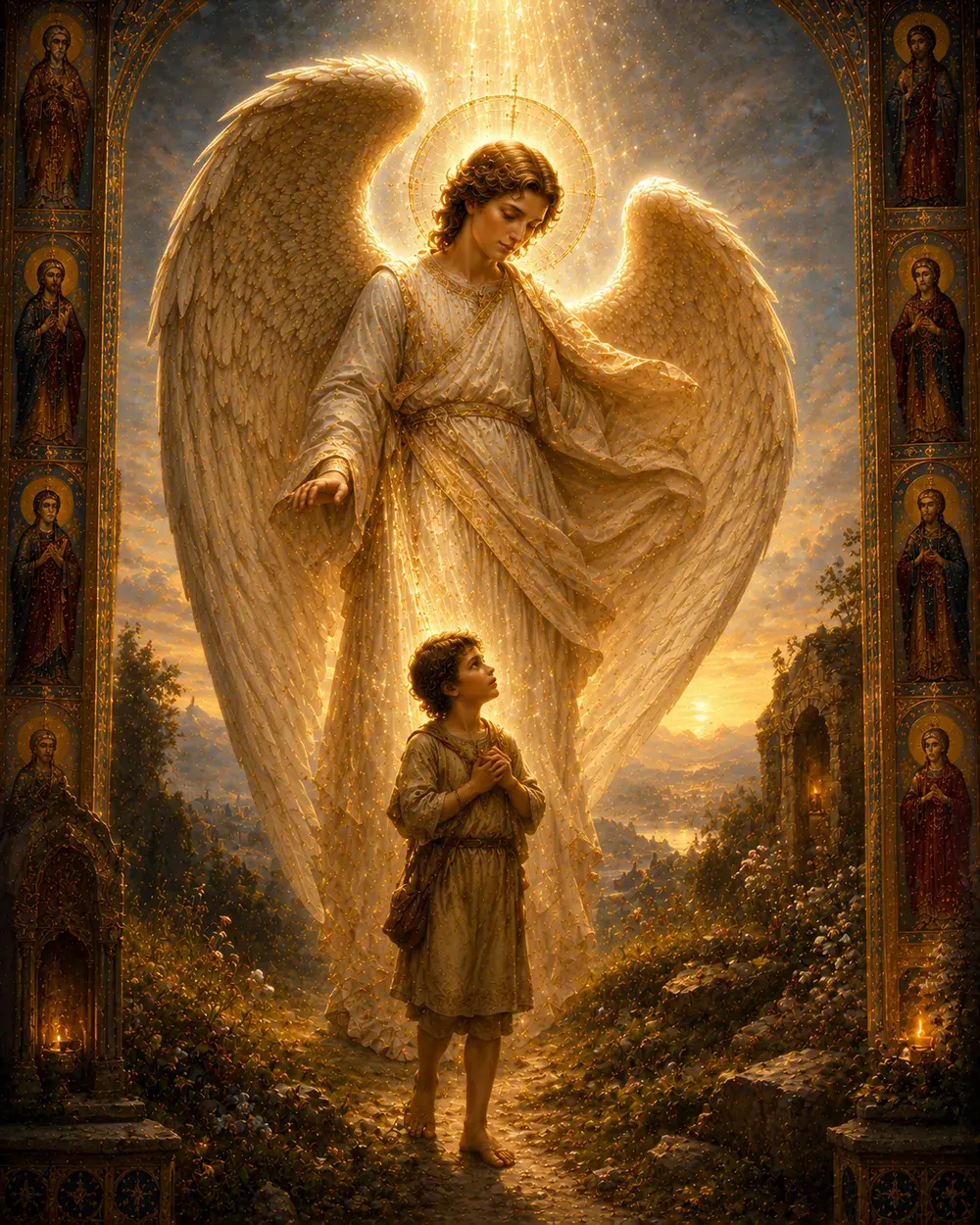
the messengers nearest to us
The messengers and guardians nearest to individual human souls.
Matthew 18:10 · Psalm 90:11
Scriptural anchors for the choirs include Colossians 1:16; Ephesians 1:21; Romans 8:38; 1 Thessalonians 4:16; Isaiah 6; Ezekiel 10; and the Apocalypse 4.
Only three angels are named in the canonical Scriptures, and the Church restricts liturgical veneration to these three — a discipline reaching back to a Roman synod under Pope St. Zachary in 745, and reaffirmed in the 2001 Directory on Popular Piety and the Liturgy.
"Who is like God?"
Prince of the heavenly host and defender of God's people. He casts down the dragon (Apocalypse 12:7), contends in Daniel 10 and 12, and disputes with the devil over the body of Moses (Jude 9). He is patron and protector of the Church.
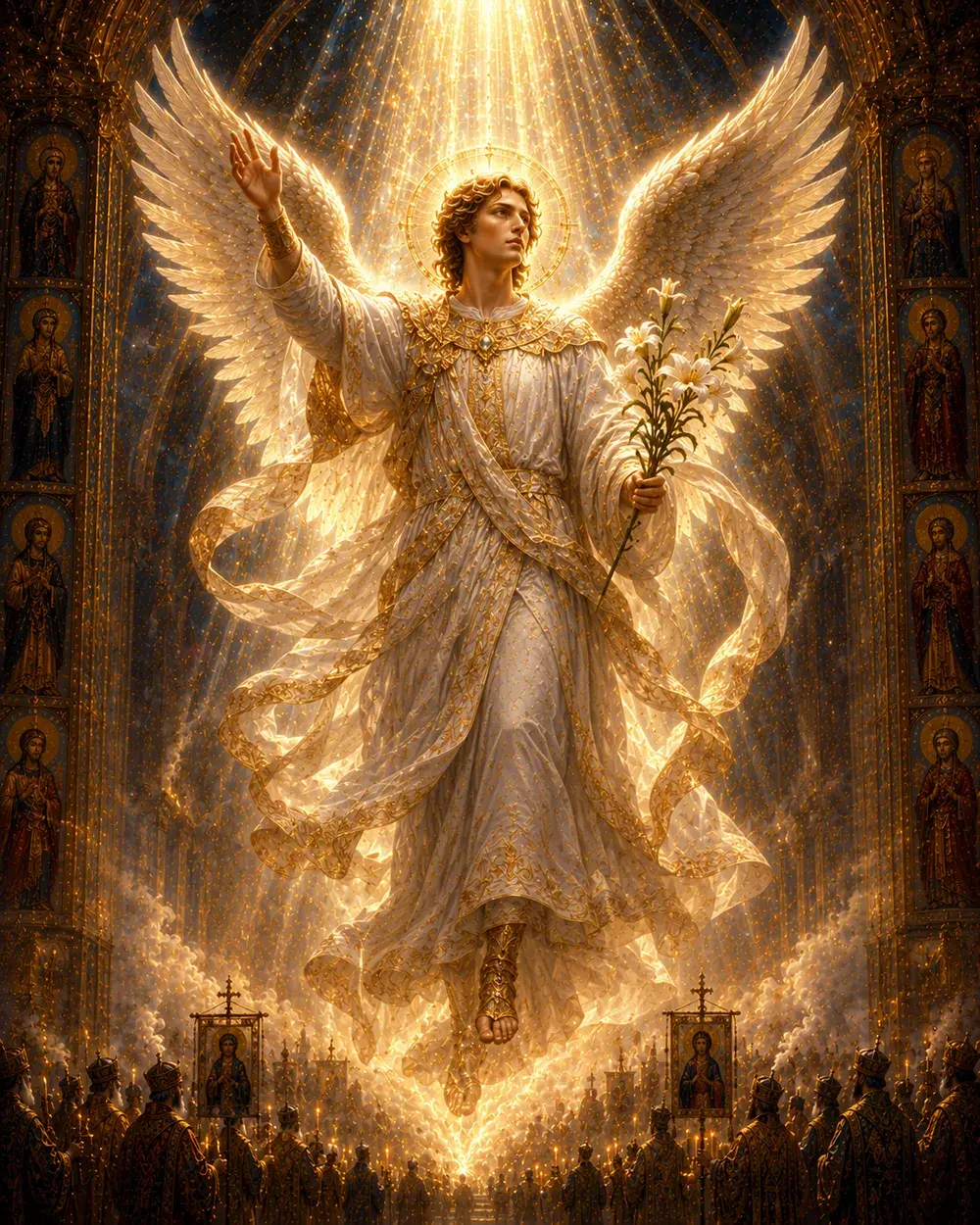
"Strength of God"
The herald of the Incarnation. He announces the births of John the Baptist and of Jesus (Luke 1), and interprets the visions given to Daniel (Daniel 8–9). His word at the Annunciation opened the way of our salvation.
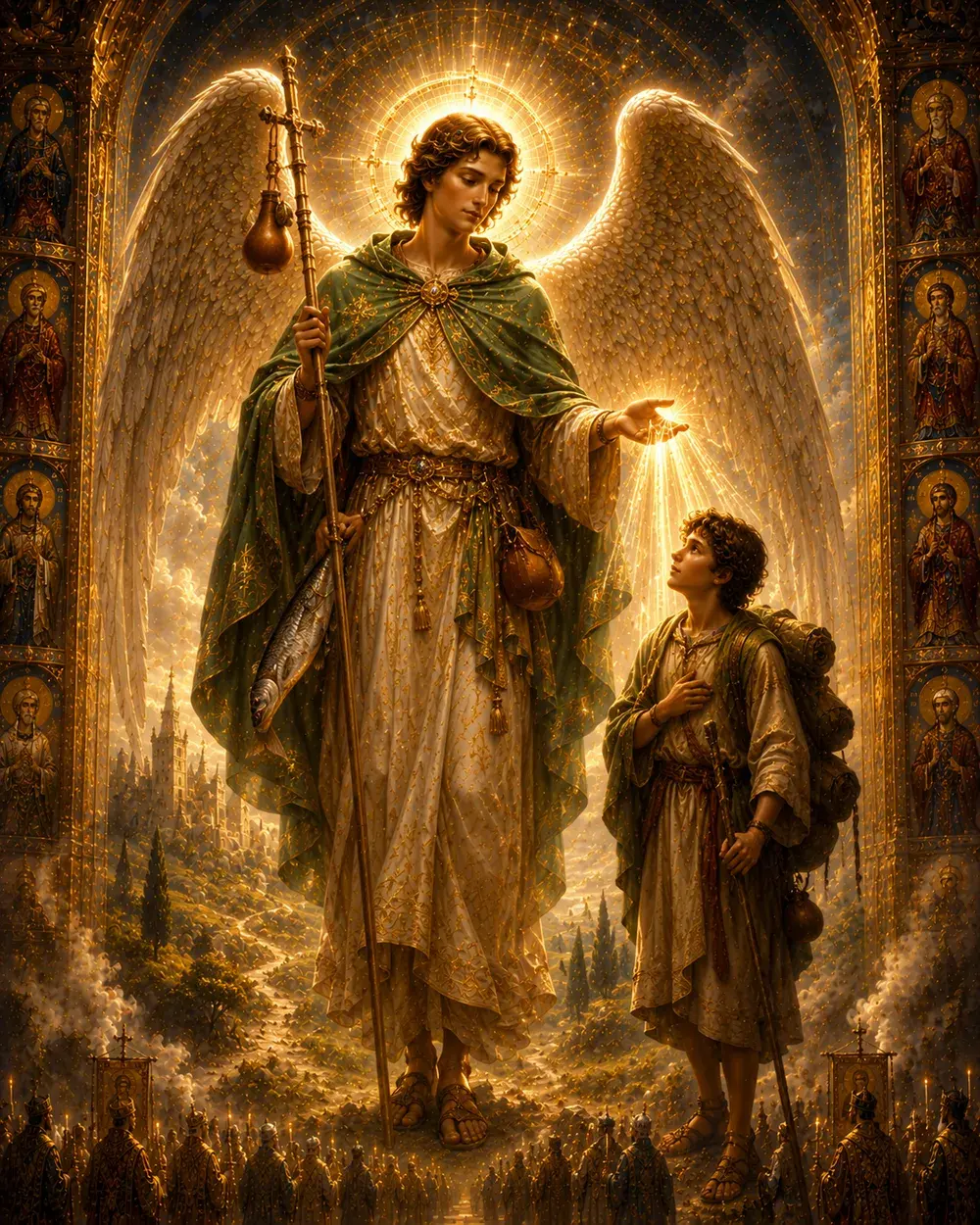
"God heals"
Companion and guide in the Book of Tobit, where he heals Tobit's blindness and protects Tobias on his journey. He reveals himself as "one of the seven angels who stand before the throne of God" (Tobit 12:15).
Feast Days
September 29 — the Feast of the Holy Archangels Michael, Gabriel, and Raphael (Michaelmas).
October 2 — the Memorial of the Holy Guardian Angels.
The "seven angels who stand before God" (Tobit 12:15; Apocalypse 8:2) appear in Scripture, but apart from the three named above the Church discourages assigning proper names to angels in devotion.
On their rank: the tradition is divided over whether the named archangels belong properly to the eighth choir (the Archangels) or to higher choirs. St. Michael, in particular, is sometimes assigned to the Seraphim, which accords with his title "Prince of the heavenly host." The name "archangel" in Scripture marks an office of high mission rather than a fixed place in the hierarchy.
Named Angels in Scripture
Michael appears as one of the chief princes, the protector of God's people, the archangel who contends with the devil, and the leader of the heavenly army against the dragon (Daniel 10:13; Daniel 12:1; Jude 9; Apocalypse 12:7).
Gabriel interprets Daniel's visions and announces the births of John the Baptist and Jesus Christ (Daniel 8:16; Daniel 9:21–27; Luke 1:19; Luke 1:26–38).
Raphael is sent to heal Tobit, guide Tobias, and reveal himself as one of the seven who stand before the Lord (Tobit 3:17; Tobit 5–12; Tobit 12:15).
From birth to death every human soul is attended by an angel. Human life, from its beginning until its end, is surrounded by the watchful care and intercession of the angels; beside each of the faithful stands one as protector and shepherd, appointed to lead him toward eternal life (CCC 336).
Their office is gentle and constant: to enlighten, to guard, to rule, and to guide. Yet they never override our freedom. An angel prompts the soul toward the good and shields it from harm, but the choice remains our own — for grace does not destroy nature, and love is not compelled.
Scripture
"See that you despise not one of these little ones: for I say to you, that their angels in heaven always see the face of my Father who is in heaven." — S. Matthew 18:10
"For he hath given his angels charge over thee; to keep thee in all thy ways." — Psalm 90:11
"Behold I will send my angel, who shall go before thee, and keep thee in thy journey, and bring thee into the place that I have prepared." — Exodus 23:20
The Church honours the guardian angels each year on October 2. For the prayer entrusted to every child of God, see the Guardian Angel prayer below →
Satan and the other demons were created good angels by God, but they became evil by their own free choice. Radically and irrevocably they rejected God and His reign (CCC 391–392). Scripture and the Church's teaching see in this rebellion a being who became Satan — "the adversary" (Hebrew) — also called the Devil (Greek diabolos, "the slanderer" or "accuser"), and known by the traditional name Lucifer, "light-bearer."
It is the irrevocable character of their choice, and not any defect in God's mercy, that makes their sin unforgivable. There is no repentance for the fallen angels after their fall, just as there is none for men after death (CCC 393).
The devil's power is real but limited. He is only a creature, permitted to act within the providence of God; he can tempt and he can harm, but he cannot compel the human will. Above all, Christ has already broken his ultimate power. The Son of God came to destroy the works of the devil, and his victory is sure (CCC 394–395). The faithful have nothing to fear, for they are sealed by Christ and defended by St. Michael and the heavenly host.
Pastoral guardrails
The Church honours the angels, but she does not adore them. Adoration belongs to God alone. Scripture warns against the worship of angels and against receiving any supposed heavenly message that contradicts the Gospel already given by Christ and His Apostles (Colossians 2:18; Galatians 1:8).
Scripture
"And there was a great battle in heaven, Michael and his angels fought with the dragon, and the dragon fought and his angels." — Apocalypse 12:7
"For this purpose, the Son of God appeared, that he might destroy the works of the devil." — 1 S. John 3:8
The Baltimore Catechism (first published 1885) taught the doctrine of the angels to generations in its plain question-and-answer form. The wording varies slightly across editions, but the doctrine is identical.
The angels are pure spirits without a body, created to adore and enjoy God in Heaven.
The angels were also created to assist before the throne of God and to minister unto Him; they have often been sent as messengers from God to man; and are also appointed our guardians.
The angels, as God created them, were good and happy.
All the angels did not remain good and happy; many of them sinned and were cast into Hell, and these are called devils or bad angels.
The Baltimore Catechism is in the public domain.
More Angelic Appearances in Scripture
Cherubim guard the way to the Tree of Life; angels appear to Hagar, Abraham, Lot, Jacob, Moses, Balaam, Gideon, and Samson's parents; and an angel goes before Israel to guide and protect the people (Genesis 3:24; 16:7–11; 18–19; 28:12; Exodus 3:2; 14:19; 23:20–23; Numbers 22:22–35; Judges 6:11–22; 13:3–21).
Angels strengthen Elijah, execute judgement, encamp around those who fear the Lord, appear in Isaiah's vision, protect Daniel and his companions, and reveal visions to Daniel through Gabriel and Michael (1 Kings 19:5–7; 2 Kings 19:35; Psalm 33:8; Psalm 90:11–12; Isaiah 6:2–6; Daniel 3:28; 6:22; 8:15–16; 9:21–27; 10:5–21; 12:1).
Angels announce Christ's conception and birth, minister to Him after His temptation, rejoice over repentant sinners, carry Lazarus to Abraham's bosom, strengthen the Lord in Gethsemane, announce the Resurrection, and gather the elect at the end of time (Matthew 1:20–24; 2:13, 19; 4:11; 13:39–49; 18:10; 24:31; 28:2–5; Luke 1–2; 15:10; 16:22; 22:43; 24:4–7).
Angels free the Apostles, direct Philip, visit Cornelius, release Peter, encourage Paul, witness the life of the Church, and remain subject to Christ. The faithful are warned not to worship angels, and are reminded that hospitality may receive them unawares (Acts 5:19; 8:26; 10:3–22; 12:7–23; 27:23; 1 Corinthians 6:3; Galatians 1:8; Colossians 2:18; Hebrews 1:4–14; 13:2; 1 Peter 1:12; 3:22).
Angels worship before the throne, deliver the Revelation to John, sound the trumpets, pour out the bowls, proclaim judgement, fight under Michael against the dragon, bind Satan, and show John the heavenly Jerusalem (Apocalypse 1:1; 5:2; 7:1–2; 8:2–13; 10:1–11; 12:7–9; 14:6–20; 16:1–21; 18:1–2; 20:1–3; 21:9–12).
Angel of God, my guardian dear,
to whom God's love commits me here,
ever this day be at my side,
to light and guard, to rule and guide. Amen.
St. Michael the Archangel, defend us in battle.
Be our protection against the wickedness and snares of the devil.
May God rebuke him, we humbly pray;
and do thou, O Prince of the heavenly host,
by the power of God, thrust into hell Satan
and all the evil spirits who prowl about the world
seeking the ruin of souls. Amen.
Composed by Pope Leo XIII, 1886
Glossary of Key Terms
Angelology — the branch of theology dealing with the angels.
Incorporeal / Pure Spirit — having no body or matter.
Choir — one of the nine ranks in the celestial hierarchy.
Seraphim / Cherubim — the two highest choirs (these are plurals; the singular is seraph, cherub).
Archangel — literally "chief angel"; the eighth choir, and the rank of Michael, Gabriel, and Raphael.
Beatific Vision — the direct sight of God, enjoyed by the holy angels and the blessed.
Doctor Angelicus — "the Angelic Doctor," the title of St. Thomas Aquinas.
Lucifer — "light-bearer"; a traditional name associated with Satan before the fall, drawn from the Vulgate rendering of Isaiah 14:12 and used in Christian interpretation with care.
Primary Source References
Sacred Scripture — Genesis 3; Job 38; Isaiah 6; Daniel 8–12; Tobit (esp. ch. 5, 12); Psalm 90; S. Matthew 18:10; S. Luke 1–2, 22; Colossians 1:16; Ephesians 1:21; Hebrews 1; Jude 9; Apocalypse 4–5, 8, 12.
Catechism of the Catholic Church — §§ 325–336, 350–352, 391–395.
St. Thomas Aquinas — Summa Theologiae, I, qq. 50–64 (the Treatise on Angels); and I, qq. 107–108.
Pseudo-Dionysius the Areopagite — The Celestial Hierarchy.
St. Gregory the Great — Homilies on the Gospels (Hom. 34, on the nine choirs).
St. Augustine — Enchiridion; City of God, Bk. XI.
Baltimore Catechism — Nos. 1–4 (1885 ff.).
Councils — Fourth Lateran (1215); First Vatican (1869–70).
Directory on Popular Piety and the Liturgy (2001) — on devotion to the angels.
Related Reading
The Chaplet of St. Michael — a devotion honouring the nine choirs of angels.
The Last Things — Death, Judgement, Heaven, and Hell, where the angels stand at the threshold of eternity.
The Faith — the wider treasury of Catholic doctrine.
Compiled by William F. Leach Jr., a layman and catechist, for the faithful of The Layman's Lantern.
Drawn from Sacred Scripture, the Magisterium, St. Thomas Aquinas, and the Fathers and Doctors of the Church. Scripture quotations are from the Douay-Rheims translation.
This page has been checked against the Catechism and the magisterial sources cited throughout; it carries no formal ecclesiastical imprimatur. Where any word here strays from the mind of the Church, the Church is right. Corrections are welcome at bill@laymanslantern.org.