 Lucerna Inventi
Death, Judgement, Heaven, and Hell — the four realities upon which the Church has always bidden her children meditate.
Michelangelo, The Last Judgement (1536–1541), Sistine Chapel, Vatican City
What these four are, and how to weigh what follows
The Four Last Things are a devotional framework, not the whole of Catholic eschatology. They gather into four meditations what a Christian most needs to keep before his eyes, and preachers have used them for centuries because four things can be held in the mind at once. But the Church's teaching about the end is wider than the four. It includes the purification of Purgatory, the Second Coming of Christ in glory, the resurrection of the body, the General Judgement of all mankind, and the renewal of the whole creation in a new heaven and a new earth. Each of those appears on this page in its place, and Purgatory has a chapter of its own →
Nor does everything below carry the same weight, and a reader is badly served by a page that states a pious opinion in the same tone as the Creed. Some of what follows is the Church's settled and binding teaching: that death closes the time of earthly probation, that each soul is judged at once, that Heaven is the vision of God, that Hell exists and is eternal, that Christ will come again and the dead will rise. Some of it is traditional theological teaching — worked out by the Fathers and the schoolmen, held with confidence, but never defined as an article of faith: the degrees of glory among the blessed, the pain of sense in Hell, the limbo of infants. And some of it is imagery: the fire, the outer darkness, the books opened before the throne, which Scripture itself uses to say what plain speech cannot. Where the distinction matters, this page marks it as it goes.
Death is the separation of the soul from the body. It is the end of man's earthly pilgrimage and the moment at which the time given him by God to work out his salvation comes to a close. After death there is no further merit and no further conversion: the will that chose in this life is no longer on the road, and does not choose again.
What is fixed at the instant of death is therefore the soul's ultimate orientation — toward God and salvation, or away from Him and damnation. That much is settled for eternity, and no later repentance can reverse it. It does not follow that nothing remains to be done. A soul that dies in God's friendship but is not yet wholly cleansed of the marks and debts of its sins is purified before it enters the joy of Heaven. Its destination is certain from the moment it dies; its purification is not yet finished. The saying that the state of the soul is fixed for all eternity should be understood in that sense: what is fixed is where the soul is bound, not that every soul is already at rest.
Death entered the world through the sin of our first parents. By one man sin entered into the world, and by sin death; it is the universal consequence of original sin and the wage justly due to every descendant of Adam. Yet for the Christian who dies in the state of grace, death is transformed: it is no longer merely a punishment but a passage — the gate through which the soul enters into the life that has no end.
Christ, by His own Death and Resurrection, conquered death and opened the gates of Heaven. He has made it possible for the faithful to die in hope, united to His Paschal Mystery. The Church therefore teaches her children to prepare for death at every moment, knowing neither the day nor the hour.
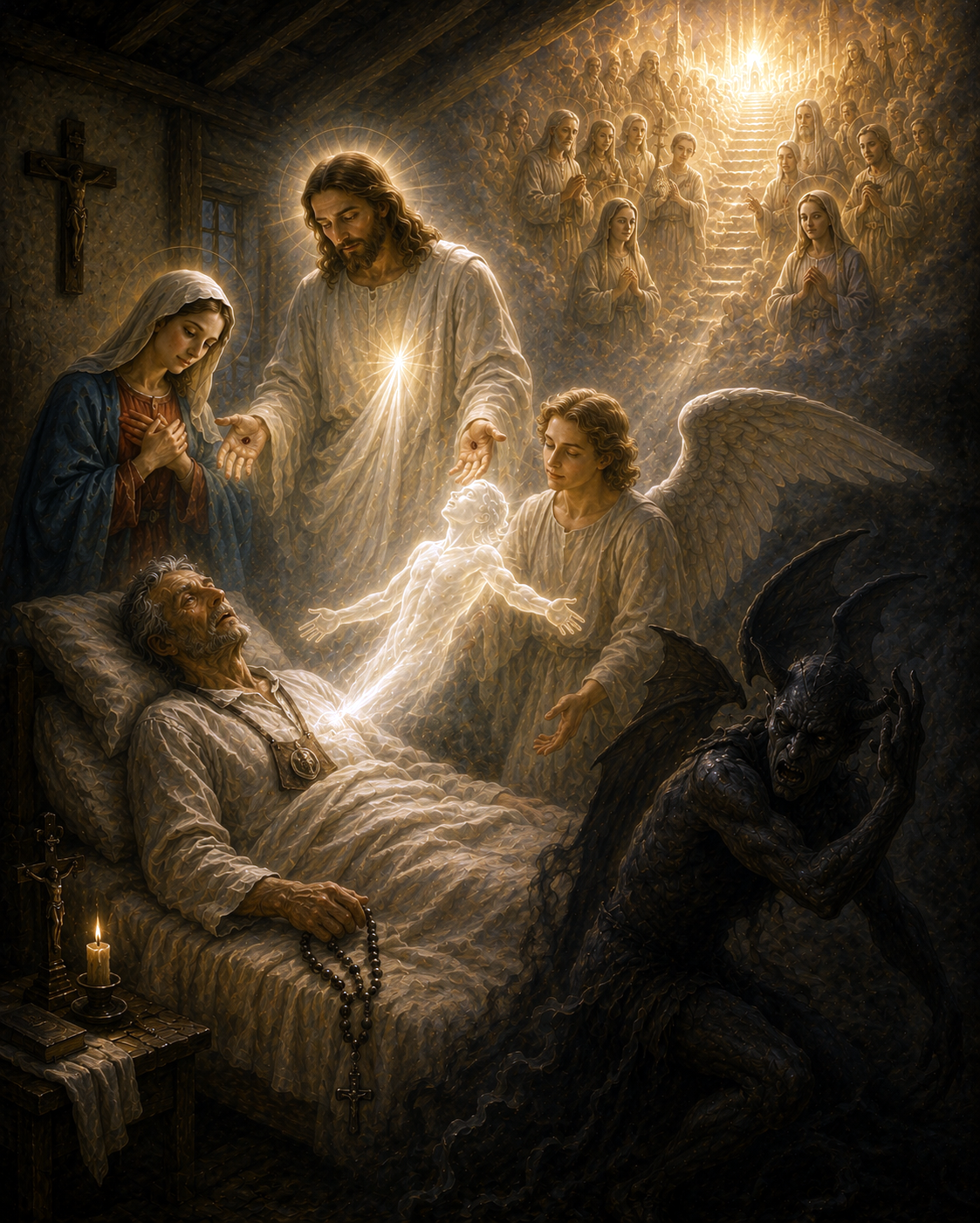
The Christian dies in hope, joined to the victory of Christ.
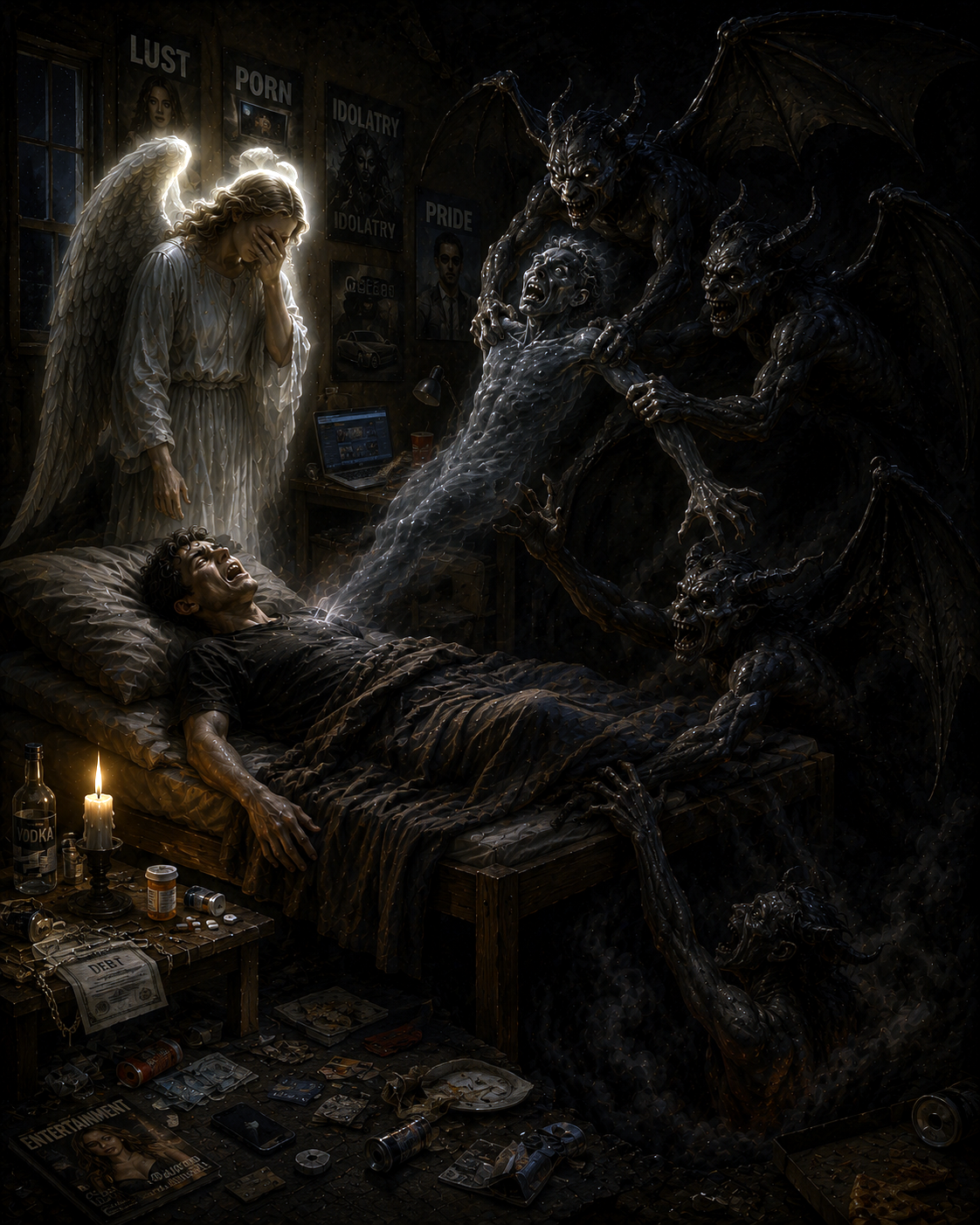
The unrepentant soul meets the end of earthly mercy.
Scripture
"And as it is appointed unto men once to die, and after this the judgement." — Hebrews 9:27
"Wherefore as by one man sin entered into this world, and by sin death; and so death passed upon all men, in whom all have sinned." — Romans 5:12
"For the wages of sin is death. But the grace of God, life everlasting, in Christ Jesus our Lord." — Romans 6:23
"Watch ye therefore, because you know not the day nor the hour." — S. Matthew 25:13
"O death, where is thy victory? O death, where is thy sting? Now the sting of death is sin: and the power of sin is the law. But thanks be to God, who hath given us the victory through our Lord Jesus Christ." — 1 Corinthians 15:55–57
Immediately upon death, each soul appears before the judgement seat of Christ to receive its eternal recompense. This is the Particular Judgement. In it the whole of a man's life — his thoughts, words, deeds, and omissions — is laid bare before the all-seeing God, and the soul is assigned to its eternal destiny: Heaven (at once or after purification), or Hell.
The Particular Judgement is personal and immediate. There is no delay between death and this reckoning. The soul does not sleep or wander but stands at once before its Creator and Judge. The parable of Lazarus and the rich man teaches that the recompense of each follows directly upon death.
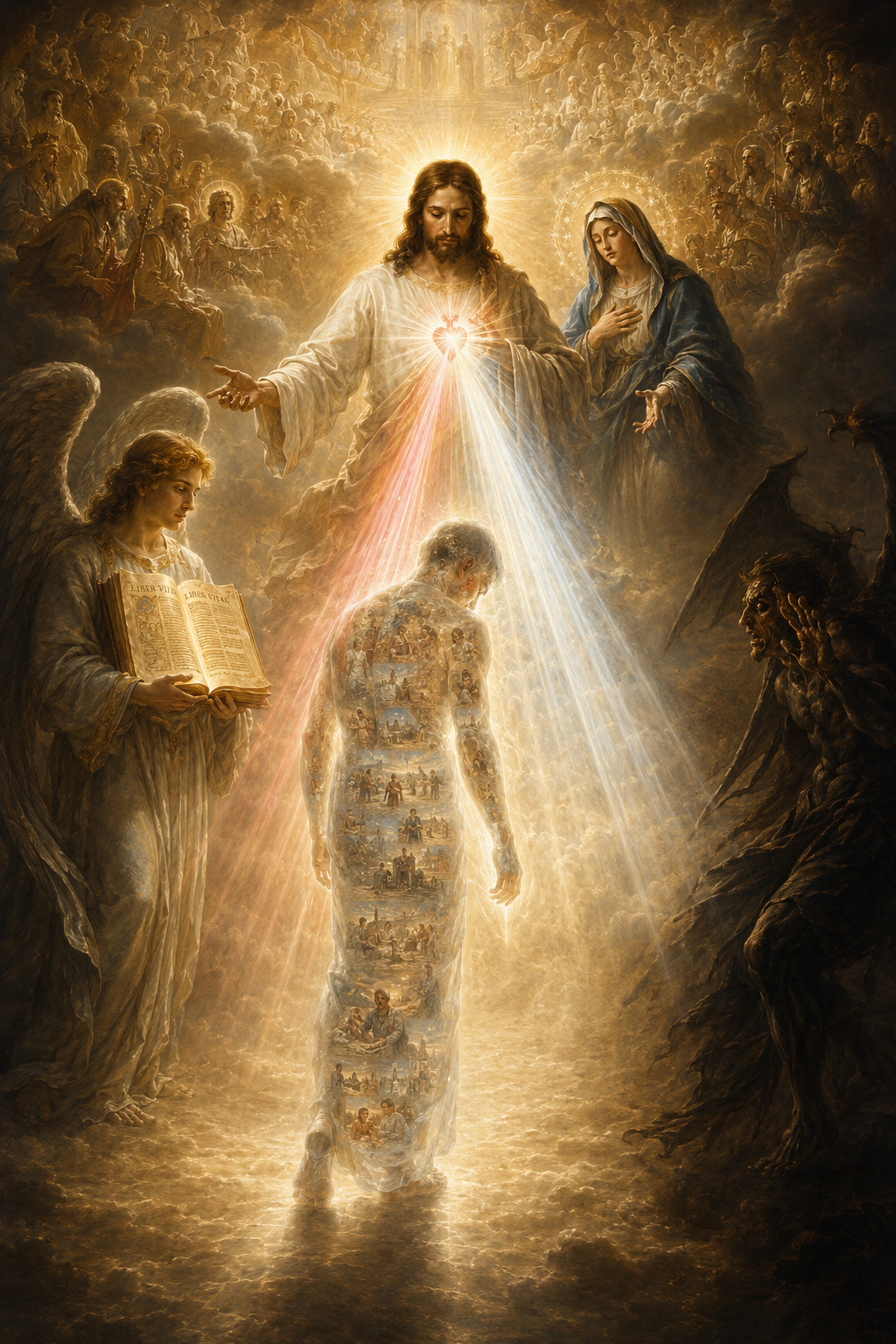
Mercy received, grace completed, the soul belongs to God.
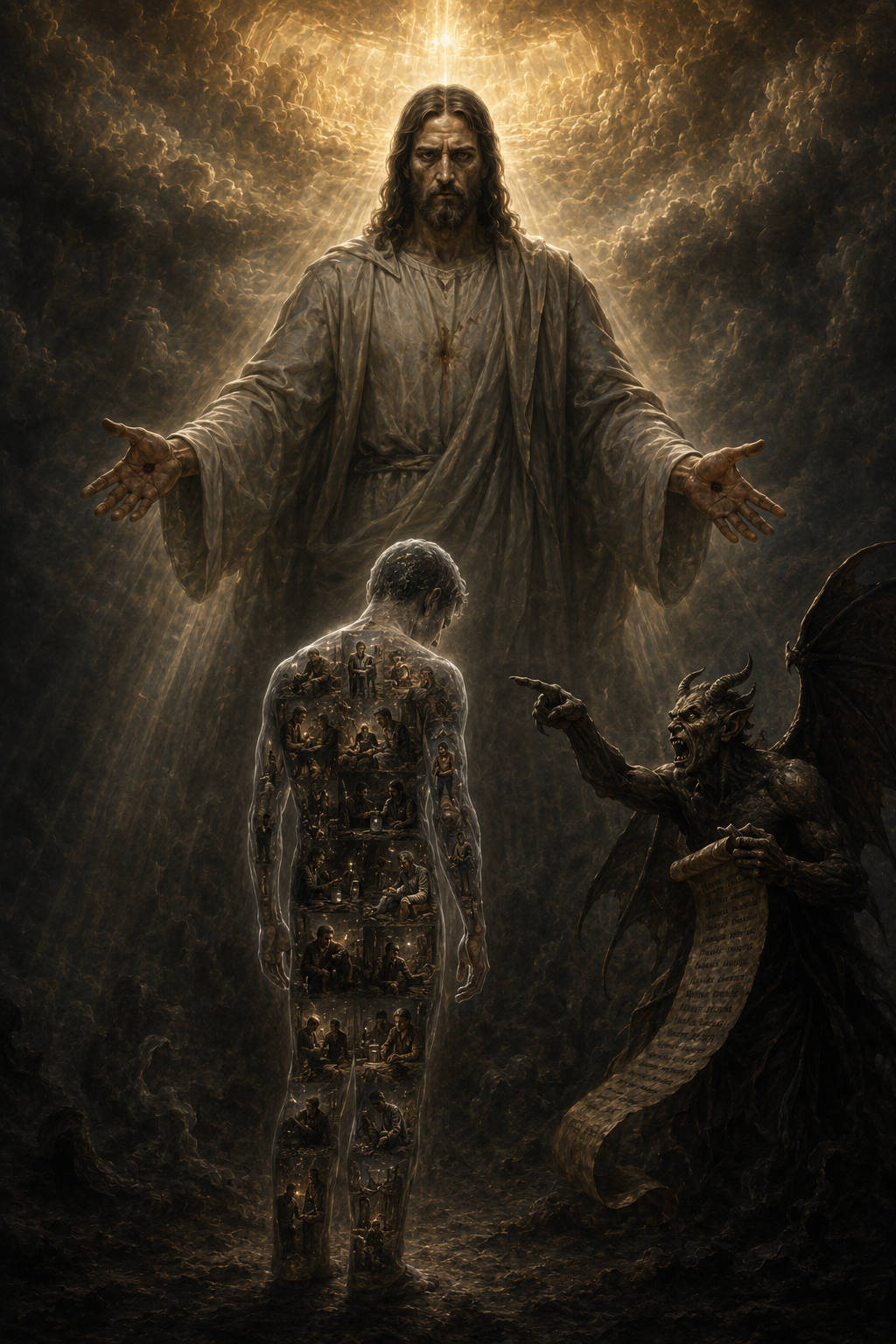
Mercy refused, the soul meets the truth it chose.
An analogy, not a doctrine. What follows is an illustration and forms no part of the Church's teaching on judgement. God has revealed no “life review,” and near-death experiences are not evidence that one occurs. Such accounts are private and unverifiable, they differ widely from one another, and much in them may have ordinary natural causes. The doctrine of this section is the Particular Judgement itself, set out above; the pages that follow only borrow a familiar image to help the mind picture it.
Many who have approached death speak of a life review: a swift, searching illumination in which the whole pattern of one's life is seen with extraordinary clarity. Taken for no more than it is, the image can serve as a natural analogy for a deeper Christian truth: before God nothing is hidden, and every act of love, every wound given, every mercy received, and every mercy refused stands in the light of Christ.
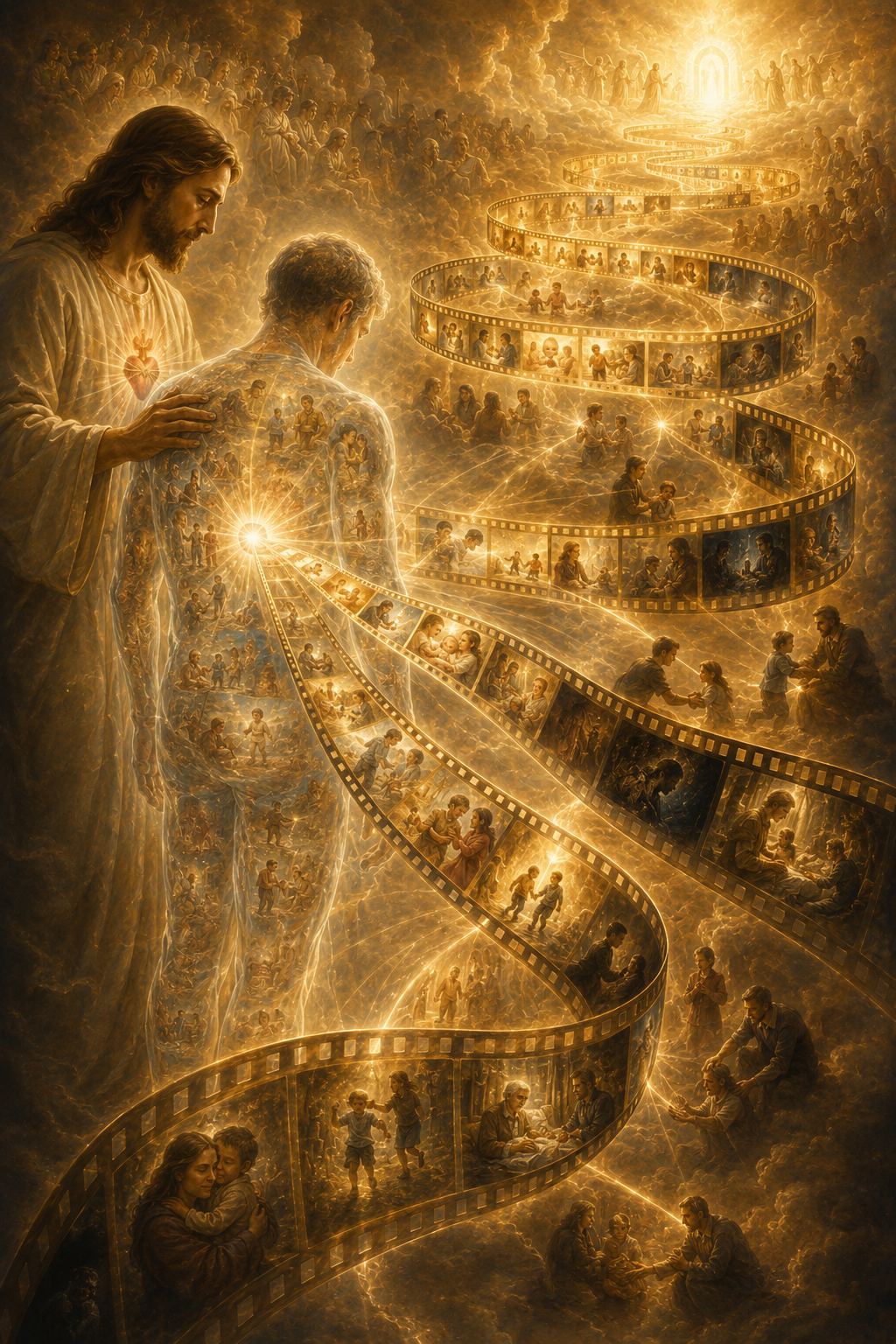
The soul sees its life in truth, not as the world judged it, but as it stands before God.
The life review, then, is an echo of conscience and nothing more — a borrowed picture, not a revelation. The reality it gestures at is greater than the picture. At death the soul does not merely remember fragments of a life; it stands before the living God, whose judgement is perfectly just, perfectly truthful, and never deceived by appearances.
Scripture
"And it came to pass, that the beggar died, and was carried by the angels into Abraham's bosom. And the rich man also died: and he was buried in hell." — S. Luke 16:22
"For we must all be manifested before the judgement seat of Christ, that every one may receive the proper things of the body, according as he hath done, whether it be good or evil." — 2 Corinthians 5:10
"Amen I say to thee, this day thou shalt be with me in paradise." — S. Luke 23:43
At the end of the world, Christ will come again in glory to judge the living and the dead. This is the General Judgement, or the Last Judgement, confessed in the Creed. All men who have ever lived — the just and the unjust, reunited with their risen bodies — will stand before the throne of the Son of Man, and the hidden counsels of every heart will be made manifest before the whole of creation.
The General Judgement does not reverse, revise, or re-open the sentence already passed at the Particular Judgement. No one is judged twice, and no destiny is decided a second time. What the last day adds is manifestation: it vindicates God's justice publicly, before every creature; it lays open the full consequence of each person's deeds upon the whole course of history, including the good and the harm that outlived him and that he never saw; and it displays the definitive triumph of Christ over sin and death. The bodies of all the dead shall be raised: those of the just to glory, those of the wicked to everlasting shame.
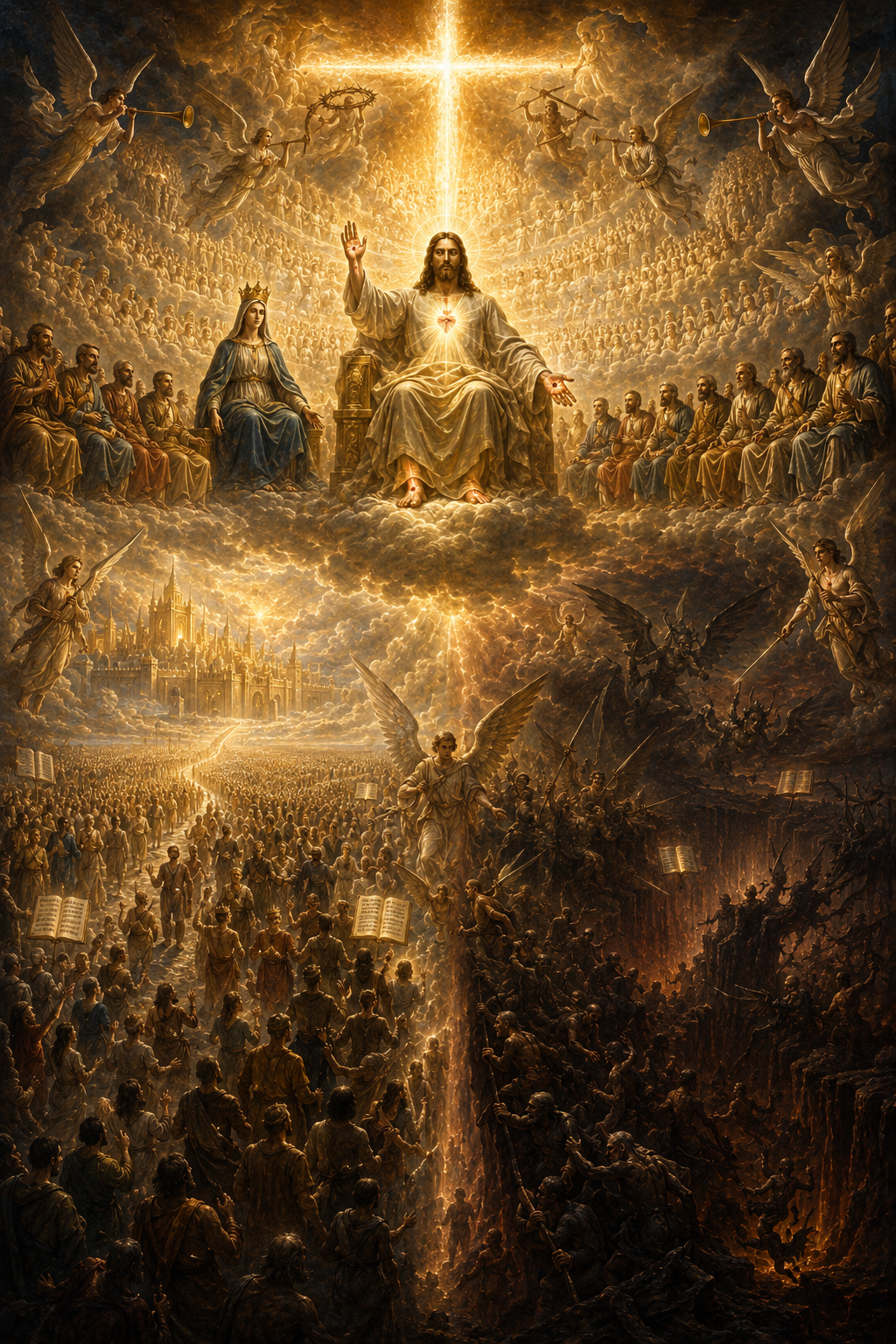
The Son of Man sits in majesty; all nations are gathered, and every hidden thing is made manifest.
The exact hour of the Last Judgement is known to God alone. Our Lord Himself declared that neither the angels of Heaven nor the Son know the day, but only the Father. The Church therefore exhorts the faithful to watchfulness and perseverance.
“Nor the Son.” These words do not mean that the Son of God lacks knowledge. As God, the Son knows everything the Father knows; the Church has always confessed His full and undiminished divinity, and with it His divine omniscience, and any reading that makes Him ignorant as God is a reading the Councils have already refused. The saying concerns His human knowledge and the mystery of His incarnate mission. He came to announce what the Father sent Him to announce, and the day and hour were not among the things given Him to reveal; what was not His to disclose, He did not know as something to be disclosed. He answers as the Son sent among us, not as a creature guessing at the future.
Scripture
"And when the Son of man shall come in his majesty, and all the angels with him, then shall he sit upon the seat of his majesty. And all nations shall be gathered together before him, and he shall separate them one from another, as the shepherd separateth the sheep from the goats." — S. Matthew 25:31–32
"And these shall go into everlasting punishment: but the just, into life everlasting." — S. Matthew 25:46
"And I saw the dead, great and small, standing in the presence of the throne, and the books were opened; and another book was opened, which was the book of life; and the dead were judged by those things which were written in the books, according to their works." — Apocalypse 20:12
"But of that day and hour no one knoweth: no, not the angels of heaven, but the Father alone." — S. Matthew 24:36
The Creed confesses the resurrection of the body, and it means what it says. Man is not a soul that has borrowed flesh for a while; he is body and soul together, one creature, and what God promises to save is the whole of him. At the coming of Christ the dead will rise in their own bodies, made incorruptible — the just to share the glory of the risen Christ, the wicked to their shame. Between death and that day the separated soul already has its recompense in full measure, and the blessed already see God; but they still await the body that belongs to them, and until the last day the saints are not yet all that God made them to be.
Nor does the hope stop at man. Scripture promises a new heaven and a new earth. The visible creation was subjected to corruption on man's account, and it is to be set free along with him and made new. The end of the world is not the discarding of the world but its transfiguration, that God may be all in all. This is why Christian hope has never been an escape from the body or from the earth: it is the redemption of both, and it is the reason the Church buries her dead with honour and calls the world God made good.
"Because the creature also itself shall be delivered from the servitude of corruption, into the liberty of the children of God." — Romans 8:21
"And I saw a new heaven and a new earth. For the first heaven and the first earth was gone, and the sea is now no more." — Apocalypse 21:1
"It is sown in corruption, it shall rise in incorruption. It is sown in dishonour, it shall rise in glory." — 1 Corinthians 15:42–43
Those who die in the grace of God but imperfectly purified undergo a cleansing after death, that they may attain the holiness necessary to enter the joy of Heaven. For the Church's teaching on this merciful doctrine, see Purgatory →
Children who die without Baptism. The Church entrusts them to the mercy of God and permits us to hope for a way of salvation for them. The traditional idea of the limbo of infants describes a possible state of natural happiness without the Beatific Vision, but it remains a theological hypothesis and has never been defined as doctrine.
Heaven is the state of supreme and definitive happiness: the eternal communion of the blessed with God, the Most Holy Trinity, the Blessed Virgin Mary, the angels, and all the saints. It is the fulfilment of man’s deepest longing — to see God face to face and to be perfectly united with Him in love.
Heaven is therefore not in the first place a place. Scripture and the liturgy speak of it in the language of place — a city, a country, a house of many mansions — because we think in pictures and cannot do otherwise; and the risen bodies of the saints will indeed be somewhere. But what is promised is not a location. It is communion with the Triune God: to be taken into the life the Father, the Son, and the Holy Spirit have eternally in common, and into the company of everyone else who has been taken into it. Heaven, as John Paul II put it, is “neither an abstraction nor a physical place in the clouds, but a living, personal relationship with the Holy Trinity.” Whatever else is true of it follows from that.
The blessed in Heaven enjoy the Beatific Vision: they see God as He is, without any veil or figure, directly, clearly, and openly. This vision surpasses all natural knowledge and is the source of an unending, ever-increasing joy. By this vision the blessed are made partakers of the divine nature and enter into the very life of the Holy Trinity.
Heaven is not earned by human merit alone but is a gift of God’s grace, promised to those who love Him and die in His friendship.
The tradition has long held that the blessed do not all share the same measure of glory: that the vision is given to each according to the charity and merit with which he died, so that one sees God more perfectly than another. The Council of Florence spoke in those terms, and the Fathers and the schoolmen before it. It is best received as what it is — the constant teaching of theologians rather than a separately defined article of faith — and it takes nothing from anyone, for there is no envy in Heaven and no one is short of joy. Each of the blessed beholds God and is filled to the whole of his capacity; it is the capacities that differ, and every one of them is full.
Scripture
“We see now through a glass in a dark manner; but then face to face. Now I know in part; but then I shall know even as I am known.” — 1 Corinthians 13:12
“That eye hath not seen, nor ear heard, neither hath it entered into the heart of man, what things God hath prepared for them that love him.” — 1 Corinthians 2:9
“In my Father’s house there are many mansions. If not, I would have told you: because I go to prepare a place for you.” — S. John 14:2
“Dearly beloved, we are now the sons of God; and it hath not yet appeared what we shall be. We know, that, when he shall appear, we shall be like to him: because we shall see him as he is.” — 1 S. John 3:2
“And God shall wipe away all tears from their eyes: and death shall be no more, nor mourning, nor crying, nor sorrow shall be any more, for the former things are passed away.” — Apocalypse 21:4
Hell is the state of definitive self-exclusion from communion with God and the blessed. It is the lot of those who freely and knowingly die unrepentant in grave sin — who to the last refuse the mercy God never stops offering them. The chief punishment of Hell is eternal separation from God, in Whom alone man can have the life and happiness for which he was created; and it is a separation the damned have chosen, not one imposed on them from outside.
What the Church knows here, and what she does not. The Church teaches the objective conditions of mortal sin — grave matter, full knowledge, and deliberate consent — and she teaches that whoever dies in that state is lost. She does not claim to read the final interior state of any particular person. Only God sees how much a given soul truly understood, how free it truly was, and what passed between it and Him in the last moment. This is why the Church canonises saints but has never declared that any named human being is in Hell; why she offers prayers and the Holy Sacrifice for every one of her dead; and why she has never told us how many are lost. Our Lord’s warnings are urgent and are meant to be taken as such, but they were given to make each of us watchful over himself, not to let us count the damned or name them.
That Hell exists, and that it is eternal, is the teaching of the Church and not a matter for speculation. The damned are never released, and their punishment is never lessened. How that punishment should be pictured is a different question. Scripture speaks of unquenchable fire, of outer darkness, of a worm that does not die, of weeping and the gnashing of teeth; and these are images of terrible power precisely as images. John Paul II taught as much plainly: the scriptural pictures of Hell “must be correctly interpreted,” for they “show the complete frustration and emptiness of life without God,” and “rather than a place, hell indicates the state of those who freely and definitively separate themselves from God, the source of all life and joy.” None of that is a softening. Symbol here does not mean unreality; it means that the thing signified is worse than any picture of it, and that a loss which is total, self-chosen, and without end cannot be made graver by insisting on the physics of flame.
The tradition distinguishes two punishments. The pain of loss (poena damni) is the privation of the sight of God, and this is the essential punishment of Hell — the one the Church insists upon, and the one that accounts for all the rest. The pain of sense (poena sensus) is a positive suffering besides the loss, held by the Fathers, the schoolmen, and the whole catechetical tradition, and not to be waved away. But it should be received as traditional theology rather than as a defined article: the Church has never determined what the fire of Hell is, or how anything of the kind acts upon a spirit, and she has defined no mechanics of infernal punishment. The certain core of the doctrine is this — eternal separation from God, freely and definitively chosen, together with the reality of punishment and suffering that has no end. Beyond that the tradition explains; it does not define.
God predestines no one to Hell. Damnation is the consequence of a free and deliberate turning away from God — a mortal sin in which one persists without repentance. The Church's teaching on Hell is not a threat but a solemn call to responsibility: to use the freedom God has given us in a way worthy of our eternal destiny, and to have recourse to His mercy while there is still time.
Scripture
"Depart from me, you cursed, into everlasting fire which was prepared for the devil and his angels." — S. Matthew 25:41
"And these shall go into everlasting punishment: but the just, into life everlasting." — S. Matthew 25:46
"And if thy hand scandalize thee, cut it off: it is better for thee to enter into life, maimed, than having two hands to go into hell, into unquenchable fire: Where their worm dieth not, and the fire is not extinguished." — S. Mark 9:42–43
"And whosoever was not found written in the book of life, was cast into the pool of fire." — Apocalypse 20:15
"And the smoke of their torments shall ascend up for ever and ever: neither have they rest day nor night." — Apocalypse 14:11
The Four Last Things — Death, Judgement, Heaven, and Hell — have been set before the faithful from the Church's earliest days as the realities upon which every Christian should meditate, that he may live in the fear and love of God and persevere in grace until the end. They are a way of ordering that meditation rather than a full account of Catholic hope, which reaches further: to the purification of Purgatory, to the return of Christ in glory, to the resurrection of the body, and to the renewal of all things. All Scripture quotations are from the Douay-Rheims translation.
On the three registers of this page. Where the page states the Church's binding teaching, it says so. Where it reports the traditional explanations of the Fathers and the theologians — held with confidence, never defined as articles of faith — it says that too. And where Scripture and the liturgy speak in images of what exceeds plain speech, the page tries to name the image as an image, which is not a way of believing it less but a way of believing the right thing.
Sources
Benedict XII, Benedictus Deus — Apostolic Constitution on the Beatific Vision and the state of the dead before the General Judgement.
Council of Trent, Decree on Justification — on the necessity of perseverance and the possibility of mortal sin after justification.
Council of Florence, Laetentur Caeli — Decree on the state of souls after death, Purgatory, and the immediate entrance of the blessed into the Beatific Vision.
Second Council of Lyons, Profession of Faith of Michael VIII Palaeologus — on the Last Judgement, Heaven, Hell, and Purgatory.
Catechism of the Catholic Church, 988–1065 — death, the particular judgement, Heaven, the final purification, Hell, the Last Judgement, and the hope of a new heaven and a new earth.
John Paul II, General Audiences of 21, 28 July and 4 August 1999 — on Heaven as personal communion with the Trinity, on Hell as definitive self-exclusion from God, on Purgatory as a condition of purification rather than a place, and on the right interpretation of the scriptural images of all three.
International Theological Commission, The Hope of Salvation for Infants Who Die Without Being Baptised (2007) — on the standing of the limbo of infants as a theological hypothesis.
Douay-Rheims Bible.
Related Reading
Purgatory — the state of purification between death and the Beatific Vision.
The Assumption of Mary — what happened to Mary is what is promised to all the faithful, at the last day.
The Tower We Carry — on the patterns of judgement from Eden to the Second Coming.
Collected for the faithful of The Layman's Lantern.
Drawn from Sacred Scripture, Sacred Tradition, and the teaching authority of the Church.