 Articles · Mariology · Revelation 12
The Assumption of Mary
The Ark Taken Up, the Body Not Abandoned, and the Hope Set Before Us
"A great sign appeared in heaven: a woman clothed with the sun, with the moon under her feet, and on her head a crown of twelve stars." — Revelation 12:1
Koimesis (The Dormition of the Virgin), Chora Church, Constantinople (c. 1316–21)
There is a question that the early Church never quite had to answer in words, because they answered it with their bodies — with feast days kept, hymns composed, churches built over an empty tomb in Jerusalem. The question is this: what became of her? The woman who carried the Incarnate God in her womb, who stood beneath the cross, who was present in the upper room at Pentecost — when she closed her eyes for the last time, what happened next? The Church's answer, held for centuries in liturgy and devotion and formally declared in 1950, is the simplest and most staggering thing: she was taken up. Body and soul, into glory. Not left behind. Not abandoned to the dust.
The Dogma
Defined Dogma — required belief for all Catholics.
On November 1, 1950, Pope Pius XII spoke with the full weight of the Church's teaching authority and declared what the faithful had believed since the earliest centuries. The words of Munificentissimus Deus are precise and deliberate; this remains the only formally ex cathedra definition made since the First Vatican Council (1870):
"The Immaculate Mother of God, the ever Virgin Mary, having completed the course of her earthly life, was assumed body and soul into heavenly glory."
Notice the careful language. Christ ascended — He rose by His own divine power, because He is God. Mary was assumed — she was taken up, received, gathered into heaven by an act of God's grace, not her own. The distinction matters; CCC §966 preserves it with equal care. It tells you everything about who she is: not divine, but so entirely given over to the divine purpose that God would not leave her body to the grave. The privilege of the Assumption is fittingly understood in light of her Immaculate Conception and her unique union with Christ, though the definition itself establishes the fact of her bodily glorification rather than the reasoning that makes it fitting. Where sin had no dominion, the tradition has long concluded, decay had no claim.
Theological Note: The definition deliberately leaves open whether Mary died before being assumed — the Eastern language of Dormition — or was assumed without dying. The Church does not resolve this question. Both the Eastern Dormition and the Western Assumption traditions are honored (CCC §966). That her body did not undergo corruption is the traditional belief, which Pius XII records within his broader argument for the Assumption rather than defining as a separate proposition; what the definition establishes is her bodily glorification.
For Further Study: CCC §966; Munificentissimus Deus (1950), §44; Brant Pitre, Jesus and the Jewish Roots of Mary, ch. 3.
The Scriptural Roots
Common Theological Teaching — strongly supported, not defined as dogma.
The Assumption is not narrated in Scripture the way the Ascension is. There is no chapter and verse that reads and Mary was taken up on the forty-first day. But the Church has never required that every truth be found on the surface of the text. Scripture is layered — literal, allegorical, moral, anagogical — and some truths are carried not in explicit statements but in the deep grammar of typology: the way one figure foreshadows another, the way the Old Covenant is a mould into which the New is poured.
The Ark of the Covenant is the decisive type. In the Old Testament the Ark was the holiest object in Israel — not because of the acacia wood or the gold overlay, but because of what it carried: the tablets of the Law, the manna from heaven, the rod of Aaron that budded. It bore the presence of God. And Israel knew, with a knowledge deeper than argument, that whatever carried God's presence was itself set apart, sacred, untouchable. When Uzzah reached out to steady the Ark, he died on the spot — not because God is cruel, but because holiness is not a metaphor.
Whatever carried God's presence was itself set apart, sacred, untouchable.
Mary is the Ark of the New Covenant. She carried not stone tablets but the Word made flesh; not manna but the Bread of Life; not a rod that budded but the eternal High Priest. If the gilded box that held the symbols of God's covenant was treated with such reverence that a man died for touching it, what would God do with the living woman who bore His Son in her body? The logic of typology does not prove the Assumption the way a syllogism proves a theorem. It does something else: it makes the Assumption fitting and intelligible within the whole pattern of revelation — the thing you would expect God to do, given everything He had already done. Revelation 11:19 shows the Ark appearing in the heavenly temple, and the verse that follows it, Revelation 12:1 — the chapter division between them is a later convention — shows a Woman clothed with the sun. Catholic typological reading finds that juxtaposition significant (Brant Pitre, Jesus and the Jewish Roots of Mary, ch. 3). It is a reading of the sequence, not a demonstration that the Woman of Revelation 12 simply is Mary.
Scriptural Note: This typological reading operates at the allegorical level of Scripture, the sensus plenior. The Assumption is not derived from Ark typology as though typology alone defined dogma; rather, the typology illumines a truth held by Tradition and later defined by the Magisterium (Dei Verbum [1965], §§15-16).
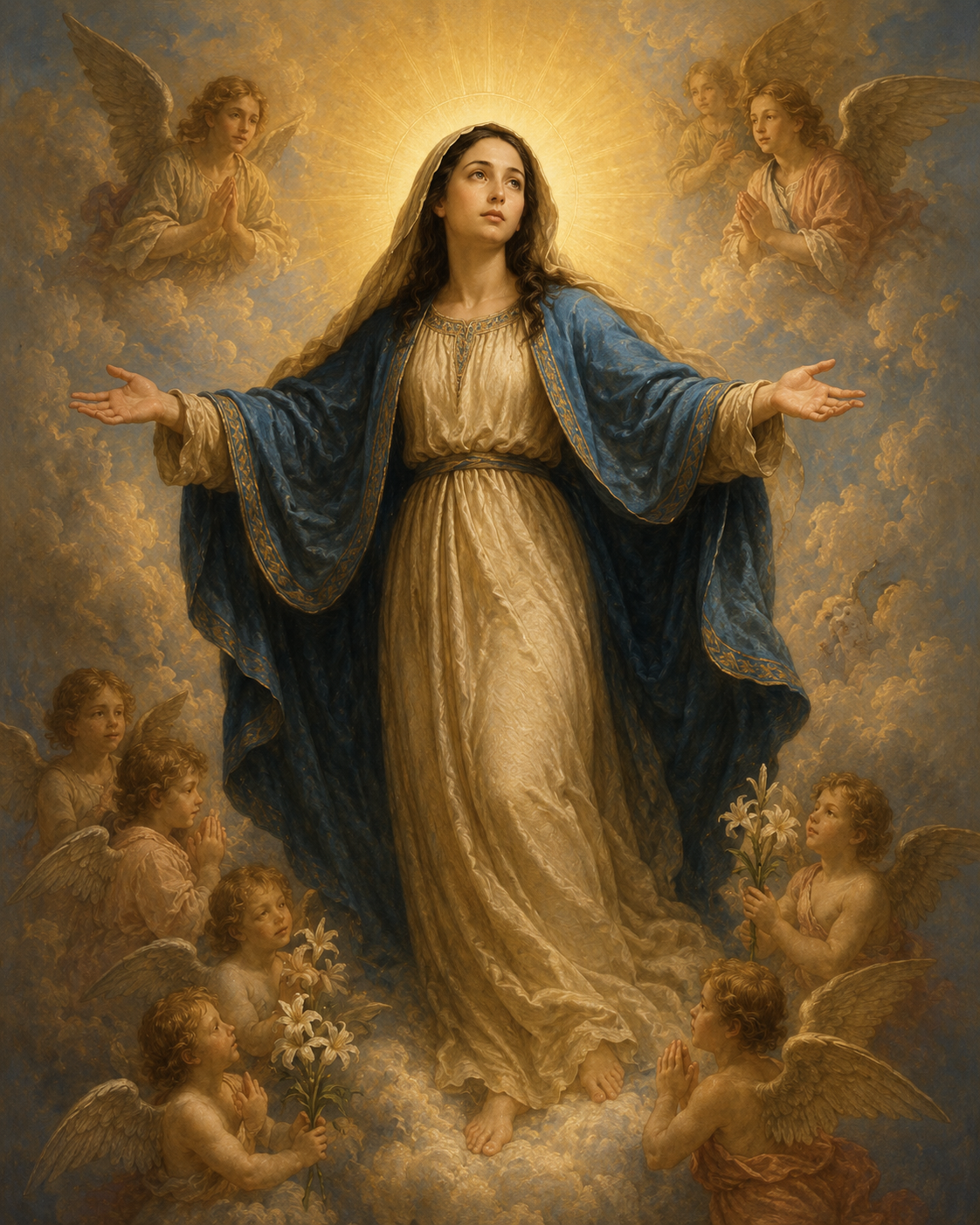
And then there is the woman of Revelation 12 — clothed with the sun, the moon beneath her feet, crowned with twelve stars. The Church reads this figure as both Mary and the Church herself, the two images superimposed the way icon painters layer gold on gold, a dual reading consonant with Lumen Gentium (1964), §§55, 63. The woman in glory, radiant, exalted — this is the vision that the feast of August 15 celebrates, the image the Church holds up and says: this is what God does with a creature who says yes.
For Further Study: CCC §966; Revelation 11:19-12:1; Brant Pitre, Jesus and the Jewish Roots of Mary, ch. 3.
The Witnesses of the Tradition
Common Theological Teaching and Private Revelation — tradition is weighty; mystical accounts are not binding.
Long before the dogma was formally defined, the faithful kept the feast. The Transitus Mariae literature — accounts of Mary's "passing" or "dormition" — circulated from at least the fifth century, and the feast of the Assumption was celebrated in Jerusalem by the late fifth century and in Rome by the seventh century under Pope Sergius I (687-701), well before the Middle Ages. The Church did not invent a doctrine in 1950; she recognized what had been believed, prayed, and celebrated for as long as memory reached.
Private Revelation Note: The following mystical accounts are drawn from writings associated with recognized or venerated Catholic figures. They may witness to devotional tradition, but they do not establish the doctrine and are not binding on the faithful; the doctrine rests on Scripture, Tradition, and the Magisterium.
Over the centuries, saints and mystics added their own witness. Venerable Mary of Ágreda, in her vast Mystical City of God, described Mary's final days in Jerusalem — the gathering of the Apostles, the peaceful death, the body remaining incorrupt and radiant. Blessed Anne Catherine Emmerich saw the Archangel Gabriel — the same messenger who brought the news of the Incarnation — returning at the end to announce her entrance into eternal glory. St. Bridget of Sweden received similar visions: Mary's death surrounded by heavenly light, her body untouched by decay, her soul received immediately into the presence of her Son.
These private revelations are not doctrine. The Church does not require anyone to believe them. But they are a kind of testimony — the way a chorus of voices, each singing slightly differently, can together establish the melody. The melody here is always the same: she who bore Life was not surrendered to death. She who was full of grace was filled, at the last, with glory.
For Further Study: CCC §67 and §966; Munificentissimus Deus (1950), §§14-21; Vatican, Norms for Proceeding in the Discernment of Alleged Apparitions and Revelations (2024).
She who bore Life was not surrendered to death.
The Body Matters
Common Theological Teaching — the Assumption illumines the resurrection of the body.
Here is where the Assumption speaks most directly to our own time. We live in an age that has lost the theology of the body. The body is commodified, displayed, surgically altered, digitally filtered, and finally discarded — treated as a costume the soul wears for a while and then throws away. Even among Christians, there is a quiet Gnosticism at work: we speak of the soul "going to heaven" as though salvation were an escape from the body rather than the redemption of it.
The Assumption is the Church's loudest no to all of that. Mary was not assumed as a spirit. She was assumed body and soul. The flesh that nursed the infant Christ, the hands that held Him, the feet that walked to Calvary — all of it was taken up into glory. The Assumption declares that the body is not incidental to salvation. It is essential. We are not angels temporarily imprisoned in meat. We are embodied souls — or, if you prefer, ensouled bodies — and our destiny is not the shedding of the flesh but its transfiguration.
What happened to Mary is what is promised to all the faithful, at the last day. Mary is the foremost anticipation and sign of that resurrection; the first fruits, in St. Paul's strict sense, is Christ alone. As he wrote to the Corinthians in 1 Corinthians 15:23: Christ the first fruits, then at His coming those who belong to Christ. The Catechism places her exactly: the Assumption is "a singular participation in her Son's Resurrection and an anticipation of the resurrection of other Christians" (CCC §966). Mary belongs to Christ more completely than any other creature, and so she received the promise first — not as a privilege that separates her from us, but as a sign that draws us forward. St. John Paul II's Theology of the Body catecheses (1979-1984) develop this same Catholic conviction: the body is not disposable matter but the person made visible and destined for resurrection.
For Further Study: CCC §§988-1019; 1 Corinthians 15:20-23; St. John Paul II, Theology of the Body audiences (1979-1984).
Mother and Mediatrix
Common Theological Teaching — Mary intercedes within Christ's one mediation.
The Assumption is not the end of Mary's story. It is, in a sense, the beginning of a new chapter. Assumed into heaven, she does not retire. As St. Maximilian Kolbe, beatified in 1971 and canonized in 1982, wrote:
"The Immaculata, assumed into heaven in body and soul, continues from there her motherly work for souls."
From heaven she intercedes. The woman who said do whatever He tells you at Cana is still saying it — still directing the servants, still pointing to her Son, still present at the wedding feast of the Church and the world. The Assumption places her not at a distance from us but at the centre of the communion of saints, closer than she could have been in Nazareth or Jerusalem, because in glory there are no walls and no miles.
And it is worth noting that this honour is not confined to Catholic devotion. Islam holds Mary in the highest reverence — the Quran names an entire surah after her and affirms the virginal conception of Jesus (Surah 3:47; 19:20). The Protestant reformers, Martin Luther among them, affirmed her perpetual virginity and her unique role in the economy of salvation. The Orthodox celebrate the Dormition with ancient solemnity. The reverence is broader and deeper than any single tradition, because the reality it responds to is broader and deeper: a woman said yes to God without reservation, and everything that followed — Incarnation, Redemption, the life of the Church — flows from that assent.
Theological Note: Mary's intercession from heaven is a participation within Christ's one mediation, not a separate mediation alongside it (1 Timothy 2:5; Lumen Gentium [1964], §§60, 62; CCC §970).
For Further Study: CCC §§969-970; John 2:1-11; Lumen Gentium (1964), §§60-62.
The Feast and the Life
Defined Dogma and Liturgical Witness — the feast teaches the Church to pray what she believes.
August 15 is one of the ten holy days of obligation named in the universal law of the Church (CIC can. 1246 §1), and one of those retained in the United States, where the bishops have transferred or set aside the rest (can. 1246 §2). The obligation there is not unconditional: by the decision of the United States bishops, the precept to attend Mass is lifted whenever the Assumption falls on a Saturday or a Monday — as it does in 2026 — so the solemnity is kept in those years without binding under pain of sin. Obligation or not, it is a day when the Church asks her children to stop, to come to Mass, to remember. It is the Fourth Glorious Mystery of the Rosary, the bead where the fingers pause and the mind lifts to the image of a woman taken up into light. But it is more than a calendar date or a decade of prayer. It is a claim about reality — about what the body is, what grace does, and where the story ends.
The Assumption tells us that our daily acts of love, sacrifice, and obedience are not lost. They are gathered up. The woman who kept all these things in her heart was herself kept — kept whole, kept bodily, kept forever. And the promise extends to every soul that follows her path: faithful discipleship does not end in the grave. It ends in the glory that Mary has already entered, the glory that awaits.
The Ark carried the presence of God.
The woman carried the Son of God.
And the God who does not abandon what He has made
did not abandon her to the dust.
For Further Study: CCC §966; CIC can. 1246 §§1–2 and the complementary norm of the United States Conference of Catholic Bishops; Munificentissimus Deus (1950), §44.
A meditation drawn from Revelation 12, 2 Samuel 6, Exodus 25, Luke 1, John 2 and 19, Acts 1, 1 Corinthians 15, and the apostolic constitution Munificentissimus Deus (1950), especially §44, CCC §966, Lumen Gentium §§55, 60, 62-63, and Dei Verbum §§15-16. Saints and mystics referenced: Venerable Mary of Ágreda, Blessed Anne Catherine Emmerich, St. Bridget of Sweden, and St. Maximilian Kolbe.
See also: The Last Things · Purgatory · Do Catholics Worship Mary?
Keep Reading

The Last Things
Limbo, Abraham’s Bosom, and the Harrowing of Hell

Spiritual Life
The Beatitudes

The Saints