
Chapter VIII-A · 14 min read
The Saints’ Map of Purgatory
Print & share
Printable folded handout
A readable six-panel version of the Saints’ Map, with the map artwork, account codes and a QR link back to this chapter. Church teaching is kept distinct from the reported imagery.
Download folded handout (PDF)US Letter landscape · 2 pages · 8.4 MB
Printing and folding instructions
- Print both pages on opposite sides of one US Letter sheet, in landscape orientation.
- Select Actual size / 100% and duplex: flip on short edge.
- With the inside spread facing up, fold the narrow right panel inward, then fold the left panel over it.
- No trimming is needed. Test one copy before printing a batch.
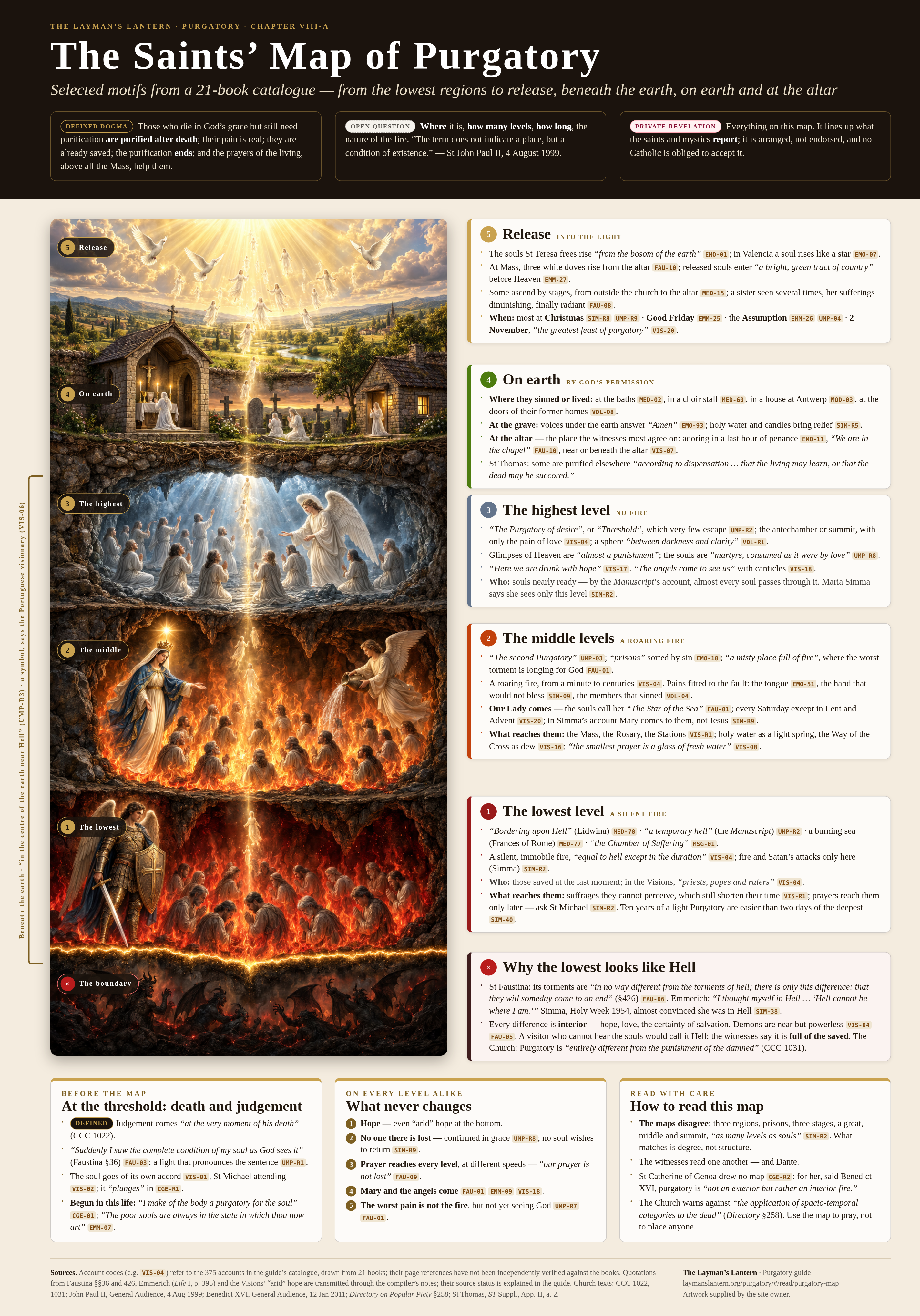

"The term does not indicate a place, but a condition of existence." — St John Paul II, General Audience, 4 August 1999
Private revelation This chapter does what the Church does not: it draws a map. Selected motifs of depth, place and passage from the account catalogue are arranged from judgement to release, and from beneath the earth to the altar. The arrangement is a synthesis of differing reports, not a verified geography.
Each piece is attributed to its witness. Where the witnesses disagree, the disagreement is shown.
Read the result as you would read a composite sketch drawn from many witnesses. It is useful for seeing what they agree on. It is not a photograph.
What the Church gives the map, and what she withholds
- Defined dogma The souls are purified after death; their pain is real; they are saved; the purification ends.
- Common teaching It differs by degree. "Some are tormented in Purgatory longer than others", and severity follows guilt while length follows how deeply sin has rooted (St Thomas; see IV-A).
- Open question Everything spatial. St Thomas held it "probable" that there is "a twofold place of Purgatory": one "below and in proximity to hell" by common law, and others "according to dispensation … that the living may learn, or that the dead may be succored" (see IV-B). That is the frame the visionaries fill in.
- The Church also warns against "the application of spacio-temporal categories to the dead" (Directory on Popular Piety, §258).
- St Catherine of Genoa, whom Benedict XVI calls a mystic who "never received specific revelations on purgatory", saw no regions at all, only "an inner fire" and each soul's own degree of light (CGE-R2).
The map below is the visionaries'.
At a glance
| Stage | What the witnesses call it | What they report there | Who they say is there | What reaches them |
|---|---|---|---|---|
| The threshold | Judgement; "the light" | The soul sees its whole life as God sees it, and goes of its own accord | Every soul | St Michael attends; Mary intercedes |
| The lowest | "Bordering upon Hell" (Lidwina); "a temporary hell" (the Manuscript); "the great Purgatory" (the Visions); "the deepest level" (Simma); "the Chamber of Suffering" (Gallagher); a "burning sea" (Frances of Rome) | Silent, immobile fire "equal to hell except in the duration"; demons near but powerless; souls who cannot perceive suffrages | Those saved at the last moment; in the Visions, "priests, popes and rulers" | Prayers "not applied" or reaching them "only later", but still shortening their time; St Michael |
| The middle | "The second Purgatory"; the "prisons" sorted by sin | A roaring fire; pains fitted to the fault; time "from a minute to centuries" | Most souls; each fault in its own prison | Masses, the Rosary, the Stations, holy water; Our Lady's visits |
| The highest | "The Purgatory of desire", or "Threshold"; "the antechamber"; a sphere "between darkness and clarity" | No fire; only the pain of love and longing; glimpses of Heaven "almost a punishment" | Souls nearly ready; by the Manuscript's account, almost every soul passes through it | Every prayer; Mary; the angels' canticles |
| Release | Rising radiant, robed in white, "like a star"; often on a feast | Most often at Christmas, Good Friday, the Assumption, 2 November |
1. The threshold: death, judgement and the lifting of the veil
Defined dogma Judgement comes "at the very moment of his death" (CCC 1022).
Private revelation The witnesses describe that judgement less as a verdict handed down than as an unveiling.
- St Faustina, before God's judgement seat (§36): "Suddenly I saw the complete condition of my soul as God sees it." She is told of "one day of fire in purgatory", and offered a short suffering on earth instead (FAU-03).
- The Unpublished Manuscript: a bewildering light in which the soul "sees its whole life spread out … and this same light pronounces its sentence" (UMP-R1).
- The Portuguese visionary watches an adolescent die. The boy hears no sentence; seeing his sins in God's holiness, his soul withdraws to Purgatory of its own accord (VIS-01). The particular judgement "takes place at the very place of death", with St Michael attending (VIS-02).
- Catherine of Genoa: the will is fixed at death, and the soul that sees its stain "plunges" into Purgatory without hesitation. It would rather cast itself "into a thousand hells" than appear before God with one spot (CGE-R1).
- Maria Simma: the souls judge themselves and choose their level; there is a "film" of one's life, and "two or three minutes to say yes" (SIM-R1).
The witnesses agree on one point: nothing new is created at death. The truth of the soul is shown to the soul, and it goes where it already belongs. (See the question Are we already in Heaven, Purgatory or Hell?)
2. The lowest level
The names.
- St Lidwina's angel calls it the part of Purgatory "bordering upon Hell". There a sinner has a "special Purgatory" in a well, with his angel sitting on its rim (MED-78).
- St Frances of Rome sees three regions, one beneath another, and the lowest is a burning sea (MED-77).
- The Unpublished Manuscript calls the lowest stage "a temporary hell where prayers are not applied" (UMP-R2).
- The Portuguese visionary calls it "the great Purgatory": "a silent, immobile fire, 'equal to hell except in the duration'". He thinks the fire is the same as Hell's, spiritual yet "almost material" (VIS-04, VIS-23).
- Maria Simma speaks of "the deepest level", where alone there are fire and Satan's attacks (SIM-R2).
- Christina Gallagher calls it "the Chamber of Suffering": grey ashes, priests in distress, a horrid smell (MSG-01).
- In the Medjugorje accounts, "the lowest level [is] near Hell" (MSG-05).
- Ursula Hibbeln places a relative "in the deepest pool of flames" (VDL-04).
Who is there. The witnesses place here the souls an onlooker would least expect to be saved:
- those surprised by sudden death, for whom "sudden deaths [are] justice or mercy" (UMP-R1);
- across all the levels, the Manuscript adds, tepid religious and priests stay longer than lay people (UMP-R2);
- in the Visions, "priests, popes and rulers" (VIS-04);
- great sinners, who, St Gertrude learns, are not helped by the ordinary suffrages "until partly purified" (MED-29).
What reaches them.
- In the Visions, the souls of the great Purgatory "do not perceive suffrages, which still shorten their time" (VIS-R1).
- In Simma's account, prayers reach "the deepest third only later", and she advises asking St Michael for them (SIM-R2).
- "Ten years of a light Purgatory are easier than two days of the deepest" (SIM-40).
- "The very guilty do not see Mary" (UMP-R8).
Why the lowest level looks like Hell
Private revelation Three witnesses who knew the doctrine perfectly well either took Purgatory for Hell or nearly did.
- St Faustina, watching a worldly man die: "although it seems to me that this soul is not damned, nevertheless its torments are in no way different from the torments of hell; there is only this difference: that they will someday come to an end" (Diary §426; FAU-06). A canonised saint, looking straight at it, could only suppose it was not Hell.
- Bl. Anne Catherine Emmerich: "Once I found myself in a sphere so horrible that I thought myself in Hell, and I began to weep aloud. My guide said: 'I am by thee, Hell cannot be where I am.'" (Life I, p. 395). She needed an angel to tell her.
- Maria Simma, Holy Week 1954: the devil "almost convinced me that I was in Hell, with flames and explosions" (Eltz, p. 156; SIM-38).
The witnesses describe the two as alike to the eye:
- Catherine of Genoa: a pain "like that of hell" (CGE-R3).
- The Manuscript: "a temporary hell" (UMP-R2).
- The Visions: "equal to hell except in the duration" (VIS-04).
- St Francis de Sales, as Schouppe quotes him: "a species of Hell as regards the suffering; a Paradise" as regards the charity (Schouppe, pp. 66–67).
Even Catholic vocabulary once ran the two together. Schouppe cites the Catechism of Trent for three "hells": Gehenna, the fire of Purgatory, and the bosom of Abraham (p. 46). The Creed's "he descended into hell" never meant the place of the damned.
Every distinguishing mark is interior. What separates the two in every account is hope, love and the certainty of salvation.
- Emmerich: "the hope of deliverance sweetens all"; Hell has despair, Purgatory hope (EMM-R1).
- The souls beg for prayers. Van den Aardweg's test is that the damned and the demons "do not sadly beg for prayers, help, and compassion; nor do they show the slightest sign of hope" (p. 45).
None of that is visible to a frightened observer who cannot hear the souls. At this level, the Visions say, the souls cannot even see a visitor, and their hope is "arid".
Demons are present nearby.
- St Faustina saw souls doing penance "like shadows" among demons (§412; FAU-05).
- The Visions say demons are perceptible though powerless in the great Purgatory (VIS-04).
- Emmerich saw evil spirits worrying souls in the "species of Purgatory" she describes beside Limbo (EMM-X2).
Fire plus torment plus demons reads as Hell to anyone who lacks a third category.
This level is the most crowded with souls who look damned.
- The Manuscript says of those whose death surprised them in grave sin: "It was almost a miracle that they were saved".
- The Visions' great Purgatory holds last-minute criminals beside bishops and popes.
A visitor to this level sees exactly the people an observer would call lost.
So a non-Catholic who glimpsed Purgatory would very likely report Hell. A Protestant near-death subject has two destinations and an experience that is neither bliss nor annihilation; the only available label is Hell. Faustina had the third category and still hedged. Anyone reasoning from such reports would conclude that very many are lost, when the witnesses say the opposite about that very level: it is full of the saved.
Three cautions from the same sources:
- Near-death subjects have not died. Asked whether near-death descriptions are reliable, Simma said: "No, certainly not. Because they have not died … Some of the widespread descriptions do have blatant falsehoods contained in them" (Eltz, p. 188; cf. SIM-04, SIM-R10). Van den Aardweg reads such experiences as breaking off at the threshold, before the particular judgement. What is seen is at most a glimpse from the doorway.
- The mistake can run the other way. The Visions' antechamber has no fire and only the pain of love. The Manuscript's soul calls her glimpses of Heaven "almost a punishment" (UMP-R8). A visitor at the top might report Heaven. The "being of light" and "indescribable beauty" of near-death accounts could as easily be the threshold of Purgatory as of Heaven; no witness in the collection decides that.
- None of this is doctrine. The Church's only relevant word is that Purgatory is "entirely different from the punishment of the damned" (CCC 1031, quoted in the Directory, §251). It is different in kind, which is exactly what the eye cannot see.
3. The middle levels
- The Visions' middle Purgatory: "a roaring fire; from a minute to centuries" (VIS-04).
- The Manuscript's soul passes "from 'the first' to 'the second Purgatory' on the Annunciation and [sees] Our Lady for the first time" (UMP-03).
- St Faustina's "misty place full of fire", where the souls' greatest torment is longing for God (FAU-01).
- In the middle the pains are most often fitted to the fault:
- St Mary Magdalen de' Pazzi walks through "prisons" sorted by sin (EMO-10);
- St Bridget sees a worldly young lady "tormented member by member", which Schouppe warns is not to be taken literally (MED-42);
- "souls burn in the members that sinned" (VDL-04);
- a theologian's tongue is tormented for uncharitable speech (EMO-51);
- a priest's right hand appears black because he neglected to bless (SIM-09);
- there is "a place in Purgatory for souls who resisted a special call from God" (FAU-16).
- Our Lady comes here.
- The angels come here too. Angels assist the souls in Frances of Rome's regions (MED-77). "The angels come to see us" with canticles (VIS-18). The guardian angel consoles (SIM-R9).
4. The highest level
- The Manuscript's "Purgatory of desire", or "Threshold" (UMP-R2): no fire, and very few escape it. Here the glimpses of Heaven are "almost a punishment", and the souls are "martyrs, consumed as it were by love" (UMP-R8).
- The Visions' "antechamber or summit": "only the pain of love". There a released priest's brother, "still in the antechamber, rejoices" (VIS-04, VIS-14).
- Von der Leyen's souls speak of a higher sphere "between darkness and clarity": "We are without pain when we are near you" (VDL-R1).
- Simma says she sees only the highest level (SIM-R2).
- The witnesses' own words for this level:
5. Release
How release looks.
- The souls Teresa frees rise "from the bosom of the earth" (EMO-01).
- In Valencia, a plague-dead religious rises "like a star" (EMO-07).
- St Malachy's sister approaches by stages, from outside the church to the altar (MED-15).
- A sister appears several times, "her sufferings diminishing, finally radiant" (FAU-08).
- At Mass on the day after All Souls, three white doves rise from the altar (FAU-10).
- Released souls enter "a bright, green tract of country before being taken to Heaven" (EMM-27).
When release comes. The days repeat across the witnesses:
- most at Christmas (SIM-R8; UMP-R9, "most go to Heaven on Christmas night"), when the Visions say no Purgatory is shown (VIS-20);
- Good Friday (EMM-25; SIM-R8);
- the Assumption, when "she has gone back to Heaven with many souls" (UMP-04; EMM-26);
- 2 November, "the greatest feast of purgatory" (VIS-20).
Beside the levels: where else the souls are found
- Beneath the earth.
- The Manuscript: "in the centre of the earth near Hell" (UMP-R3).
- The Visions: "in the center of the earth", which the visionary himself takes as a symbol, "a prison without walls or guards" (VIS-06).
- Emmerich: "a place near the earth", souls at different depths, "some up to the neck, some to the breast" (EMM-17).
- Bishop Brentano hears voices under the earth answer "Amen" at a grave (EMO-93).
- A soul's Lord's Prayer is heard "as if from the bottom of a deep cave" (SIM-25).
- On earth, where they sinned or lived.
- The deacon Paschasius at the baths (MED-02).
- The friar in his own choir stall (MED-60).
- The banker in his house at Antwerp (MOD-03).
- Souls waiting at the doors of their former homes (VDL-08).
- The Manuscript's soul, beside her nun by day and "actually in Purgatory" at night (UMP-02).
- Leonarde Collin, nursing her niece (EMO-84).
- Simma: "they come to us with Purgatory"; she takes poltergeist activity as a sign of the deeper levels (SIM-R3, SIM-R4).
- St Thomas's "dispensation" covers all of these.
- At the altar.
- A dead sister adoring in her last hour of penance (EMO-11).
- Mother de Montoux under the chalice on Holy Thursday (EMO-21).
- The lady of Trèves in adoration each November (EMO-52).
- A young father "almost constantly in a church near or beneath the altar" (VIS-07).
- Some make their Purgatory "at the foot of the altar as a reward" (UMP-R3).
- "We are in the chapel" (FAU-10).
Of all the places named, the altar is the one the witnesses most often agree on.
- In the body, before death.
- Catherine of Genoa: "I see my soul … in the midst of my body as in a purgatory"; the Lord tells her, "I make of the body a purgatory for the soul" (CGE-01).
- Emmerich goes down into Purgatory in her own sufferings, and her angel tells her, "The poor souls are always in the state in which thou now art" (EMM-15, EMM-07).
- The Manuscript: some have their Purgatory on earth "by suffering or by love" (UMP-R3).
- St Faustina is offered a short suffering on earth in place of "one day of fire" (FAU-03).
- Three hours of Simma's suffering spare a soul twenty years (SIM-35).
- Next door. Emmerich's Limbo has "three spheres" and is "a species of Purgatory" (EMM-X2). Simma places unbaptised infants in Limbo, "and also some adults" (SIM-41).
What every level has in common
Across the whole map, five things never change:
- Hope. No witness describes a soul in Purgatory without hope, even "arid" hope at the bottom.
- No soul there is lost. "Confirmed in grace" (UMP-R8); "no soul wishes to return" (SIM-R9).
- Prayer reaches every level, at different speeds. "Our prayer is not lost" (FAU-09).
- Mary and the angels come, except, in some accounts, to the very guilty at first.
- The worst pain is not the fire. "Not seeing God is the worst" (UMP-R7). Their "greatest torment is longing for God" (FAU-01).
How to read the map
- The levels differ between maps. Three regions, a corridor of prisons, three stages, a great, a middle and a summit, "three main levels" and "as many levels as souls" (SIM-R2). If God had shown one architecture, the plans would match. What matches is degree, not structure (see IV-A).
- The witnesses are not independent. The moderns had read Schouppe, and everyone had read Dante.
- The best guide to the map is the mystic who refused to draw one. Catherine of Genoa sees "an inner fire", not a geography. Benedict XVI notes that "for her it is not an exterior but rather an interior fire."
- Pictures from both ends can mislead. A view from the bottom looks like Hell, and a view from the top may look like Heaven.
- Use the map to pray, not to place anyone. No reader can know which level holds a particular soul. That is why the Church prays for all of them, at every Mass.
Sources and context
Quotation provenance
The following passages are transmitted through the compiler’s notes and have not been independently collated with the cited editions: Faustina §426, full wording (FAU-06 cites §425–426); Emmerich, Life I, p. 395, "Hell cannot be where I am" (EMM-17 cites p. 395); Simma, Eltz p. 156, "almost convinced me" (SIM-38 cites pp. 156–157); Simma on near-death accounts, Eltz p. 188 (SIM-04 cites pp. 187–188); St Francis de Sales via Schouppe, pp. 66–67; The Roman Catechism's three "hells", via Schouppe, p. 46; Van den Aardweg's test, p. 45, and his reading of near-death experiences; The Visions on "arid" hope and on souls who cannot see a visitor; Emmerich's evil spirits worrying souls in the "species of Purgatory" (EMM-X2 records the "species of Purgatory" but not the spirits); The Manuscript's "almost a miracle that they were saved"; Faustina §36, "Suddenly I saw the complete condition of my soul" (FAU-03 cites §36); The Manuscript, p. 38, "sees its whole life spread out" (UMP-R1 cites p. 38).
Church texts and other sources are identified in the chapter. Reported experiences remain distinct from Church teaching; catalogue page references have not all been independently verified against the source editions.