 Articles · Sacred Scripture · Romans 11
The Root Bears Thee
Romans 11, the Irrevocable Call, and What the Church Actually Teaches About the Jews
“Thou bearest not the root, but the root thee.” — Romans 11:18
Few subjects generate more heat and less light among Catholics right now than the Jews — and much of that heat comes not from the Church's teaching but from politics wearing theology's clothes. Two errors are pulling at the faithful from opposite sides, and the eleventh chapter of Romans answers both.
ITwo Ditches, One Road
What the confusion actually consists of
Walk into any parish hall, comment section, or family dinner and you will find two positions presented as the only two available. On one side: the modern State of Israel is the fulfillment of biblical prophecy, and to support it is a Christian duty — God's clock is running, the fig tree has budded, and questioning any of it borders on blasphemy. On the other: the Jews are a rejected people whose covenant expired at Calvary, and everything that follows from that assumption, down to the old libels that the Church has condemned again and again.
Neither is Catholic. That is the plain fact underneath the noise, and it is worth saying before anything else: the first of these — Christian Zionism in its modern dispensationalist form — is a relatively recent Protestant system, developed especially in the nineteenth century, and the second is a sin the Church has explicitly renounced. A Catholic who thinks he must choose between them has been handed a false pair of options by people who are not teaching him the faith.
That first description needs care. Sympathy for a Jewish return to the land is older than dispensationalism, and a great many Protestants who support Israel hold no part of the dispensationalist scheme. What is weighed below is the system — the claim that current events in the Holy Land are decoded prophecy and that Christians are religiously bound to a political programme — and not every Protestant who feels warmly toward the Jewish people.
The road between those two ditches is narrow, but it is well marked. St. Paul walked it first, and he did it in the very chapter that both errors misuse.
IIThe Apostle to the Gentiles
Romans 11:13 · Romans 15:15–16 · Galatians 2:7–9
Paul names his own office without embarrassment. He is the apostle of the Gentiles — and he understands that office in priestly terms. He describes himself as a minister of Christ Jesus among the nations, offering the gospel as a sacrifice so that the oblation of the Gentiles may be made acceptable and sanctified in the Holy Ghost (Rom 15:15–16). This is not a job description. It is a liturgy.
And it was recognized as such by the pillars in Jerusalem. When Paul went up and laid out his gospel, James, Peter, and John saw that the gospel of the uncircumcision had been committed to him as the gospel of the circumcision had been to Peter, and gave him and Barnabas the right hand of fellowship (Gal 2:7–9). Two commissions, one Church. Peter's apostolic mission was especially associated with the circumcised, and Paul's with the Gentiles, with no daylight between them on the substance of what was preached.
Hold that in mind, because everything Paul says about Israel in Romans 9–11 he says as a man with a Gentile assignment and a Jewish heart. He is not writing about a foreign people. He is writing about his own kinsmen according to the flesh, for whom he would be willing to be anathema himself (Rom 9:3).
IIIHoly Jealousy
Paul's strategy, which is stranger than it looks
Then comes the paradox that organizes the whole chapter.
I say then, have they so stumbled, that they should fall? God forbid. But by their offence, salvation is come to the Gentiles, that they may be emulous of them.
For I say to you, Gentiles: as long indeed as I am the apostle of the Gentiles, I will honour my ministry, if, by any means, I may provoke to emulation them who are my flesh, and may save some of them.
Romans 11:11, 13–14
Read that again slowly, because it is easy to skate past. Paul says his ministry to the Gentiles is itself part of his strategy for the Jews. He magnifies the Gentile mission — deliberately, publicly — so that his own people will see what they are missing and want it. The salvation of some among the nations is meant to result in the salvation of some among Israel, as God provokes them to jealousy through what He is doing among the Gentiles.[1]
The Church's growth among the nations was never meant to be an argument against Israel. It was meant to be an invitation to Israel.
This alone should govern how a Catholic speaks. If the whole point of the Gentile harvest is to make Israel want what the Church has, then every act of Christian contempt toward Jews works directly against the apostolic purpose. Contempt does not provoke jealousy. It provokes revulsion — and it has, for centuries, with consequences we are still living with.
IVThe Redemptive Reversal
A threefold movement, not a verdict
Paul then presses the logic further. If their stumbling was riches for the world, what will their fullness be? If the loss of them is the reconciliation of the world, what shall the receiving of them be but life from the dead? (Rom 11:12, 15). The argument runs from lesser to greater: if God brought this much good out of a partial hardening, wait until you see what He brings out of the healing of it.
And the mercy runs in a circle. Gentiles once disobeyed and have now received mercy through Jewish disobedience; the Jews have now become disobedient so that through the mercy shown to Gentiles they too may obtain mercy (Rom 11:30–31). Paul presents Israel's hardening not as the end of the story but within a threefold movement: Israel's rejection leads to Gentile inclusion, and Gentile inclusion leads back to Israel's inclusion.[2]
Notice what that structure forbids. It forbids the Gentile Christian from reading his own inclusion as a verdict of condemnation on anyone. He was grafted in because of a hardening that God intends to lift. He is a beneficiary of a delay, not the winner of a contest.
VThe Warning to the Grafted Branch
Romans 11:17–24
Paul knew exactly which sin the Gentile Church would fall into, and he named it two thousand years before it happened.
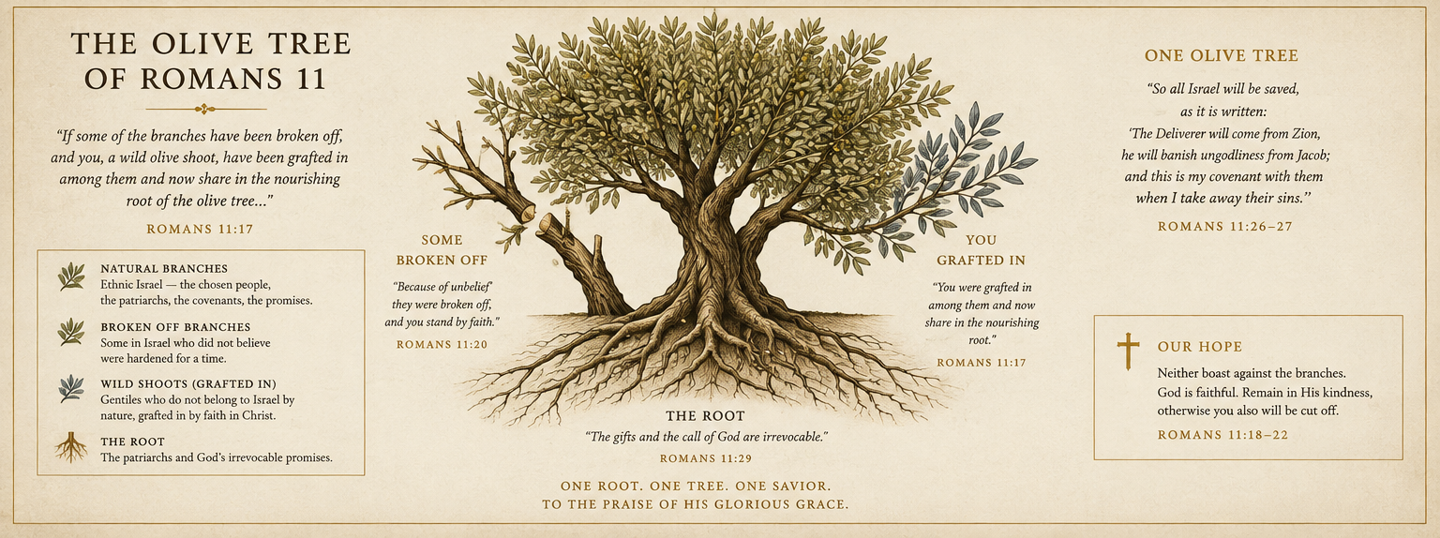
And if some of the branches be broken, and thou, being a wild olive, art ingrafted in them, and art made partaker of the root and of the fatness of the olive tree, boast not against the branches. But if thou boast, thou bearest not the root, but the root thee.
Romans 11:17–18
The wild branch does not sustain the tree. The tree sustains the wild branch. Every Gentile Christian is a transplant living off a root that is not his by nature — the patriarchs, the covenants, the law, the prophets, the promises, and Christ Himself according to the flesh (Rom 9:4–5). Our Lord's own summary is blunter still: salvation is of the Jews (Jn 4:22).
And then the warning turns sharp. If God did not spare the natural branches, He will not spare you either. Stand in fear, Paul says — you stand by faith, not by entitlement, and if God was able to break off natural branches He is far more able to graft them back in (Rom 11:20–24). The Gentile who reads Romans 11 as a trophy has read it exactly backwards. It is a caution notice.
VIUntil the Fullness of the Gentiles
The mystery Paul refuses to leave vague
For I would not have you ignorant, brethren, of this mystery (lest you should be wise in your own conceits), that blindness in part has happened in Israel, until the fulness of the Gentiles should come in. And so all Israel should be saved…
As concerning the gospel, indeed, they are enemies for your sake: but as touching the election, they are most dear for the sake of the fathers. For the gifts and the calling of God are without repentance.
Romans 11:25–26, 28–29
Three things are being asserted at once, and they must be held together or the chapter collapses into one of the two ditches.
First, the hardening is partial and temporary. Not all Israel, and not forever. Paul himself is the standing proof — a Jew, and a believer, and there were thousands like him from the first day (Rom 11:1, 5).
Second, God's gifts and call are irrevocable. He has not gone back on His word. Whatever else is true, the promises to Israel stand, because God's fidelity does not depend on the fidelity of the people He chose. This is not sentimentality; it is the same argument Paul makes for our own salvation. A God who breaks His word to Israel is a God who might break it to you.
Third, the resolution is salvation in Christ — not a separate arrangement, not a parallel track, not a political settlement. Paul's whole hope is that his kinsmen come to the Deliverer who comes out of Sion (Rom 11:26). His prayer to God for Israel is unto salvation (Rom 10:1), and he never once redefines what salvation means in order to spare anyone's feelings.
VIIWhat the Church Teaches
The magisterium on Romans 11, in its own words
The Church has taken Paul's chapter and taught from it directly. Four points, authoritative in different ways, must govern Catholic thinking:
The Jews remain beloved. The Second Vatican Council, in Nostra Aetate §4, cites Romans 11:28–29 by name to teach that the Jews remain dear to God for the sake of the fathers, that they are not to be presented as rejected or accursed, and that the Church deplores hatred, persecutions, and antisemitism directed against Jews at any time and by anyone. This is conciliar teaching, not an opinion.
The covenant was never revoked. God's covenantal fidelity has not failed. St. John Paul II spoke at Mainz in 1980 of the people of God of the Old Covenant as “never revoked by God.”[3] The 2015 reflection of the Commission for Religious Relations with the Jews, which takes its very title from Romans 11:29, developed this insight theologically, while noting that the precise formulation should not simply be read back into Nostra Aetate. That reflection is offered as a contribution to theological discussion, not as a magisterial definition.[4] This must be heard precisely. The Church's affirmation that God's covenant with the Jewish people has not been revoked does not establish a second way of salvation apart from Christ. The Church confesses one Savior and one universal economy of salvation, while acknowledging that the precise manner in which Israel is drawn into the fullness of Christ remains a mystery.
The guilt of the Passion is not a racial inheritance. The Catechism is unsparing here. The Jews as a people cannot be charged with Christ's death; sinners were the authors and ministers of all the sufferings the divine Redeemer endured, and Christians bear the greater blame because they know what they do (CCC 597–598). If you want someone to accuse, the Catechism hands you a mirror.
Israel's recognition of the Messiah belongs to the last things. The Catechism, citing Romans 11:25–26, teaches that the glorious coming of the Messiah is bound up with the recognition of Him by all Israel, whose full inclusion after the full number of the Gentiles will enable the People of God to achieve the measure of the stature of Christ (CCC 674). Within the range of Catholic interpretation, Paul's teaching is reflected in the Church's eschatological expectation that Israel will come to recognize the Messiah; the Church has not defined the chronology of that recognition, nor the manner of it.
The Church's hope for Israel is a hope for Israel in Christ. Anything less is not a kindness; it is a demotion.
That last point cuts against a fashionable error in the other direction — the so-called dual-covenant theory, which holds that Jews are saved by the Sinai covenant and need no reference to Christ at all. The Church has not taught this and cannot. She holds both that God's covenant with Israel endures and that salvation comes through Christ alone; how those two truths meet is, in the Commission's own careful phrase, an unfathomable divine mystery. The Church's witness to the Jewish people is to be offered with particular respect for their unique relationship to God, without coercion or contempt, while never ceasing to bear witness to Christ. That is a matter of manner, not of message — and it is precisely Paul's method. He did not stop preaching Christ to Jews. He tried to make them want Him.
VIIIOne Word, Four Things
Where nearly all the confusion actually lives
Most arguments about "the Jews and Israel" go wrong in the first thirty seconds because four distinct things are being carried by two or three words. Separate them and the fog lifts.
- Israel of the promise
- The elect people of the covenant, whose gifts and calling are irrevocable, and whose full inclusion Paul awaits. A theological reality. Not a government.
- Judaism
- The living religion of the Jewish people after the Temple's fall. A religious reality, engaged by the Church in dialogue and by every Catholic in ordinary charity.
- The Jewish people
- Actual human beings, our neighbors, made in God's image, owed justice and love without qualification, and owed an apology for a great deal of Christian history.
- The State of Israel
- A sovereign nation founded in 1948, with a government, borders, elections, policies, critics, and defenders — a political reality, judged by the same standards as any other state.
And Zionism is a fifth thing again: a political movement, born in the late nineteenth century, aimed at Jewish national self-determination. It has always contained secular, religious, socialist, and revisionist strands that disagree bitterly with one another.
Once these are separated, the questions stop tangling. Whether God's promises to Israel stand is a question of faith — settled, and settled in the affirmative. Whether a particular state's particular policy is just is a question of politics and prudence — not settled, legitimately contested among faithful Catholics, and not resolvable by proof-texting Genesis or Romans.
IXWhy Christian Zionism Is Not Catholic
A system with a birth certificate
Here is the claim that the Church genuinely does not hold: that the founding of the modern State of Israel is a fulfillment of biblical prophecy, that its territorial expansion is a stage in God's end-times timetable, and that Christians are therefore religiously obliged to support its policies.
That framework is dispensational premillennialism. It was systematized in the 1830s, spread through the Scofield Reference Bible after 1909, and became a fixture of American evangelicalism in the twentieth century.[5] Restorationist sympathies of a looser kind run further back, through Puritan and later Protestant writers, and they should not be confused with the system that later organized them into a prophetic timetable. It is that system which is not ancient, not patristic, and not Catholic. Its architecture requires a permanent two-track division between Israel and the Church, a rebuilt Temple with restored sacrifice, and a literalist prophetic calendar — every one of which sits badly with Catholic doctrine.
The Catholic difficulties are specific:
The promises are fulfilled in Christ, not in cartography. The land promises of the Old Testament are read by the Fathers and by the Church as opening onto something larger — the inheritance of the whole earth by the meek, the heavenly Jerusalem, the Church as the assembly of the redeemed of every nation. Reducing them back down to a set of coordinates is a downgrade, not a fulfillment.
The Church is not a parenthesis. Dispensationalism treats the age of the Church as an interruption in God's dealings with Israel. Catholic teaching holds that the Church participates in the fulfillment of God's promises in Christ, while Israel's election and future place in God's plan remain mysteriously affirmed. The nations are grafted onto Israel's own root — one tree, not two, and not an interlude between two dealings with one people.
The Temple sacrifice is finished. This objection has to be made carefully, because most dispensationalist writers do not expect a rival to Calvary. They generally read the sacrifices of Ezekiel's temple as memorial or ceremonial — a backward look at the Cross, much as they understand the Lord's Supper. The Catholic difficulty survives that distinction. The Letter to the Hebrews does not describe the Levitical cultus as a rite awaiting a commemorative revival; it describes it as taken away so that the one offering of Christ may stand (Heb 10:9–14), and the worship of the first covenant as growing old and near to vanishing (Heb 8:13). And the memorial of Calvary is not left to us to design: Christ instituted it Himself — do this for a commemoration of me (Lk 22:19) — and the Church knows it as the Mass, the unbloody re-presentation of the one sacrifice of the Cross. A restored animal cultus, even a strictly memorial one, would stand beside the Eucharist as a second divinely willed memorial of the same offering. That is what Catholic teaching cannot grant.
Prophecy is not a newspaper. The Church has consistently discouraged reading current political events as decoded prophetic fulfillment. Our Lord Himself refused to supply the timetable (Acts 1:7).
None of this makes the State of Israel illegitimate, and none of it tells a Catholic how to vote. It simply means that no political arrangement in the Holy Land — anyone's — carries the weight of revealed doctrine. That is the whole point.
XAnd the Other Ditch Is Deeper
Why the correction must not become the error
Here is where a great many well-meaning Catholics lose their footing. Having discovered — correctly — that dispensationalist Christian Zionism is a modern Protestant system and not Catholic doctrine, they conclude that the opposite must be the traditional Catholic view, and go looking for it in the ugliest corners of the internet, where it is always available.
It is not the traditional Catholic view. It is a sin the Church has named and condemned, repeatedly, at the highest level, and in our own lifetimes. Pius XI said plainly that spiritually we are Semites. St. John Paul II called the Jews our elder brothers and prayed at the Western Wall. Benedict XVI, a German who had seen where the road ends, wrote at length on the Jewish roots of the faith.[6] Pope Leo XIV, marking the sixtieth anniversary of Nostra Aetate, stated that the Church does not tolerate antisemitism and fights it on the basis of the Gospel itself.[7]
Notice which sin Paul actually warns the Roman Christians about in chapter 11. Not insufficient political enthusiasm. Not naivety. He warns them against boasting, against being wise in their own conceits, against high-mindedness toward the broken branches. He saw the danger from the Gentile side, and he was right.
A Catholic who has correctly identified that Christian Zionism is not doctrine, and who then slides into contempt for Jews, has traded a Protestant theological error for grave sin. Hatred of the Jewish people, and serious unjust discrimination against them, is grave matter; what any particular soul is guilty of depends on knowledge and consent, and God alone weighs that. But the exit from a bad theology is never a worse one.
XIThe Holy See's Actual Record
Which is neither of the things people claim
The historical record is worth knowing, because both camps quote fragments of it.
On 26 January 1904, Theodor Herzl was received by St. Pius X and left with a refusal. Herzl set the audience down in his own diary the next day: the Pope's answer was theological — the Jews had not recognized Our Lord, and so the Church could not recognize the national claim — and he closed it with non possumus.[8] The episode is real and it is often quoted. It is also a private audience recorded by one participant rather than an act of the magisterium. That conversation reflects the theological and political context of its time and should not be treated as the final expression of the Church's later teaching.
For decades afterward the Holy See's public concern ran along a consistent and narrow line: the holy places, the Christian presence in the region, and peace.[9] Recognition of the State of Israel came only in the Fundamental Agreement of 30 December 1993, which established full diplomatic relations and committed both parties to religious freedom, access to the holy places, and joint opposition to antisemitism. That agreement also contains a sentence Catholics on all sides should memorize: the Holy See commits itself to remaining a stranger to all merely temporal conflicts, a principle it applies specifically to disputed territories and unsettled borders.[10]
That is the Church's posture in one line. She recognizes the state. She does not sacralize it. She pleads for peace, for the protection of the holy places, for the security of Israelis and the dignity of Palestinians — a great many of whom are Christians — and she declines to hand anyone a theological warrant for a border.
XIIWhat Is Asked of the Layman
Practical, and harder than it sounds
Refuse both ditches, out loud. When someone tells you God's promises hinge on a modern government's policies, you may say that is not the Catholic faith. When someone tells you the Jews are accursed, you may say that is not the Catholic faith either, and cite the Council when you do.
Keep the categories apart. You can criticize a government's decision without touching a covenant, and you can honor a covenant without endorsing a government. Anyone who tells you those two are the same thing is selling you something, from one direction or the other.
Let politics be politics. On the actual disputes of the Holy Land, faithful Catholics may and do disagree. Weigh the facts, apply the Church's social teaching on peace, justice, and the protection of civilians, and hold your conclusions as prudential judgments rather than articles of faith.
Pray as the Church prays. The Church's liturgy remembers that Israel received God's promises first and prays for the fullness of redemption. On Good Friday the deacon bids the faithful pray for the Jewish people, “to whom the Lord our God spoke first,” that God may grant them “to advance in love of his name and in faithfulness to his covenant”; and the collect that follows asks Him who bestowed His promises on Abraham and his descendants that “the people you first made your own may attain the fullness of redemption.”[11] That prayer holds the whole Catholic position together: the promises came to them first, they are beloved, and what the Church asks for them is the fullness of redemption, which is Christ.
Provoke the good kind of jealousy. Paul's method was to make the faith so evidently full of life that his own people would want it. That is still the assignment. A Catholicism worth being jealous of is not built by argument on the internet. It is built by holiness, by charity toward the actual Jewish people in front of you, and by a Church that looks like it is carrying something worth having.
Paul ends the chapter not with a policy but with a doxology — the depth of the riches of the wisdom and knowledge of God, whose judgments are incomprehensible and whose ways are unsearchable (Rom 11:33). He has just laid out the most intricate argument in his letters, and he closes by admitting he cannot see the bottom of it.
That is not a bad posture for the rest of us in confusing times. Hold what the Church has actually given us: God's covenant with Israel has not been revoked, salvation is in Christ, the branch does not carry the root, and contempt is forbidden. Beyond that, the ways of God are unsearchable — and the man who claims to have them mapped, in either direction, has stopped reading at verse 32.
Notes
- Jarvis J. Williams, “Letter to the Romans,” in The New Testament in Color: A Multiethnic Bible Commentary, ed. Esau McCaulley et al. (Downers Grove, IL: IVP Academic, 2024), 302. ↩
- Richard J. Lucas, “The Dispensational Appeal to Romans 11 and the Nature of Israel's Future Salvation,” in Progressive Covenantalism: Charting a Course between Dispensational and Covenantal Theologies, ed. Stephen J. Wellum and Brent E. Parker (Nashville, TN: B&H Academic, 2016), 243. ↩
- St. John Paul II, Address to Jewish representatives, Mainz, 17 November 1980. Cited and discussed in the 2015 reflection of the Commission for Religious Relations with the Jews, cited below. ↩
- Commission for Religious Relations with the Jews, “The Gifts and the Calling of God are Irrevocable” (Rom 11:29): A Reflection on Theological Questions Pertaining to Catholic–Jewish Relations on the Occasion of the 50th Anniversary of “Nostra Aetate” (No. 4), 10 December 2015. A reflection of the Commission, offered as a contribution to theological discussion rather than as a magisterial definition. ↩
- On the history of the system: Ernest R. Sandeen, The Roots of Fundamentalism: British and American Millenarianism, 1800–1930 (Chicago: University of Chicago Press, 1970), and Timothy P. Weber, On the Road to Armageddon: How Evangelicals Became Israel's Best Friend (Grand Rapids, MI: Baker Academic, 2004), ch. 1, on John Nelson Darby and the origins of the scheme. The Scofield Reference Bible was published by Oxford University Press in 1909 and revised by its editor in 1917. ↩
- Pius XI, remarks to a Belgian pilgrimage, 6 September 1938: “Spiritually, we are Semites.” The words were spoken extemporaneously and did not appear in L'Osservatore Romano; they reached print through the Belgian Catholic press, and some reference works date the audience to 8 September. St. John Paul II, Address in the Great Synagogue of Rome, 13 April 1986, where the Jewish people are called “our elder brothers”; he prayed at the Western Wall on 26 March 2000. Joseph Ratzinger, Many Religions, One Covenant: Israel, the Church and the World, trans. Graham Harrison (San Francisco: Ignatius Press, 1999). ↩
- Pope Leo XIV, General Audience of 29 October 2025, dedicated to the sixtieth anniversary of Nostra Aetate, confirming “that the Church does not tolerate antisemitism and fights against it, on the basis of the Gospel itself.” He returned to the theme in his Address to a Delegation of the United Jewish Appeal–Federation of New York, 15 June 2026, recalling that the declaration “took a firm stand against antisemitism” and that the Church rejects every form of discrimination. ↩
- Theodor Herzl, diary entry of 27 January 1904, in Raphael Patai, ed., The Complete Diaries of Theodor Herzl, trans. Harry Zohn (New York: Herzl Press and Thomas Yoseloff, 1960), 4:1601–05. The audience itself took place on 26 January 1904. ↩
- On the Holy See's public concerns across this period see Pius XII, In Multiplicibus Curis (24 October 1948) and Redemptoris Nostri Cruciatus (15 April 1949), both on peace in Palestine, the protection of the holy places, and the refugees; and Paul VI, Nobis in Animo (25 March 1974), on the needs of the Church in the Holy Land and the Good Friday collection taken up for its support. ↩
- Fundamental Agreement Between the Holy See and the State of Israel, signed at Jerusalem, 30 December 1993. The agreement runs to fifteen articles and an Additional Protocol. Diplomatic relations are the subject of art. 14, which provides for the exchange of Special Representatives on signing and then for relations at the level of Apostolic Nunciature and Embassy. The principle of temporal non-involvement is art. 11 §2: the Holy See, “while maintaining in every case the right to exercise its moral and spiritual teaching-office, deems it opportune to recall that, owing to its own character, it is solemnly committed to remaining a stranger to all merely temporal conflicts, which principle applies specifically to disputed territories and unsettled borders.” ↩
- The Roman Missal, 3rd typical edition (English translation, 2011), Friday of the Passion of the Lord (Good Friday), The Solemn Intercessions, VI: “For the Jewish People.” ↩
Sources
- Scripture quotations are from the Douay-Rheims translation.
- Second Vatican Council, Nostra Aetate §4 (28 October 1965) — on the Church's relation to the Jewish people, the enduring election, and the condemnation of antisemitism.
- Catechism of the Catholic Church §§597–598 (responsibility for the Passion), §674 (the coming of the Messiah and the recognition by all Israel), §§839–840 (the Jewish people and the People of God).
- Pontifical Biblical Commission, The Jewish People and Their Sacred Scriptures in the Christian Bible (2001) — on the Christian reading of the promises.
- Commission for Religious Relations with the Jews, The Gifts and the Calling of God are Irrevocable (2015).
- Fundamental Agreement Between the Holy See and the State of Israel (1993) — art. 14 on the establishment of full diplomatic relations, and art. 11 §2 on the Holy See's commitment to remain a stranger to merely temporal conflicts, disputed territories, and unsettled borders.
- The Roman Missal, 3rd typical edition — the Good Friday Solemn Intercessions, VI: “For the Jewish People.”
- On the history of dispensationalism — Ernest R. Sandeen, The Roots of Fundamentalism (1970), and Timothy P. Weber, On the Road to Armageddon (2004).
- On the Holy See before 1993 — Pius XII, In Multiplicibus Curis (1948) and Redemptoris Nostri Cruciatus (1949); Paul VI, Nobis in Animo (1974).
- On the papal statements cited in section X — Pius XI to the Belgian pilgrims (1938); St. John Paul II at the Synagogue of Rome (1986) and the Western Wall (2000); Joseph Ratzinger, Many Religions, One Covenant (1999); Pope Leo XIV, General Audience of 29 October 2025 and Address to the United Jewish Appeal–Federation of New York, 15 June 2026. Full references in the notes above.
- Raphael Patai, ed., The Complete Diaries of Theodor Herzl, trans. Harry Zohn (1960), 4:1601–05 — Herzl's own account of his audience with St. Pius X, 26 January 1904.
A note on what is and is not settled
The doctrinal points in this article — the enduring election of Israel, the condemnation of antisemitism, salvation through Christ, the rejection of a prophetic-timetable reading of current events — are the Church's teaching, and Catholics are bound by them. The political questions surrounding the modern State of Israel, its borders, its policies, and the conflicts of the region are not doctrinal, and faithful Catholics of good will reach different conclusions about them. This article deliberately declines to settle those, and readers should be wary of anyone — on any side — who presents a political position as though the faith required it.
Related reading
- The Tower We Carry — on the patterns of judgement from Eden to the Second Coming.
- The Catechism — the truths of the Faith every Catholic is bound to know.
- Apologetics — the reasoned defense of the Faith against common objections.
Collected for the faithful of The Layman's Lantern.
Ad majorem Dei gloriam.
Keep Reading

Sacred Scripture
Strait Is the Gate

Sacred Scripture
The Refusal Before the World

Sacred Scripture