The Protoevangelium
Common Theological Teaching — Christological reading primary; Marian reading typological and derivative.
Before humanity had fallen, before the long centuries of waiting, the Mother of the Redeemer was already foreseen — revealed in the very sentence God pronounces upon the serpent.
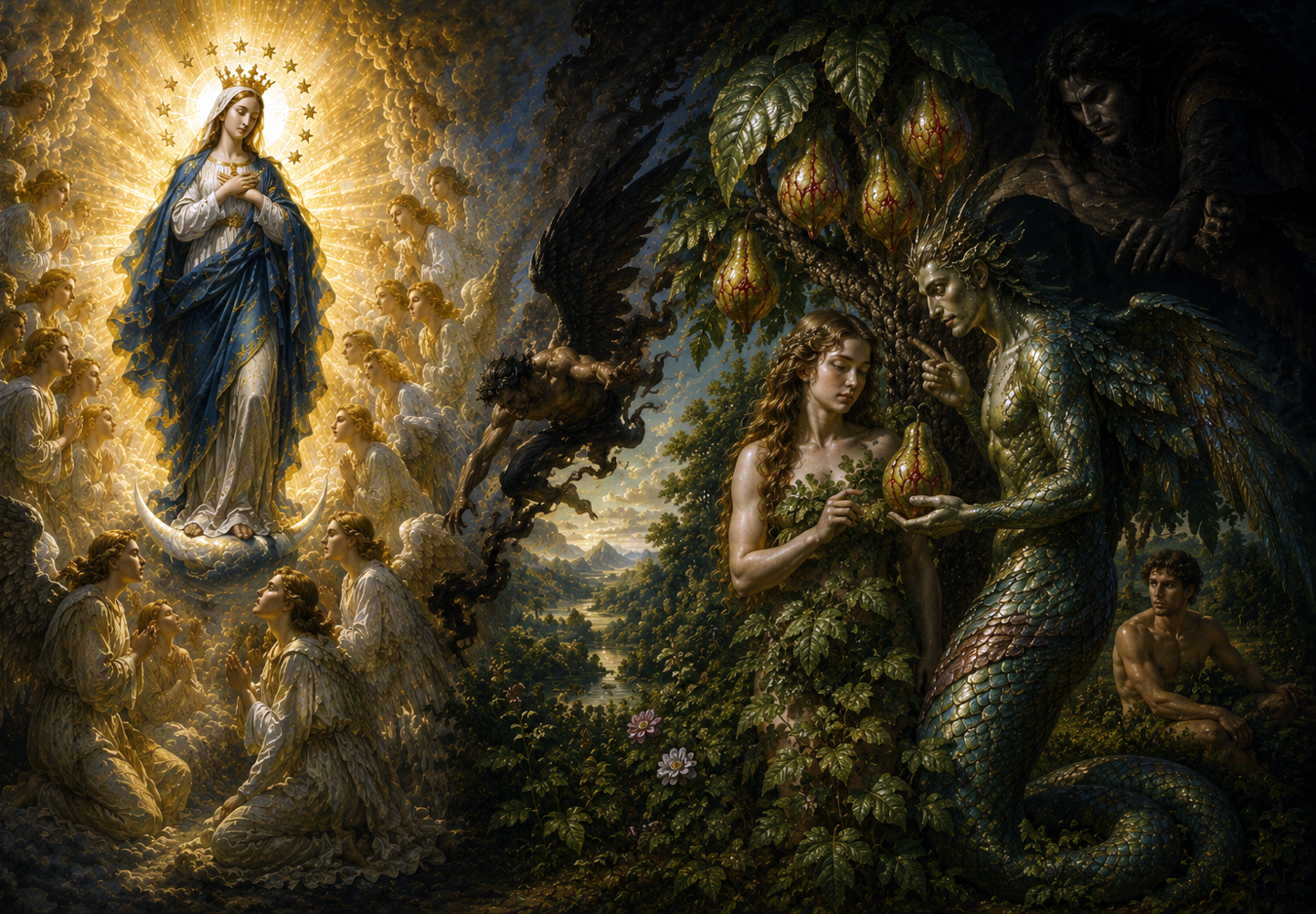
In the third chapter of Genesis, immediately after the sin of Adam and Eve, God turns to the serpent and speaks the first promise of redemption in all of Scripture. The Church has called this verse the Protoevangelium — the "first gospel" — because hidden within God's curse upon the serpent is the announcement of a coming victory.
"I will put enmities between thee and the woman, and thy seed and her seed: she shall crush thy head, and thou shalt lie in wait for her heel." Genesis 3:15 (Douay-Rheims, from the Clementine Vulgate)
The Catholic reading of this verse identifies three figures: the serpent (Satan), the Woman, and her seed (the Messiah). Where the first woman, Eve, had cooperated in disobedience and brought death, God promises a new Woman whose offspring will crush the serpent's head. The Catechism of the Catholic Church (§410–411) teaches that this passage "has been called the Protoevangelium" and that the Church's tradition sees in "the Woman" an announcement of "the New Eve," whose Son is the New Adam.
A note on the translation: "she" or "he"?
The traditional Latin Vulgate, in its later Clementine form, rendered the clause "ipsa conteret caput tuum" — "she shall crush your head." St. Jerome's original fourth-century translation most likely used ipse ("he," referring to the seed), while medieval manuscript variants introduced ipsa ("she"), which the Clementine Vulgate later standardized in 1592. Most modern translations, following the Hebrew, read "he" (the seed, Christ) or the neuter "it." The Church holds both readings as fruitful: Christ directly crushes the serpent, while Mary crushes him indirectly and derivatively, through her free cooperation in giving the Redeemer to the world.
Pope Pius IX settled the sense of the Marian reading in the very act of defining the Immaculate Conception. Ineffabilis Deus teaches that the prophecy foretold Christ, "that his most Blessed Mother, the Virgin Mary, was prophetically indicated; and, at the same time, the very enmity of both against the evil one was significantly expressed" — and then concludes:
So the most holy Virgin, united with him by a most intimate and indissoluble bond, was, with him and through him, eternally at enmity with the evil serpent, and most completely triumphed over him, and thus crushed his head with her immaculate foot. Pope Pius IX — Ineffabilis Deus (December 8, 1854)
Note precisely what that document does and does not do. It quotes Genesis only as far as "I will put enmities between you and the woman, between your seed and her seed," and then states the crushing as its own theological conclusion. The Marian reading therefore rests on the authority of the Magisterium, not on a textual variant presented as the inspired wording — and the safeguard travels inside the same sentence: with him and through him.
The prophet Isaiah then gives the sign by which this Woman would be known:
"Therefore the Lord himself will give you this sign: the virgin shall conceive, and bear a son, and shall name him Emmanuel." Isaiah 7:14 (NABRE)
Joachim & Anne — The Grandparents of God
Pious Tradition — venerated liturgically, with apocryphal details not required belief.
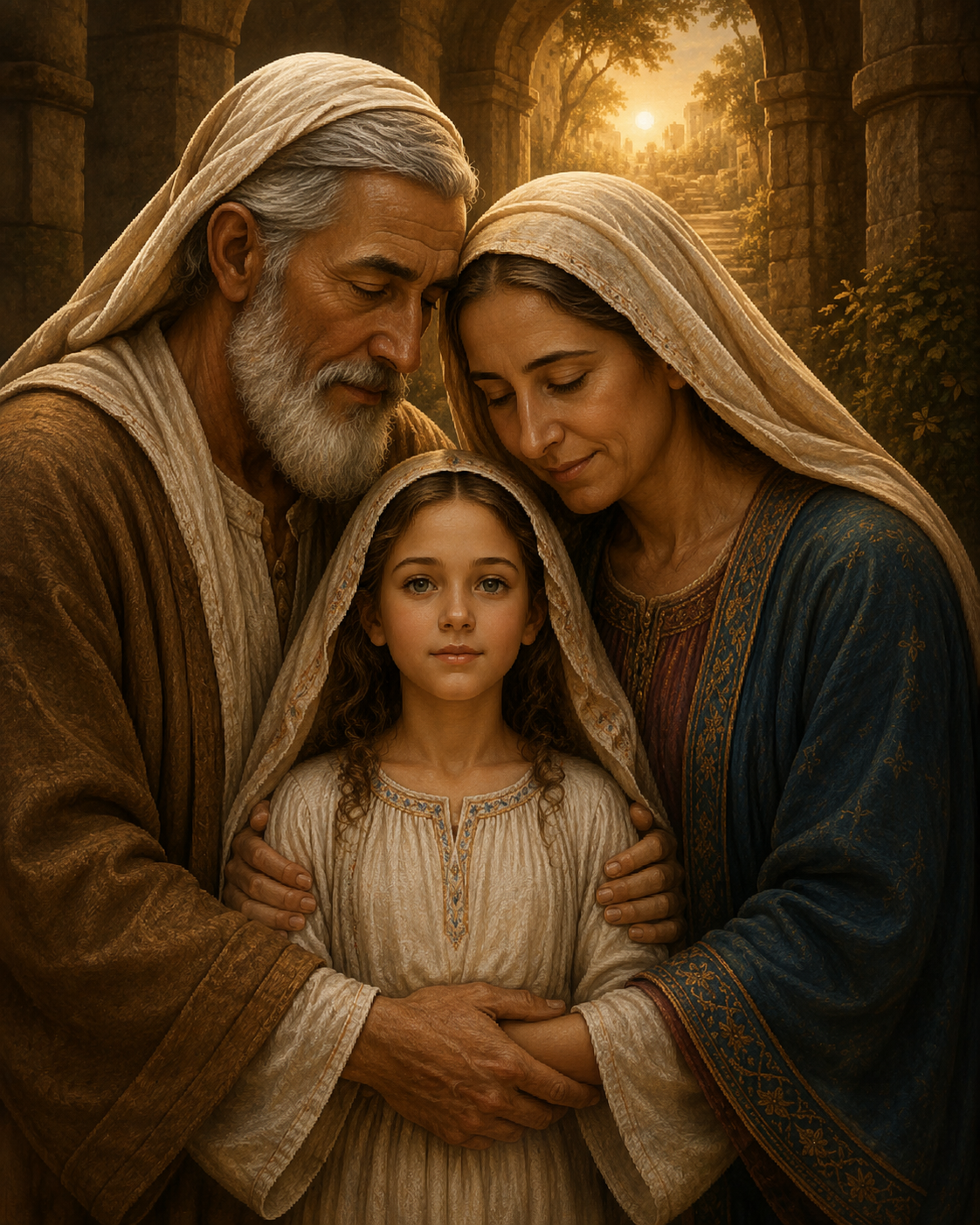
Before the Woman could give her "yes," she herself had to be born — and tradition remembers the aged, childless couple whose long-awaited daughter would become the Mother of God.
The four Gospels are silent about Mary's parents. Yet from the earliest Christian centuries the Church has honored them by name: Saint Joachim and Saint Anne (Hebrew Hannah, "grace") — the maternal grandparents of Jesus Christ. The Church celebrates them together on July 26 and invokes them as the patrons of grandparents; the feast of Saints Joachim and Anne has stood in the Roman calendar since the sixteenth century, giving liturgical weight to the tradition without requiring historical certainty about apocryphal details. They are mentioned by name not in Scripture but in an early second-century writing.
The story handed down
According to the Protoevangelium, Joachim and Anne were a devout and well-to-do couple of the line of David who had grown old together without ever having a child. In their culture, barrenness was felt as a reproach; the account tells of Joachim being turned away when he came to offer sacrifice, because he had fathered no offspring in Israel. Grief-stricken, he withdrew into the wilderness to fast and pray, while Anne, in her own sorrow, vowed that if God granted her a child, she would dedicate that child wholly to His service.
An angel appeared to each of them with the promise that Anne would conceive. Their joyful reunion — known in Christian art as the Meeting at the Golden Gate — became one of the most beloved scenes in the medieval Life of the Virgin. In due time Anne bore a daughter and named her Mary.
The pattern of the barren mother
This is the detail you may already have noticed echoing through all of salvation history. The aged or barren mother who conceives by God's gift is one of Scripture's great recurring patterns — and it always signals a child of destiny:
The parallel with Hannah is especially striking and surely deliberate in the tradition: like Hannah, Anne is barren; like Hannah, she vows her long-awaited child to God's service; and like the boy Samuel — brought to the sanctuary at Shiloh and raised there (1 Samuel 1:24–28) — the child Mary is offered to the Temple. Anne even shares Hannah's very name. Where these earlier mothers brought forth prophets and patriarchs, the last of them brings forth the one who would bear the Savior. The pattern reaches its summit in Mary, and then is surpassed entirely: for after her, the truly impossible birth is not that of an old woman, but of a virgin.
The Presentation of Mary in the Temple
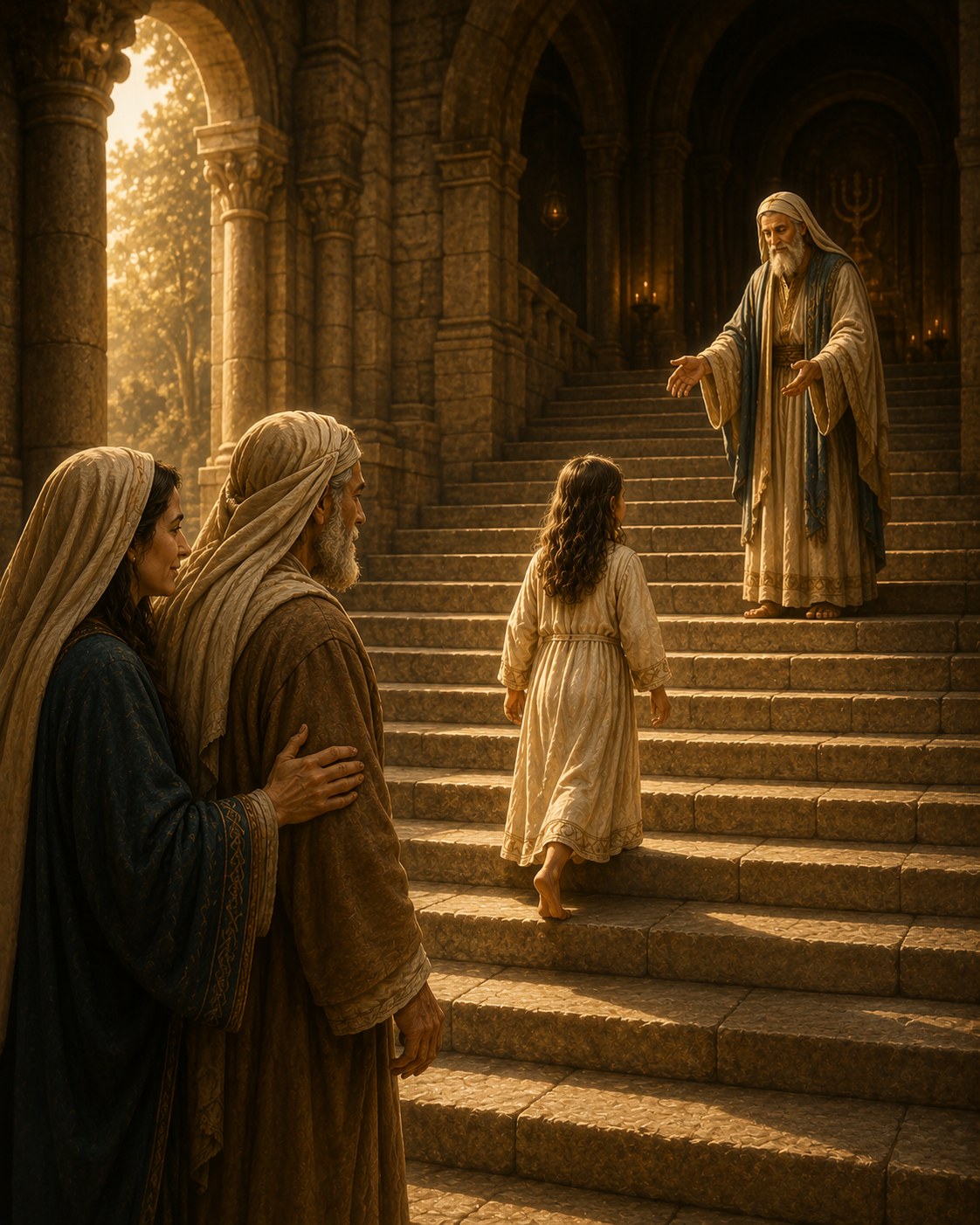
In fulfillment of Anne's vow, the tradition continues, Joachim and Anne brought Mary — at the age of three — to the Temple in Jerusalem, where she was consecrated to God and (in the telling) was raised among the Temple's holy women. This event is commemorated in the liturgical feast of the Presentation of the Blessed Virgin Mary, kept on November 21.
"And the child was three years old… they went up into the temple of the Lord. And the priest received her, and blessed her, saying: The Lord has magnified thy name in all generations." Protoevangelium of James 7 (Roberts–Donaldson trans.) — an apocryphal source, not Scripture
This feast is far older and grander in the Christian East, where as "The Entry of the Most Holy Theotokos into the Temple" it ranks among the Twelve Great Feasts of the Byzantine year; in the Roman calendar it is kept as an obligatory memorial. Its historical roots are tied to the dedication of a church of Mary near the Temple Mount in Jerusalem (c. A.D. 543). The Church is candid that the feast rests on tradition rather than Scripture — its spiritual meaning is what endures: that Mary belonged wholly to God from the very beginning of her life, the living Temple being prepared within the stone one. She who would one day be the New Ark was first brought to dwell beside the old.
Saints and grandparents
Devotion to Joachim and Anne is, as the Church teaches, simply an extension of love for Mary — and through her, for Jesus. As Pope Francis observed, it was "in the home of Joachim and Anne" that Mary "learned to listen to the Lord," within "a long chain of people who had transmitted their faith and love for God… down to Mary, who received the Son of God in her womb." St. Anne is among the most venerated saints in the world (her great shrine at Sainte-Anne-de-Beaupré in Canada draws pilgrims from across the globe), and the two together remind us that the Incarnate God chose to enter not only a mother's womb but a real human family — with grandparents who loved Him.
How Typology Works
Common Theological Teaching — Scripture read in the unity of God's plan.
"The New Testament lies hidden in the Old, and the Old is made manifest in the New." — St. Augustine
A type is a real person, object, or event in the Old Testament that foreshadows and prepares for a greater reality — the antitype — in the New. St. Paul himself uses this method when he calls Adam "a type of the one who was to come" (Romans 5:14). Typology is not allegory or invention; it is the recognition that the same God who authored history wrote His plan of salvation into its very pattern.
The Marian types are among the richest in Scripture. The Church and the Fathers consistently read the Blessed Mother through three great Old Testament patterns, each of which we will examine in turn:
Augustine's principle — that "the Old Testament is the New concealed, and the New Testament is the Old revealed" (Questions on the Heptateuch 2:73) — is the master key. What follows is not later pious invention but a reading rooted in the second-century Fathers and confirmed by the Church's magisterium.
Christ the New Adam — and the New Moses
The Marian types rest upon the Christological ones. Jesus is the New Adam (Romans 5; 1 Corinthians 15:45–47) who undoes the first Adam's fall — which is precisely why Mary is the New Eve. But He is also the New Moses, leading a new Exodus out of the slavery of sin, and the Gospels draw the parallel deliberately:
This matters for Mary because the New Moses inaugurates a new Tabernacle and a new Ark — and that new Ark, as we will see, is Mary herself, who carried the true Manna, the Word written not on stone but in flesh, and the great High Priest.
Mary, the New Eve
Common Theological Teaching — received by the Fathers and Vatican II.
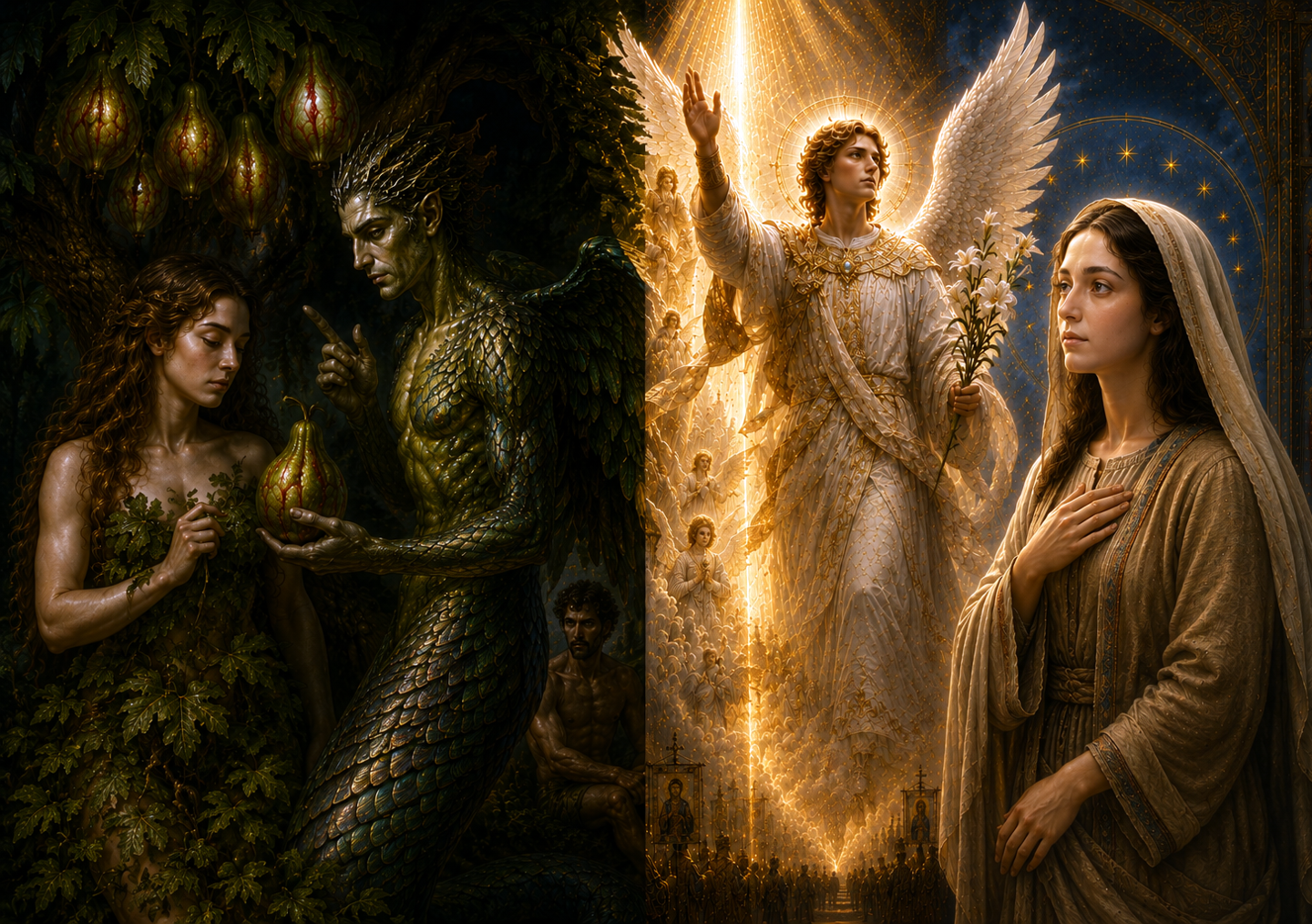
As death came through a virgin's disobedience, so life came through a Virgin's obedience. This was the earliest Marian teaching of the Church Fathers.
The parallel between Eve and Mary is the oldest developed Marian doctrine we possess. It appears already around A.D. 155 in St. Justin Martyr's Dialogue with Trypho 100, and is expanded around A.D. 180 by St. Irenaeus of Lyons in Against Heresies III.22.4. Irenaeus had been taught by St. Polycarp, who was himself a disciple of the Apostle John — placing this teaching within living memory of the apostolic age.
Just as Jesus is the New Adam (1 Corinthians 15:45; Romans 5) who undoes the sin of the first Adam, Mary is the New Eve who reverses the disobedience of the first Eve. Irenaeus framed it with unforgettable precision:
And thus also it was that the knot of Eve's disobedience was loosed by the obedience of Mary. For what the virgin Eve had bound fast through unbelief, this did the virgin Mary set free through faith. St. Irenaeus of Lyons — Against Heresies III.22.4 (c. A.D. 180), Ante-Nicene Fathers translation
The contrast is sharply drawn at every point: a virgin in each case; one bound by unbelief, the other loosed by faith; one a cause of death, the other a "cause of salvation" for herself and the whole human race (Irenaeus's own phrase). St. John Henry Newman regarded this Eve–Mary teaching as the very first sustained meditation on Mary handed down by the Fathers.
The greeting: kecharitomene
Before any of this, there is the angel's first word to her. Gabriel does not begin by using her name. He addresses her by a title:
"And coming to her, he said, 'Hail, favored one! The Lord is with you.'" Luke 1:28 (NABRE)
The title is, in Greek, kecharitomene, from charitoo, "to grace" or "to favor." The grammar carries the weight. Kecharitomene is a perfect passive participle: it describes a completed action whose effect is a settled, present state. It is not "you are receiving grace" or "you will be graced," but something closer to you who have been, and therefore now stand, graced. And it is used in place of her name, which in Semitic usage names what someone fundamentally is.
The verb charitoo occurs only twice in the New Testament — here of Mary before Christ's redemptive work, and at Ephesians 1:6 of the grace God bestows on believers through Christ.
This typology is woven into Luke's account of the Annunciation. Where Eve listened to the fallen angel and doubted, Mary listens to the angel Gabriel and consents:
"Behold, I am the handmaid of the Lord. May it be done to me according to your word." Luke 1:38 (NABRE)
The Second Vatican Council made this patristic teaching its own. Lumen Gentium §56 quotes Irenaeus by name — "as St. Irenaeus says, she 'being obedient, became the cause of salvation for herself and for the whole human race'" — and adds that "not a few of the early Fathers gladly assert in their preaching, 'The knot of Eve's disobedience was untied by Mary's obedience; what the virgin Eve bound through her unbelief, the Virgin Mary loosened by her faith.'"
The witness of the early Fathers
St. Justin Martyr gives the Eve-Mary parallel in Dialogue with Trypho 100, and St. Irenaeus gives its classic form in Against Heresies III.22.4. Vatican II formally received the same typology in Lumen Gentium (1964), §56: the knot of Eve's disobedience was untied by Mary's obedience.
The "death through Eve, life through Mary" antithesis runs all through the early Church. Scripture itself frames the problem: "From a woman sin had its beginning, and because of her we all die" (Sirach 25:24) — and the Fathers answered it with the reversal worked through the new Woman:
A virgin expelled us from Paradise; through a Virgin we have found eternal life. St. John Chrysostom (4th century)
St. Ephrem the Syrian (4th century) sang of her freedom from every stain — "You alone and your Mother are more beautiful than all others; for there is no blemish in you, nor any stain upon your Mother" — and St. Ambrose called her "free from all stain of sin." These witnesses, centuries before the dogma was defined, already grasped that Mary was, with Christ, the great exception to the universal reign of sin.
Recapitulation — Christ "sums up" and reverses Adam
Underlying all of this is the doctrine St. Irenaeus called recapitulation (from the Greek anakephalaiōsis, "to sum up" — Ephesians 1:10). Christ "recapitulates" — gathers up and re-does — the whole history of fallen humanity, reversing at every point what Adam undid: where Adam disobeyed at a tree, Christ obeyed unto death on the tree; where the first Adam took his flesh from the earth, the New Adam took His flesh from the New Eve. As the Catechism teaches, "Christ's whole life is a mystery of recapitulation. All Jesus did, said, and suffered had for its aim restoring fallen man to his original vocation" (CCC §518). The reversal even preserves the order of the Fall: as the woman's "no" came before the man's in the ruin, so the Woman's "yes" had to come before the New Adam could bring salvation.
The Women Who Foreshadowed Mary
Common Theological Teaching — biblical figures illumine Mary typologically.
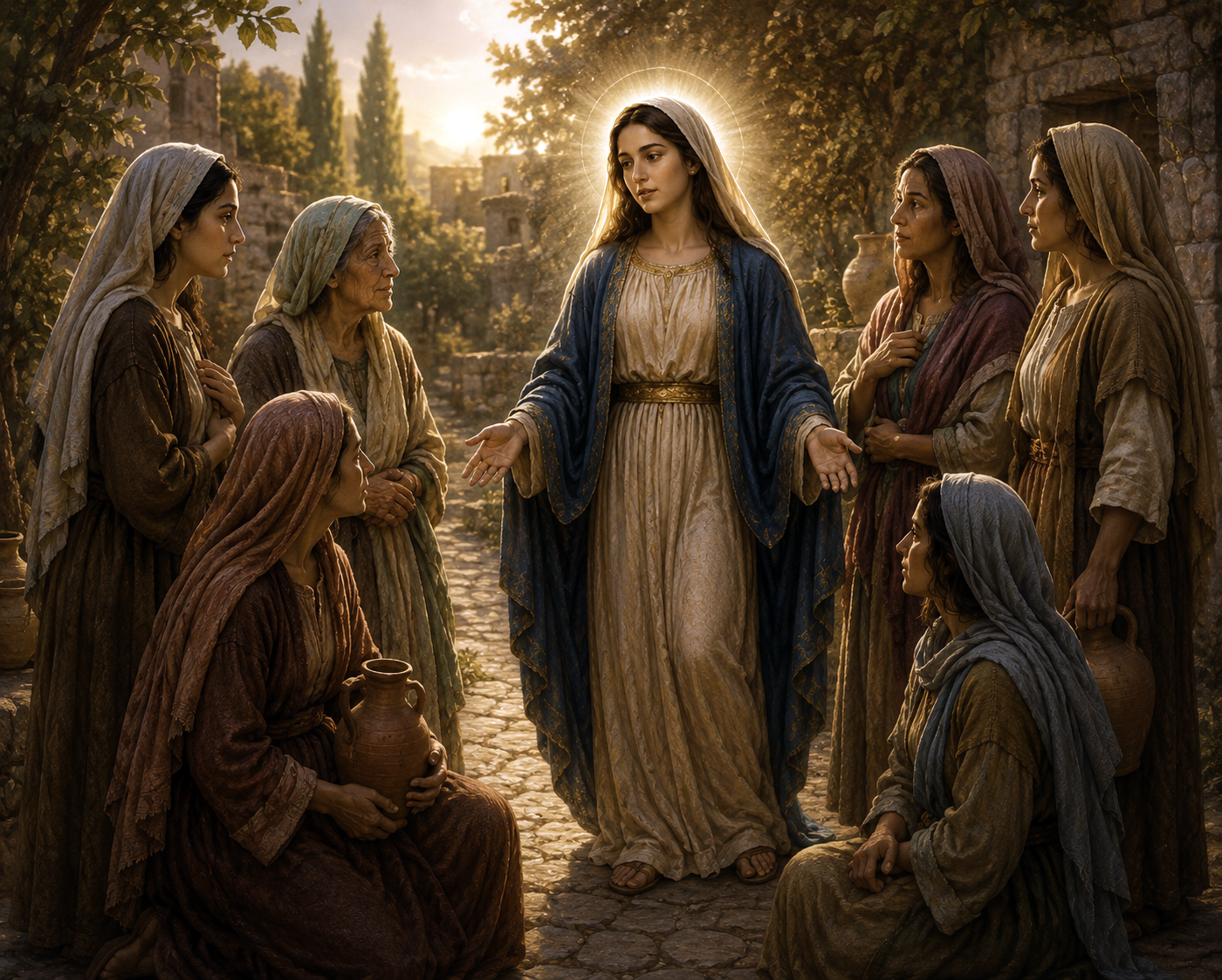
Throughout the Old Covenant, God raised up a succession of holy women — each one carrying forward a fragment of the role that would be fulfilled, completely, in the Mother of God.
The Eve–Mary parallel is the first and greatest of the female types, but it is not the only one. The Catechism teaches that "throughout the Old Covenant the mission of many holy women prepared for that of Mary" (CCC §489). God repeatedly "chose those who were considered powerless and weak to show forth his faithfulness to his promises." Each of these women anticipates some facet of Mary; gathered together, they form a portrait that only she completes.
Sarah — the miraculous mother and queen of nations
When God renewed His covenant with Abraham, He changed Sarai's name to Sarah — and the promise He attached to it was royal and maternal: "I will bless her… she shall give rise to nations, and rulers of peoples shall issue from her" (Genesis 17:15–16). Sarah is the first foreshadowing of Mary as the queen-mother of nations. And like Mary, she conceived against all natural possibility: Sarah long past the age of childbearing, Mary a virgin. The angelic annunciations even echo: "Sarah your wife shall bear you a son, and you shall call his name Isaac" (Genesis 17:19) beside "you will conceive… and you shall call his name Jesus" (Luke 1:31). The three mysterious visitors who announced Isaac's birth at the oak of Mamre (Genesis 18) have long been read as a glimpse of the Trinity whose power would overshadow Mary.
Deborah — the mother of Israel who leads in battle
Deborah, the prophetess and judge (Judges 4–5), prophesied that Israel's enemy would fall "by the hand of a woman" — fulfilled when Jael drove a tent peg through the temple of the enemy commander Sisera (Judges 4:21). Deborah called herself "a mother in Israel" (Judges 5:7), and in her song of victory she praised Jael as "most blessed of women" for crushing the head of God's enemy (Judges 5:24–26). The parallels to Mary are vivid: Deborah is mother of the old Israel, Mary of the new Israel, the Church; Deborah led Israel's army, Mary leads us in the spiritual battle; a woman crushed the enemy's head and was called blessed — as Mary, the Woman of Genesis 3:15, crushes the serpent's head and is called blessed by all generations.
Ruth — the faithful handmaid
Ruth, the Moabite widow, refused to abandon her mother-in-law Naomi: "Wherever you go I will go… your people shall be my people, and your God my God" (Ruth 1:16). Her words of total self-gift prefigure Mary's fiat. Ruth chose to be a humble servant; Mary called herself "the handmaid of the Lord." Ruth journeyed to Bethlehem to perform her act of loving service; Mary journeyed to Bethlehem to bear the Savior. The Lord blessed Ruth with Boaz as protector, as He gave Mary Joseph; and Ruth, a foreigner, became great-grandmother of King David and an ancestor of the Messiah — a sign that the Savior born of Mary came for all nations, not the Jews alone.
Judith — the woman who beheads the enemy
The widow Judith saved her besieged people by going alone into the enemy camp and beheading the Assyrian general Holofernes with his own sword, having prayed for God's help and been preserved from defilement (Judith 13). When she returned victorious, the people sang words the Church now applies to Mary: "Blessed are you, daughter, by the Most High God, above all the women on earth" (Judith 13:18) — strikingly close to Elizabeth's "Most blessed are you among women" (Luke 1:42). Judith conquered not by force of arms but by trusting in God alone when Israel had relied on its walls and soldiers. So Mary, the true Ark, leads God's people to victory over the true enemy; the woman who struck off the enemy's head prefigures the Woman who crushes the serpent's.
Esther — the queen who saves by intercession
Queen Esther risked her life by approaching the king unbidden — forbidden on pain of death — to intercede for her people and save them from Haman's genocide (Esther 4–7). She "relied on God alone" (cf. Esther C:12–30 in the NABRE; Esther 14:3–19 in the Vulgate and Douay-Rheims — the Greek additions). Esther is the clearest type of Mary as Queen and Intercessor: Esther alone was exempted from the rigor of the Persian law that condemned all others, as Mary alone was exempted from original sin; Esther saved her people by interceding with the king, as Mary intercedes with Christ the King; and Mordecai, her faithful guardian, prefigures Joseph, guardian of Mary and Jesus.
The Ark of the New Covenant
Common Theological Teaching — Ark typology is scriptural and patristic.
The Ark of old held the tokens of God's presence. Mary holds God Himself, made flesh in her womb.
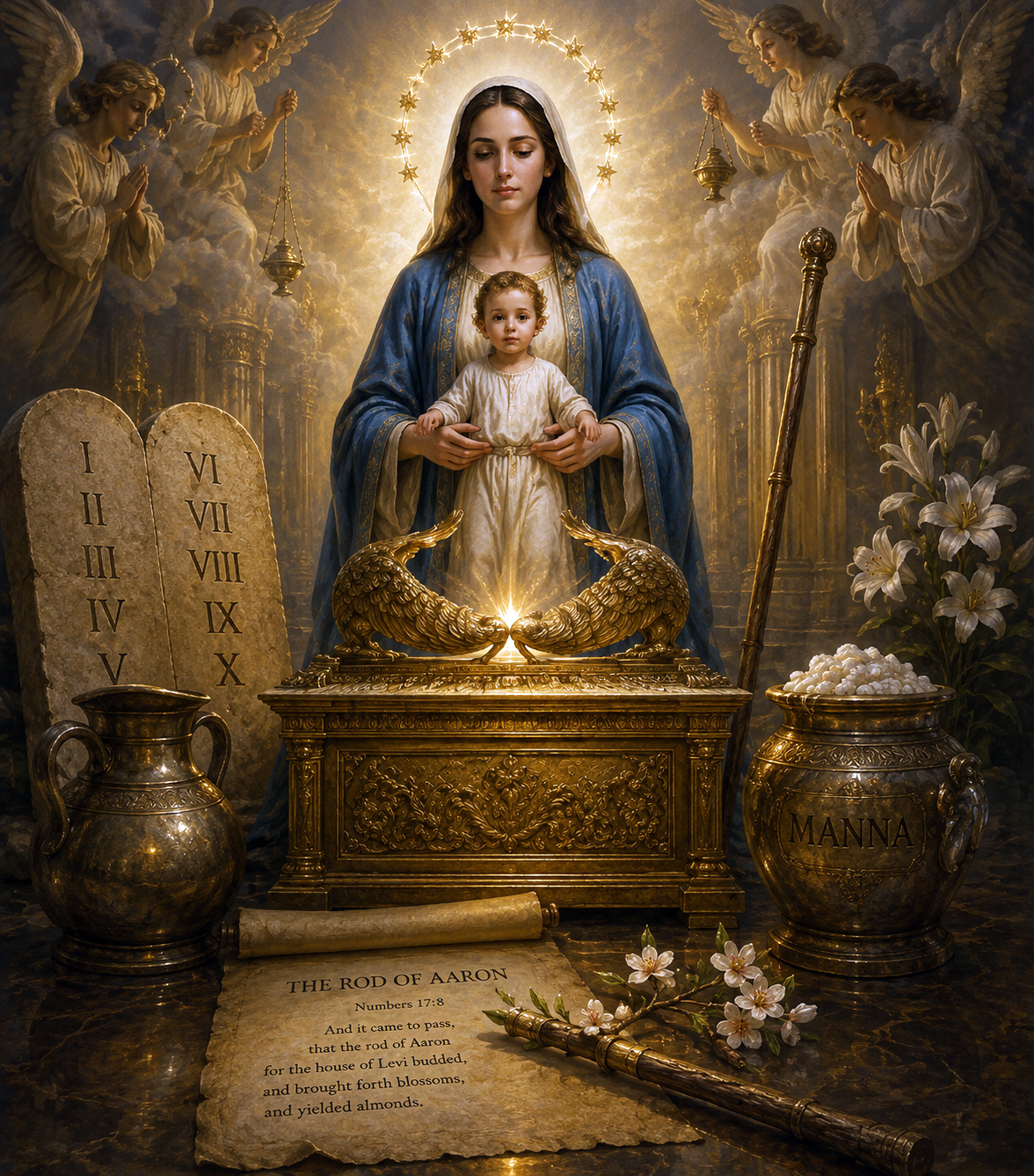
In the Old Covenant, the Ark of the Covenant was the holiest object in Israel — a chest of acacia wood overlaid entirely with pure gold, upon which the glory-cloud of God descended (Exodus 25; 40:34–35). Within it were placed three sacred things: the stone tablets of the Law, a golden jar of manna, and the priestly rod of Aaron (Hebrews 9:4).
The New Testament scholar Brant Pitre, in Jesus and the Jewish Roots of Mary, shows how St. Luke deliberately presents Mary as the living Ark. The key is the word "overshadow." At the Annunciation, Gabriel tells Mary that "the power of the Most High will overshadow you" (Luke 1:35) — using the very Greek verb (episkiazō) that the Greek Old Testament uses for the glory-cloud overshadowing the Ark and the Tabernacle (Exodus 40:35).
Luke's deliberate parallels
Elizabeth's cry — "And how does this happen to me, that the mother of my Lord should come to me?" (Luke 1:43) — echoes David's awe before the Ark: "How can the ark of the Lord come to me?" (2 Samuel 6:9). The Fathers saw the same. A fragment traditionally attributed to St. Hippolytus of Rome (c. A.D. 200), though its authenticity is disputed, together with St. Athanasius, hails Mary as the Ark "in which is found the golden vessel containing the true manna."
The power of the Ark — and what it tells us about Mary
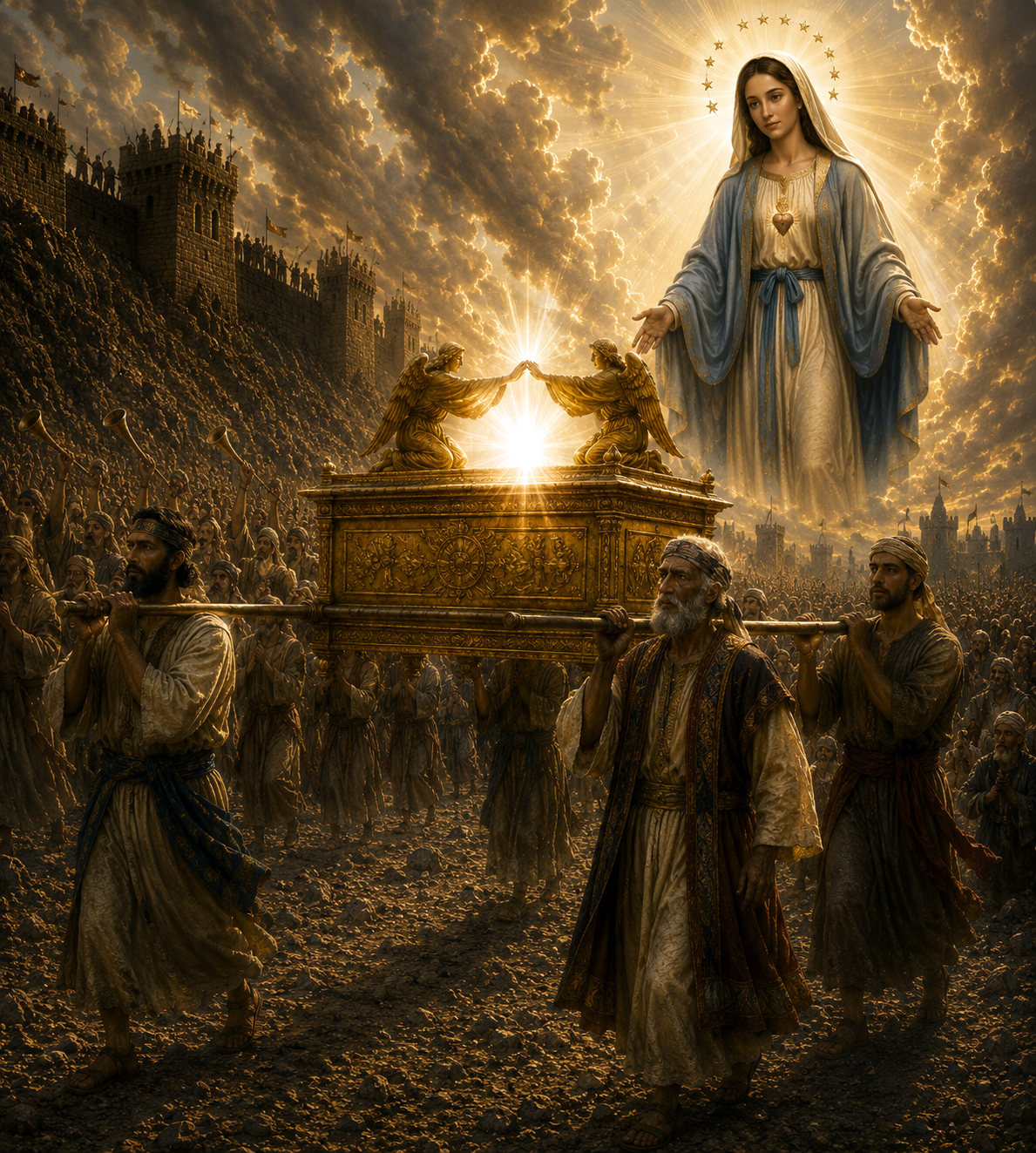
The typology carries a further meaning that is often overlooked: the Ark of the Old Covenant was not merely holy — it was mighty. Because it bore the presence of God, the Ark went before Israel as a power against which no enemy could stand:
- When the priests carried the Ark into the Jordan River, the waters parted and Israel crossed on dry ground (Joshua 3:14–17).
- At Jericho, Israel did not storm the city; they carried the Ark in procession around its walls for seven days, and on the seventh "the wall fell down flat" (Joshua 6:4–20; cf. Hebrews 11:30). The fortress fell before the presence of God.
- When the Philistines captured the Ark and set it in the temple of their god Dagon, they found the idol toppled and shattered before it the next morning, and the cities that held it were struck with plague until they sent it back in fear (1 Samuel 5:1–12).
If the Ark that held only shadows of God's presence — tablets, manna, a rod — carried such power that walls collapsed and false gods fell before it, how much greater is the New Ark who carried God Himself. This is the scriptural root of the Church's confidence in Mary's intercession and her power against the forces of evil. She is not divine, and her power is entirely derivative — it is the presence of her Son that makes her mighty, just as it was the presence of God that made the wooden Ark mighty. Yet through that presence, tradition holds, she is established by God over all creatures, the woman whose offspring crushes the serpent (Genesis 3:15), the Queen before whom hell itself trembles. The Fathers and saints draw out exactly this: as the demons confessed through St. Dominic, no creature is feared by hell more than the Mother of God (see "The Reservoir of All Graces" below).
This typology reaches its climax in the Book of Revelation, where — because there was no chapter break in the original Greek — the appearance of the heavenly Ark flows seamlessly into the vision of the Woman:
"Then God's temple in heaven was opened, and the ark of his covenant could be seen in the temple… A great sign appeared in the sky, a woman clothed with the sun." Revelation 11:19 – 12:1 (NABRE)
This identification of Mary as the heavenly Ark is ancient: the ninth-century theologian Paschasius Radbertus wrote that the Ark seen in the heavenly temple "was not the Ark made by Moses, but is the Blessed Virgin." It also undergirds the dogma of her Assumption — for if Mary is the New Ark, she belongs in the heavenly sanctuary, body and soul.
The Visitation & the Leaping of John
Common Theological Teaching — biblical exegesis and typology.
When the voice of the Virgin reached Elizabeth, the Holy Spirit fell upon both mother and unborn child — and the forerunner, still in the womb, was the first to greet his Lord.
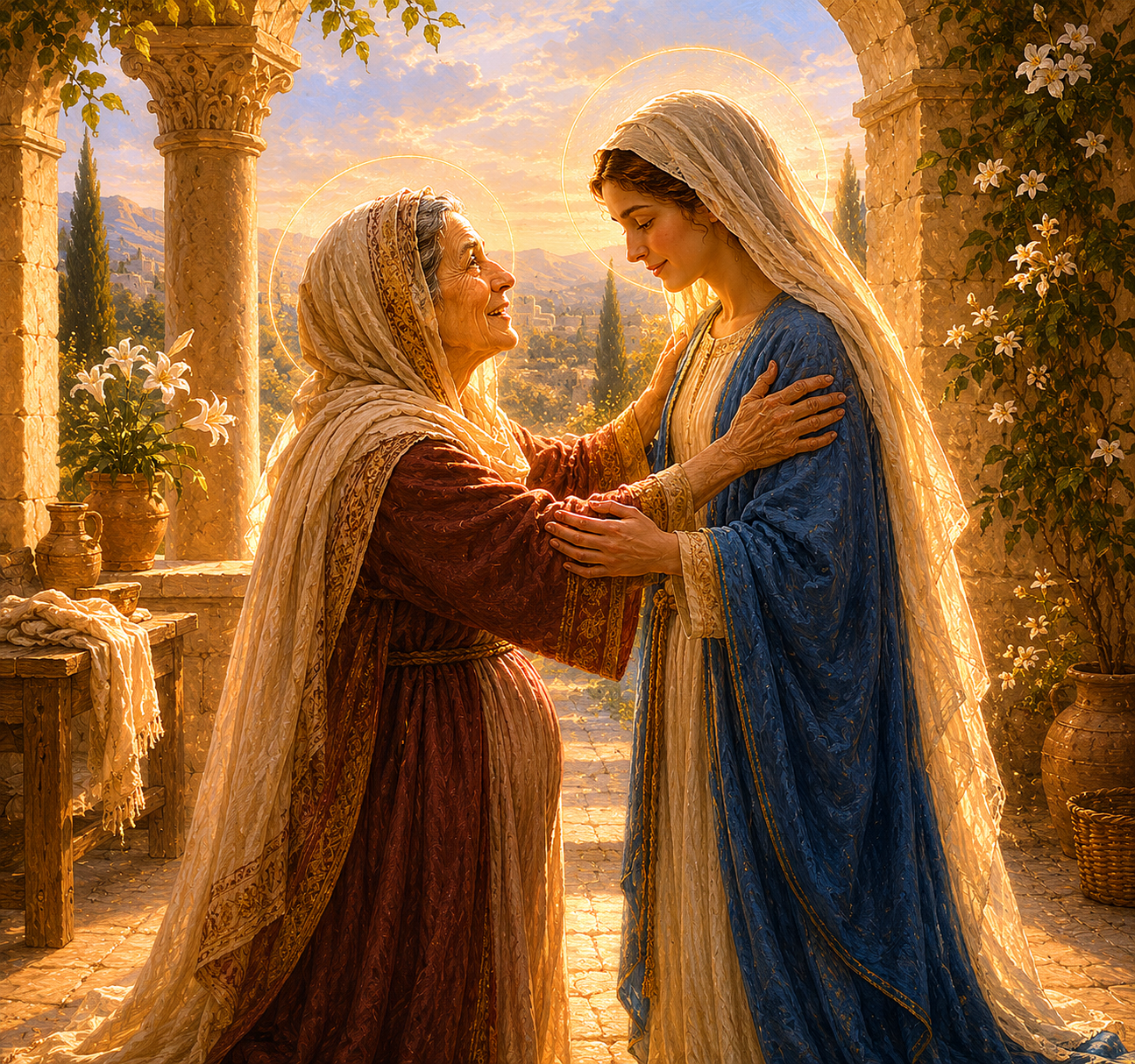
No sooner had Mary conceived than she "set out and traveled to the hill country in haste" (Luke 1:39) to visit her kinswoman Elizabeth, who was six months pregnant with John. What unfolds at that meeting — the Visitation — is one of the most theologically dense scenes in the Gospels, and the living climax of the Ark typology we have just traced.
"When Elizabeth heard Mary's greeting, the infant leaped in her womb, and Elizabeth, filled with the Holy Spirit, cried out in a loud voice and said, 'Most blessed are you among women, and blessed is the fruit of your womb… For at the moment the sound of your greeting reached my ears, the infant in my womb leaped for joy.'" Luke 1:41–44 (NABRE)
The Holy Spirit poured out
Notice the order of events. It is Mary's voice — carrying the unseen Christ within her — that becomes the occasion of grace. At that sound, two things happen at once: the child leaps, and Elizabeth "was filled with the Holy Spirit." Filled with the Spirit, Elizabeth then prophesies, speaking the words the Church has prayed ever since in the Hail Mary: "Blessed are you among women, and blessed is the fruit of your womb."
So the Holy Spirit descends upon Elizabeth at Mary's greeting, prompting her inspired proclamation. And the Spirit's work reaches her unborn son as well — which brings us to the most striking traditional teaching of this scene.
The sanctification of John in the womb
The constant tradition of the Church, taught by St. Thomas Aquinas and many Fathers, holds that John the Baptist was sanctified — cleansed of original sin — while still in his mother's womb, at the very moment Mary's voice reached Elizabeth. This is why he "leaped for joy": not a mere physical stir, but the response of a soul touched by grace, recognizing the presence of his Lord. The angel had foretold to Zechariah that John would be "filled with the Holy Spirit even from his mother's womb" (Luke 1:15) — and here that promise is fulfilled.
This special grace is the reason the Church celebrates John's birthday (June 24) — one of only three nativities in the entire liturgical calendar, alongside Jesus (December 25) and Mary (September 8). The Church marks the births of these three precisely because tradition holds each came into the world already sanctified. The prophet Jeremiah received a like promise — "Before you were born I dedicated you" (Jeremiah 1:5) — and the Fathers saw John as its fullest realization, the last and greatest of the prophets, set apart from the womb to prepare the way.
Why John leaped — David and the Ark
The Gospel writer chooses his words with care. The verb for John's "leaping" deliberately recalls King David, who "leaped and danced" before the Ark of the Covenant as it was carried up to Jerusalem (2 Samuel 6:14–16). As David exulted before the Ark bearing God's presence, so John — the new David's herald — exults before Mary, the New Ark bearing God in the flesh. The unborn prophet does in the womb what David did before the sanctuary: he worships. Every detail of the Visitation reinforces it:
The scene then overflows into Mary's own great prophetic hymn, the Magnificat (Luke 1:46–55) — explored in the next section.
The Magnificat
Defined Dogma and Scriptural Witness — Mary confesses God her Savior.
Mary's own words — the longest passage she speaks in all of Scripture — are a prophecy, a hymn of revolution, and the fulfillment of the song of another long-awaited mother a thousand years before.
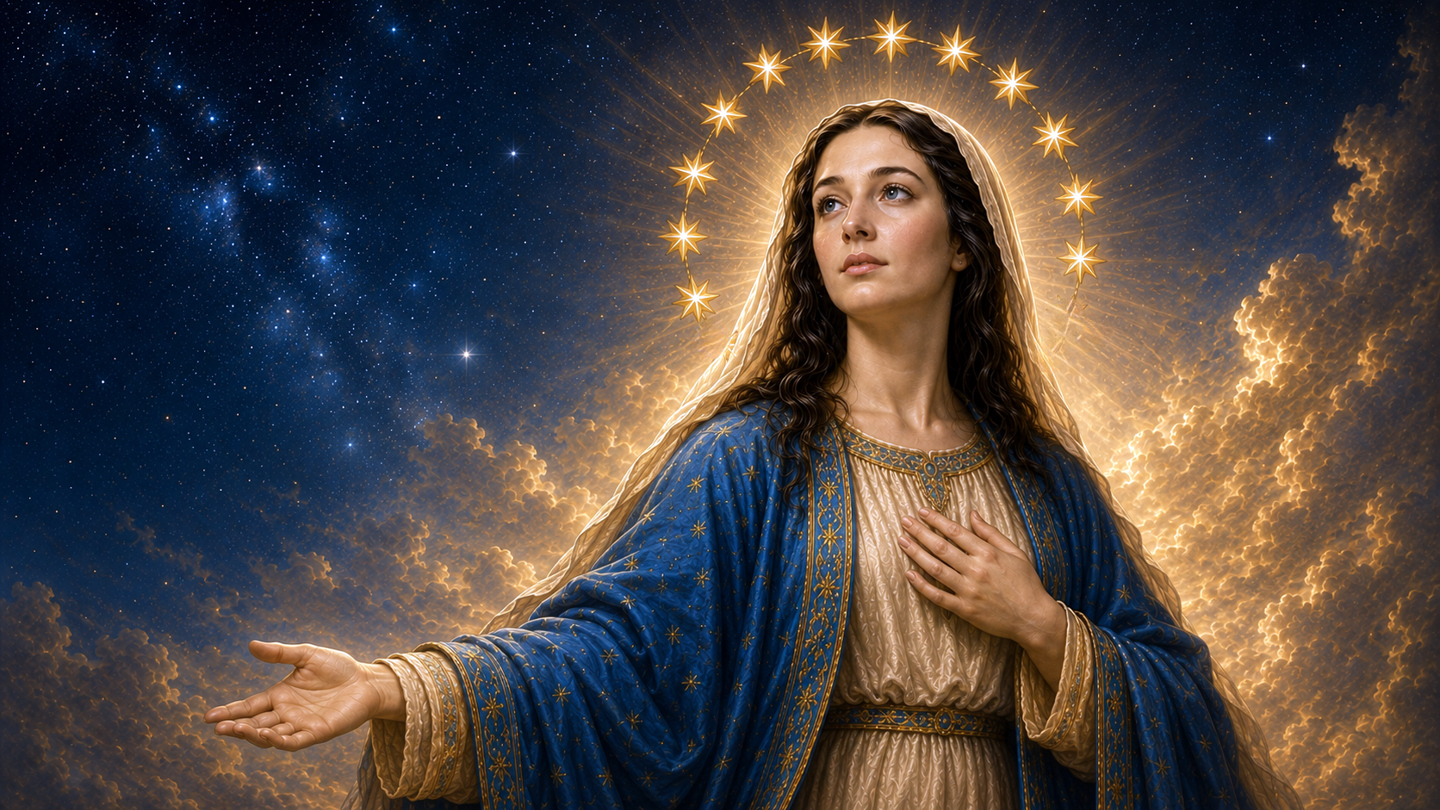
In response to Elizabeth's Spirit-filled greeting, Mary pours out the canticle the Church has sung every evening for sixteen centuries. Named from its first Latin word — Magnificat, "magnifies" — it is the first and greatest of the New Testament hymns, and the only extended speech the Gospels record from Our Lady's own lips:
"My soul proclaims the greatness of the Lord; my spirit rejoices in God my Savior, for he has looked upon his lowly servant. From this day all generations will call me blessed: the Almighty has done great things for me, and holy is his Name. He has mercy on those who fear him in every generation. He has shown the strength of his arm, he has scattered the proud in their conceit. He has cast down the mighty from their thrones, and has lifted up the lowly. He has filled the hungry with good things, and the rich he has sent away empty." Luke 1:46–53 (NABRE)
"My spirit rejoices in God my Savior"
The Magnificat's second line is one of the great keys to understanding Mary. She calls God her "Savior" (Luke 1:47) — and in doing so she herself testifies that she, too, was redeemed by Christ. As the Church teaches, Mary's preservation from sin was the most perfect form of salvation: she was saved not by being cleansed of sin but by being preserved from it, "in view of the merits of Jesus Christ." Far from contradicting the Immaculate Conception, this line confirms it: the sinless one is the most perfectly redeemed of all, and she knows it, ascribing everything to God's grace ("the Almighty has done great things for me").
The first of "all generations"
"From this day all generations will call me blessed" (Luke 1:48) is itself a prophecy — and one being fulfilled in this very document and in every Hail Mary prayed across the world. Elizabeth, moments earlier, was the first to call her blessed; the honor the Church gives Mary is not invented but commanded by Scripture, spoken by Mary under the inspiration of the Holy Spirit.
The song of the great reversal
The heart of the Magnificat is God's overturning of the world's order: He scatters the proud, casts down the mighty, lifts up the lowly, fills the hungry, and sends the rich away empty. It is the spirituality of the anawim — the faithful poor of Israel who place all their hope in God. Mary, the lowly handmaid exalted to be Mother of God, is herself the supreme instance of the reversal she sings. This is why the song has resonated through history as a hymn of hope for the oppressed.
The echo of Hannah — and the chain of mothers
The Magnificat is woven through with the Old Testament, but its closest model is unmistakable: the Song of Hannah (1 Samuel 2:1–10), sung by the once-barren mother of the prophet Samuel after she dedicated him to God. The parallel is the deliberate climax of the chain of mothers we have already traced (Sarah, Hannah, Elizabeth, Mary), and ties directly back to the account of Mary's own parents:
Both songs are sung by mothers whose sons were gifts of God's grace; both dedicated those sons to God; both proclaim the God who reverses human fortunes. Where Hannah's son Samuel was the prophet who would anoint Israel's first kings, Mary's Son is the King of Kings Himself. Hannah's song was the seed; the Magnificat is the flower. The whole arc of the Old Covenant's faithful women finds its voice, at last, in the Mother of God.
The Wedding at Cana
Common Theological Teaching — biblical exegesis; the pattern of Marian intercession.
She notices a need no one has brought to her, carries it to her Son, tells Him nothing about what to do, and turns every eye toward Him. The whole of Marian intercession is in six verses.
Early in John's Gospel, before any public miracle, Jesus and His mother are guests at a village wedding. What happens there is the first of the "signs" by which John structures his whole account — and it happens because Mary asks.
"On the third day there was a wedding in Cana in Galilee, and the mother of Jesus was there. Jesus and his disciples were also invited to the wedding. When the wine ran short, the mother of Jesus said to him, 'They have no wine.' [And] Jesus said to her, 'Woman, how does your concern affect me? My hour has not yet come.' His mother said to the servers, 'Do whatever he tells you.'" John 2:1–5 (NABRE)
The shape of her intercession
Read the sequence slowly, because it answers more objections than any argument about it can.
No one asks her. The couple do not petition Mary; the stewards do not appeal to her. She notices. The first movement of Marian intercession in Scripture is her own attention to a need that has not been announced.
She does not tell Him what to do. "They have no wine" is four words of description and no instruction. She states the need and leaves the manner, the timing, and the decision entirely to Him.
She directs everyone away from herself. Her last recorded words in all of Scripture are an order to obey her Son: Do whatever he tells you. She does not say "watch what I can obtain." She points at Christ and steps out of the frame.
And He acts. Whatever John 2:4 means — and it is the hardest verse here — the water becomes wine.
The Second Vatican Council reads the scene in exactly these terms, and makes it the pattern of Mary's place in the public ministry:
In the public life of Jesus, Mary makes significant appearances. This is so even at the very beginning, when at the marriage feast of Cana, moved with pity, she brought about by her intercession the beginning of miracles of Jesus the Messiah. Second Vatican Council — Lumen Gentium §58 (November 21, 1964)
"Woman, how does your concern affect me?"
This is the verse a skeptical reader will raise, and it should be met directly rather than deferred.
The Greek is ti emoi kai soi, gynai — literally "what to me and to you, woman." It is a Semitic idiom found in the Old Testament, and its force varies with context: it can mark sharp distance, or simply signal that the speaker's concerns and the hearer's are not the same. It is not, in itself, a rebuke.
Three things settle the reading:
- He does what she asks. Whatever distance the phrase marks, the next thing that happens is the miracle. A refusal that is immediately followed by compliance is not a refusal.
- "Woman" is a title, not a coldness. Jesus addresses her the same way from the Cross (John 19:26), at the other moment when her maternal role is most public. The word reaches back to the Woman of Genesis 3:15 and forward to the Woman clothed with the sun.
- "My hour has not yet come" is John's own vocabulary for the Passion. The "hour" runs through the Gospel and arrives at Calvary. Cana and the Cross are tied together by it — the two scenes where Mary appears in John, and in both she is called Woman.
The beginning of the signs
"Jesus did this as the beginning of his signs in Cana in Galilee and so revealed his glory, and his disciples began to believe in him." John 2:11 (NABRE)
John does not say this was merely the first miracle in sequence. He calls it the beginning of the signs — the opening of the public ministry, the first revelation of glory, and the occasion of the disciples' first belief. And it begins at his mother's prompting.
There is a further detail John is careful to record: the water was in "six stone water jars there for Jewish ceremonial washings" (John 2:6). The vessels of the old purification are filled to the brim and their contents become the good wine kept until now. The sign is about the passing of one covenant into another, and it is set in motion by a woman's request.
Virgin Before, During & After
Defined Dogma — required belief for all Catholics.
The Church does not teach merely that Mary was a virgin when she conceived. She confesses Mary Aeiparthenos — Ever-Virgin — before, in, and after the birth of her Son.
The perpetual virginity of Mary is one of the four Marian dogmas — a truth the Catholic Church holds to be divinely revealed. It has three parts, expressed in the ancient Latin formula virgo ante partum, in partu, et post partum: virgin before the birth, during the birth, and after the birth. The reality of Mary's perpetual virginity is attested from the second century (e.g., the Protoevangelium of James); the Greek title Aeiparthenos ("Ever-Virgin") is securely documented from the fourth century onward, the Second Council of Constantinople (A.D. 553) used it, and the Lateran Synod of 649 under Pope Martin I defined all three moments together (CCC §499-501; Lumen Gentium §57 leaves the precise theological explanation of in partu virginity open).
Virgin before the birth
The virginal conception is the most plainly scriptural of the three — Matthew and Luke leave no doubt. Mary asks the angel, "How can this be, since I have no relations with a man?" (Luke 1:34), and is told the child will be conceived by the Holy Spirit (Luke 1:35; Matthew 1:18, 20). This is the Isaiah 7:14 sign fulfilled: "the virgin shall conceive."
Virgin during the birth (in partu)
The Church also confesses that Mary's virginity was preserved in the very act of giving birth. The Lateran Synod of 649 under Pope Martin I declared that she "gave birth to Him without injury, her virginity remaining equally inviolate after the birth"; Lumen Gentium §57 teaches that the birth of Christ "did not diminish His mother's virginal integrity but sanctified it," and the Catechism (§499) affirms her "real and perpetual virginity even in the act of giving birth."
Virgin after the birth (post partum) — and the "brothers of Jesus"
The Church confesses that Mary remained a virgin for her whole life, never bearing other children. The chief objection is the mention of the "brothers" (and "sisters") of Jesus (Mark 6:3; Matthew 13:55). The answer turns first on language.
The word does not mean what modern English assumes
The Gospels were written in Greek, but Jesus and His circle spoke Aramaic, and the Old Testament background is Hebrew. Crucially, neither Hebrew nor Aramaic possessed a distinct word for "cousin." A cousin or more distant relative was simply called a "brother" — Hebrew 'ach — or described by a circumlocution like "son of my uncle." When this Semitic usage was carried into Greek, the translators of the Septuagint and the Gospel writers rendered it with the ordinary word adelphos ("brother"), even where a true sibling was not meant. Scripture itself does this openly: Lot is called Abraham's "brother" (Genesis 13:8; 14:14) though he was actually his nephew; Laban calls Jacob his "brother" though Jacob was his nephew (Genesis 29:15).
So the presence of the word "brother" in the Gospel text simply does not settle whether a blood sibling is meant — the term was used far more broadly. Context must decide, and the wider context points away from siblings.
Scripture quietly identifies the "brothers" as others' sons
Two of the men named as Jesus' "brothers," James and Joseph (Mark 6:3), are elsewhere named as the sons of another Mary — "Mary the mother of James and Joseph" — who stood at the cross distinct from Jesus' own mother (Matthew 27:56; Mark 15:40; cf. Catechism §500). Nowhere does Scripture ever call anyone besides Jesus "the son of Mary" his mother.
The decisive sign: Christ entrusts His mother to John
The strongest argument is the scene at Calvary. From the cross, Jesus gives His mother into the care of the apostle John:
"When Jesus saw his mother and the disciple there whom he loved, he said to his mother, 'Woman, behold, your son.' Then he said to the disciple, 'Behold, your mother.' And from that hour the disciple took her into his home." John 19:26–27 (NABRE)
In first-century Jewish society this is unthinkable if Mary had other sons. The care of a widowed mother fell, by sacred duty, to her surviving children — and to hand her instead to an outsider would have been a grave dishonor to living brothers, a public shame upon the family. As St. Jerome argued against Helvidius in the fourth century, Christ would never have entrusted Mary to John had she borne other sons to provide for her. That He did so is powerful evidence that Jesus was her only child. St. Jerome's classic defense, Against Helvidius (A.D. 383), remains the foundational treatment (full text at New Advent).
This is why the doctrine was held with such constancy — by the Fathers (Athanasius, Ambrose, Augustine, Jerome) and, remarkably, by the Protestant reformers themselves: Martin Luther and Huldrych Zwingli both affirmed Mary's perpetual virginity, Luther calling her "Ever-Virgin" throughout his life, while John Calvin rejected the argument that the "brothers" of Jesus were other sons of Mary (survey of patristic witnesses).
The "exclusive" pattern — and Ezekiel's closed gate
There is a fitting pattern in the Gospels by which what is most sacred to Christ is reserved for Him alone. He entered Jerusalem on a colt "on which no one has ever sat" (Luke 19:30), and He was laid in a tomb "in which no one had yet been buried" (John 19:41). In the same way, He was carried in a womb that had known no man and would bear no other child — a vessel set apart for the Messiah alone.
The Fathers heard this foreshadowed in the prophet Ezekiel's vision of the temple's eastern gate:
"This gate is to remain closed; it is not to be opened for anyone to enter by it; since the Lord, the God of Israel, has entered by it, it shall remain closed." Ezekiel 44:2 (NABRE)
In the literal sense the prophet speaks of the gate leading to the temple sanctuary. But the tradition saw in it a type of Mary: the gate through which the Lord God of Israel entered the world, and which therefore "remains shut" — a beautiful image of her virginity, reserved wholly for the One who passed through it. (Jerusalem's actual Golden Gate has, by a striking providence, stood sealed for centuries.)
The Queen Mother of the Kingdom
Common Theological Teaching — Mary's Queenship is taught by the Magisterium.
In the kingdom of David, the queen was never the king's wife — she was his mother. She reigned, and she interceded.
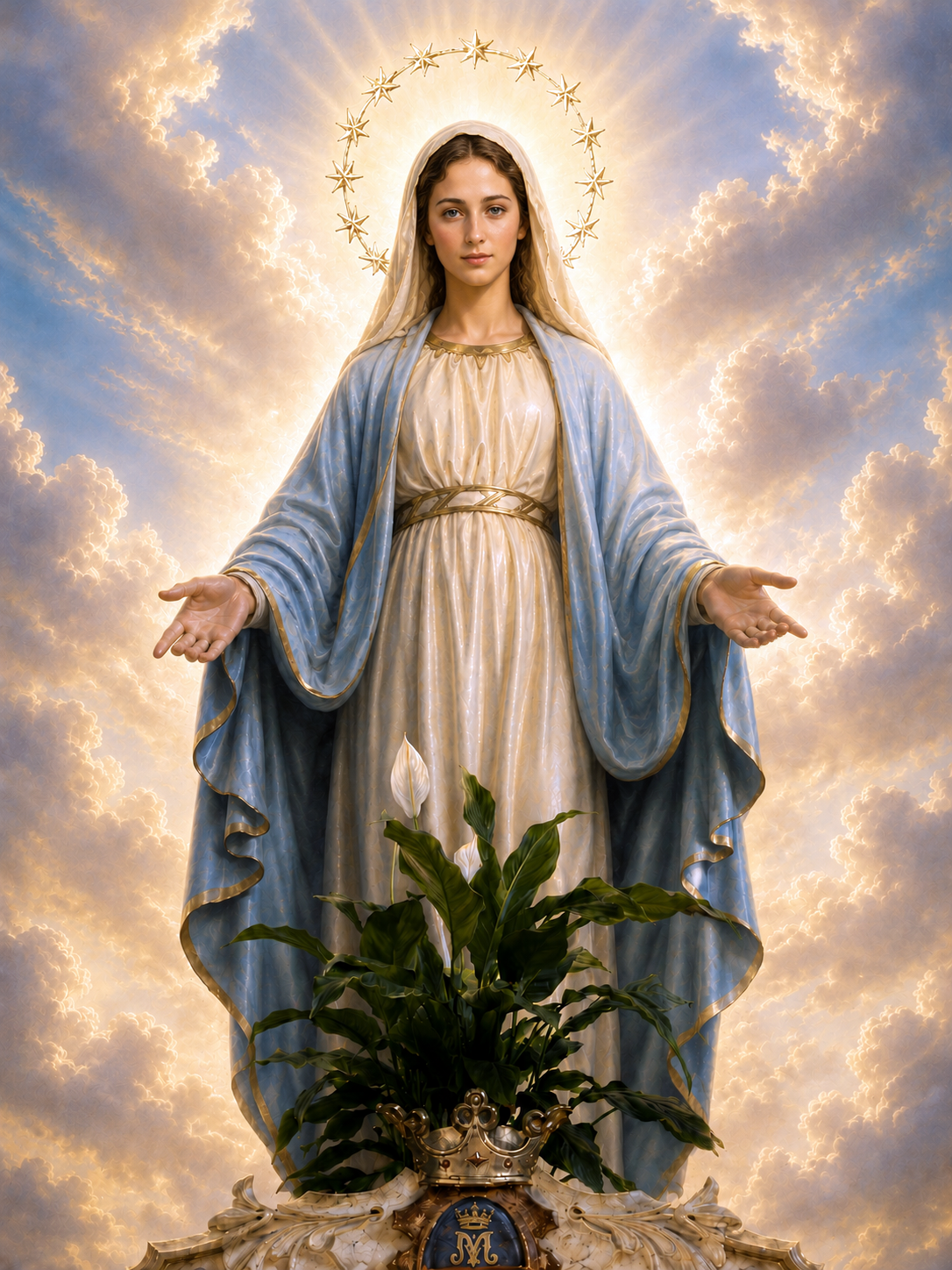
In the Davidic monarchy the mother of the king bore the title Gebirah — "Great Lady" or Queen Mother — a genuine royal office. Because the kings of Israel had many wives, it was the king's mother who held the queenly throne. The Hebrew term appears throughout the books of Kings and Chronicles, and whenever a new Davidic king is introduced, Scripture records his mother's name alongside his own (e.g., 1 Kings 15:13; Jeremiah 13:18).
The decisive scene is the accession of Solomon. When his mother Bathsheba approaches, the king himself rises and bows before her — and seats her on a throne at his right hand:
"So Bathsheba went to King Solomon… The king stood up to meet her and paid her homage. Then he sat down upon his throne, and a throne was provided for the king's mother, who sat at his right." 1 Kings 2:19 (NABRE)
Crucially, Bathsheba comes bearing a petition on behalf of another, and Solomon replies, "Make your request, mother, for I will not refuse you" (1 Kings 2:20). The Gebirah's role was therefore twofold: she reigned beside her son and she interceded with him for the people. This is precisely the role the Church recognizes in Mary. The royal psalm sings of this very queen: "the queen stands at your right hand, arrayed in gold" (Psalm 45:10 in the NABRE; 45:9 in translations that do not count the superscription) — a verse the Church applies to Mary enthroned beside Christ the King.
Since Jesus is "the Son of the Most High" to whom "the Lord God will give the throne of David his father," reigning "forever" (Luke 1:32–33), His mother is the Queen Mother of an everlasting kingdom. We see her exercise the Gebirah's intercessory office at the wedding feast of Cana — she brings the need to her Son ("They have no wine"), and her counsel to the servants is the perfect summary of all Marian devotion:
"Do whatever he tells you." John 2:5 (NABRE)
Pope Pius XII drew this teaching together in his 1954 encyclical Ad Caeli Reginam, establishing the feast of the Queenship of Mary, which he set on May 31; the 1969 reform of the calendar moved it to August 22, the octave day of the Assumption, where it remains. He grounded her queenship in two truths: she is the Mother of God, and "as the New Eve she was associated with the New Adam" in His redemptive work. The Church is careful to add (Lumen Gentium §60) that this maternal role "in no wise obscures or diminishes this unique mediation of Christ, but rather shows His power."
The Reservoir of All Graces
Theological Opinion — strong devotional and papal support, not defined dogma.
All grace comes from God alone, through the one Mediator, Christ. Yet the tradition of the Church holds that God, having given the world its Savior through Mary, continues to give His gifts through her hands.
A reservoir holds no water of its own making — it gathers and distributes what flows into it from the source. So the saints have spoken of Mary: not the origin of grace, but its appointed channel. The principle was given its classic expression by St. Bernardine of Siena (1380–1444):
Every grace that is communicated to this world has a threefold course. For by excellent order, it is dispensed from God to Christ, from Christ to the Virgin, and from the Virgin to us. St. Bernardine of Siena — Sermon on the Nativity of the B.V.M., n. 6
This is not a marginal devotion but a teaching repeatedly taken up by the popes. Pope Leo XIII cited St. Bernardine's words directly in his encyclicals Iucunda Semper (1894) and Adiutricem Populi (1895). St. Bernard of Clairvaux had taught that "God wills that we should have nothing which has not passed through the hands of Mary," and St. Alphonsus Liguori gathered the whole tradition in his classic The Glories of Mary. Lumen Gentium §62 affirms that Mary "by her constant intercession continued to bring us the gifts of eternal salvation," while insisting this flows entirely from Christ's merits and in no way adds to His unique mediation.
Why hell trembles at her name
From Genesis 3:15 — God's promise to set "enmity" between the serpent and the Woman — flows the constant conviction that Satan and his demons hold a special dread of Mary. She is the creature most perfectly opposed to him: the sinless one whose obedience undid Eve's fall, whose Son crushed the serpent's head, and through whose hands grace is poured out to rescue the souls hell seeks to claim. The saints teach that her very humility, as the lowly handmaid exalted above the angels, is unbearable to the proud spirits who fell.
St. Dominic and the fifteen thousand demons
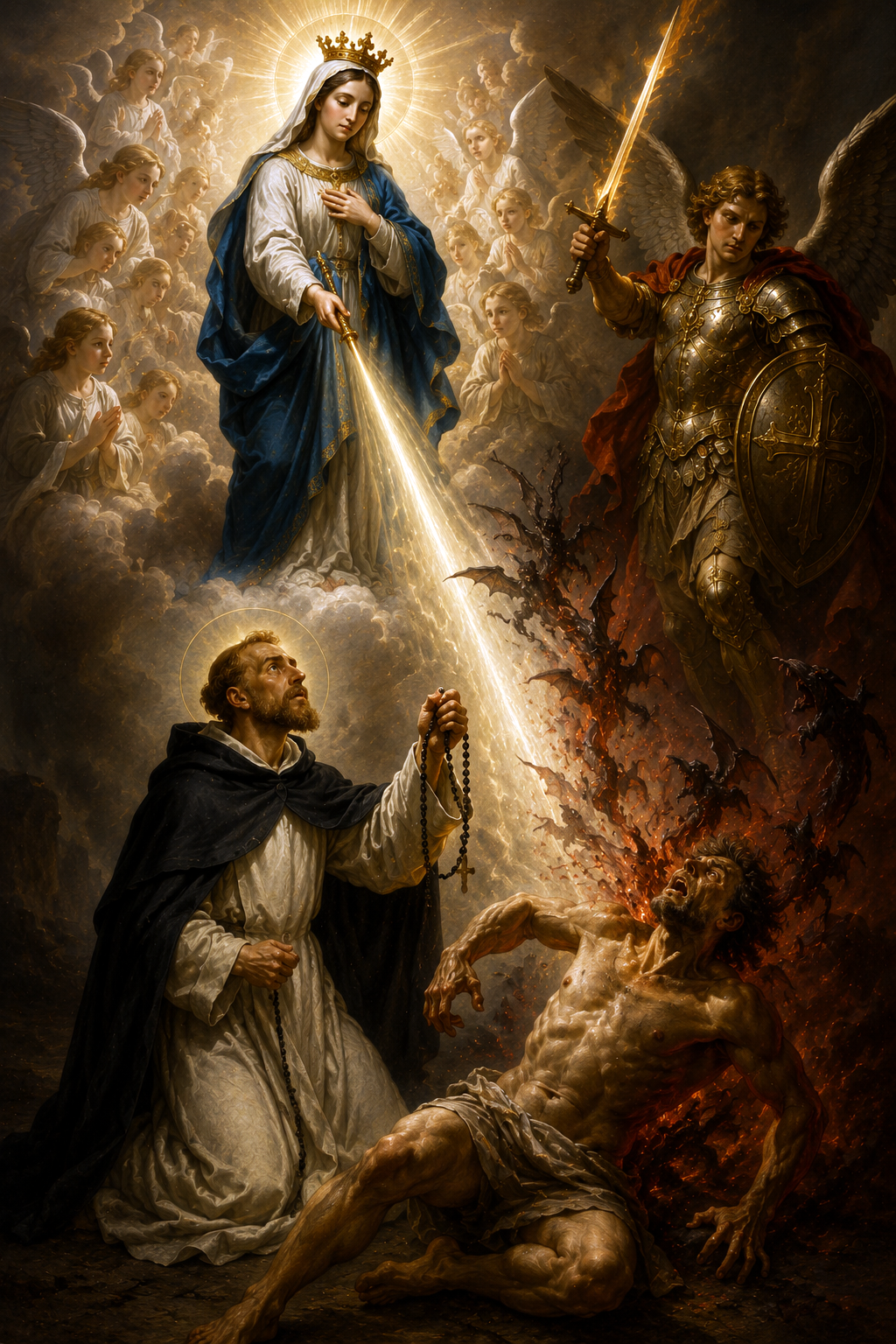
The most vivid illustration in the tradition is recounted by St. Louis de Montfort in The Secret of the Rosary (the "Thirty-third Rose"). The episode is presented as a pious account, not as Scripture or verified history — but it powerfully conveys what the Church believes about Mary's power over the forces of darkness.
According to that later devotional account, while St. Dominic (c. 1170–1221) was preaching the Rosary near Carcassonne in southern France, a man possessed by demons — an Albigensian heretic who had publicly attacked the mysteries of the Rosary — was brought to him before a crowd said to number over twelve thousand. As St. Dominic exorcised him, the demons were compelled, against their will, to answer his questions. They confessed:
- that there were fifteen thousand of them in the man's body, because he had attacked the fifteen mysteries of the Rosary;
- that by preaching the Rosary, Dominic "put fear and horror into the very depths of Hell," and that he was the man they hated most in all the world, for the souls he snatched from them through devotion to the Rosary.
St. Dominic then placed his rosary around the possessed man's neck and demanded the demons name which of all the saints in Heaven they feared most. When the demons tried to evade, screaming so that many in the crowd fell to the ground in terror, St. Dominic knelt and implored Our Lady's help by the power of the Rosary. Compelled at last, the demons were forced to confess the truth about Mary — words wrung from them against their will:
Listen well, you Christians: the Mother of Jesus Christ is all-powerful, and she can save her servants from falling into hell. She is the Sun which destroys the darkness of our wiles… It is she who uncovers our hidden plots, breaks our snares, and makes our temptations useless and ineffectual. The demons' compelled testimony, recounted in St. Louis de Montfort, The Secret of the Rosary (33rd Rose)
The demons further admitted, however reluctantly, that no soul who truly perseveres in devotion to Mary and her Rosary has ever been damned, for she obtains true repentance even for hardened sinners before they die. In the fuller telling, as the crowd prayed the Rosary aloud, Our Lady drove the demons out — at each Hail Mary a number of them departing in the form of red-hot coals — until the man was wholly delivered, after which he renounced his heresy and was converted. The full text is available in de Montfort's The Secret of the Rosary.
The Suffering Mother
Common Theological Teaching — Mary cooperates subordinately in Christ's work.
Mary's cooperation in salvation was not painless. Foretold by Simeon and fulfilled at Calvary, her sorrow joined her, in a wholly subordinate way, to the redemptive suffering of her Son.
At the Presentation of the infant Jesus in the Temple, the aged Simeon blessed the child and then turned to His mother with a prophecy that would shadow her whole life:
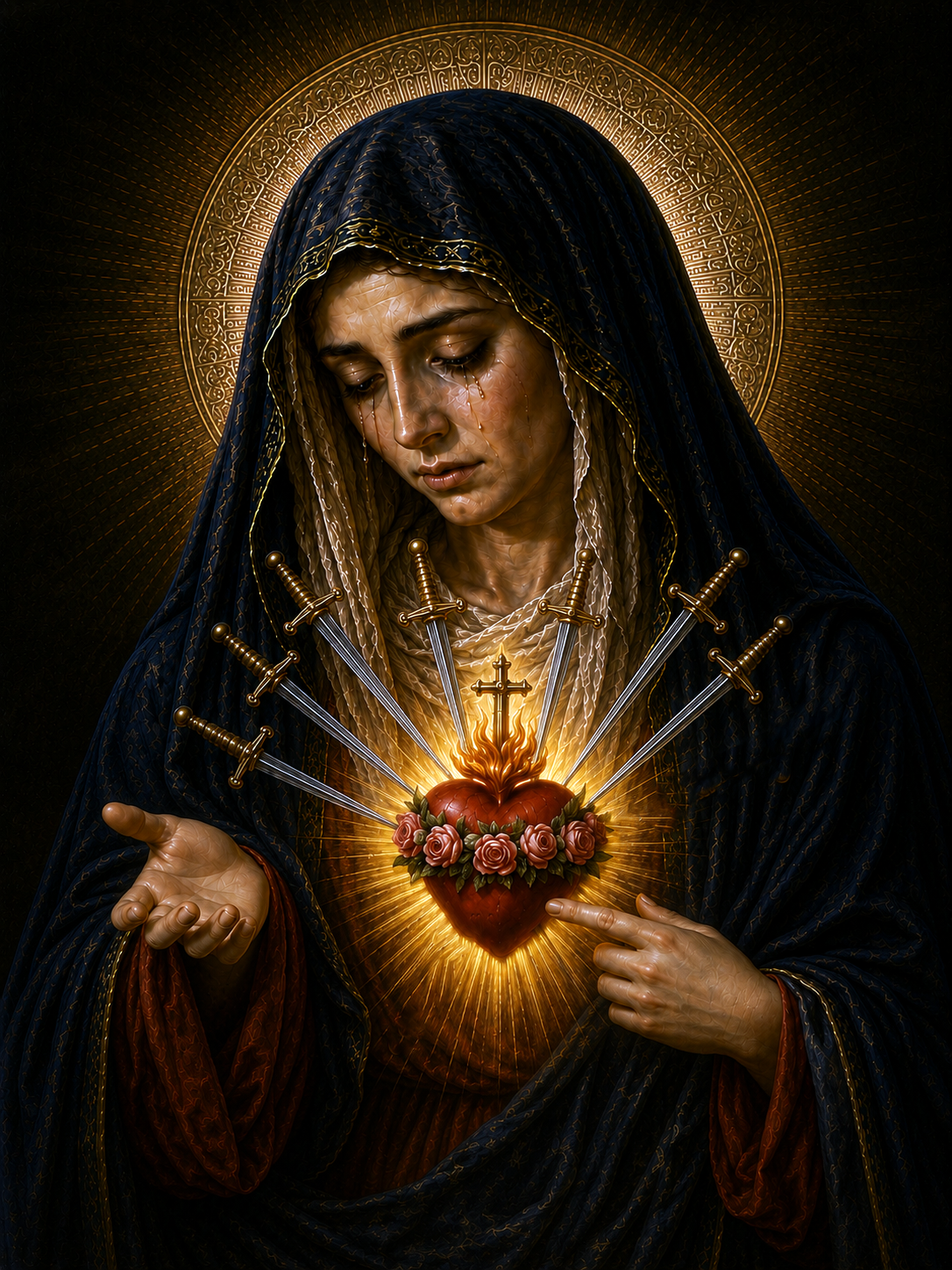
"Behold, this child is destined for the fall and rise of many in Israel, and to be a sign that will be contradicted — and you yourself a sword will pierce — so that the thoughts of many hearts may be revealed." Luke 2:34–35 (NABRE)
This is the origin of Mary's title Our Lady of Sorrows. Just as Isaiah foretold the Messiah as the Suffering Servant (Isaiah 53), Simeon foretells Mary as the suffering mother. The sword that would pierce her soul was fulfilled above all at the foot of the cross (John 19:25), where, as a sword pierced the side of her Son (John 19:34), sorrow pierced her heart. Her deep union with His redemptive work was, in the truest sense, a union in suffering.
The finding in the Temple — "they did not understand"
Between the Presentation and the public ministry stands the one episode of Jesus' youth the Gospels record, and it contains one of the few sentences Scripture puts in Mary's mouth. After three days of searching, she finds the twelve-year-old in the Temple:
"Son, why have you done this to us? Your father and I have been looking for you with great anxiety." Luke 2:48 (NABRE)
Luke's next observation is as important as her question: "they did not understand what he said to them" (Luke 2:50). The mother preserved from sin is not therefore a mother spared incomprehension. She is told she will be pierced, she loses her Son for three days, she does not grasp His answer — and she goes on believing anyway.
Her pilgrimage of faith — and what she kept
Twice Luke tells us what she did with what she could not yet understand:
"And Mary kept all these things, reflecting on them in her heart." Luke 2:19 (NABRE); cf. Luke 2:51
This is Mary's own interior life as Scripture describes it: not immediate comprehension but retention, pondering, and trust. The Council gave the same reality its own phrase — "the Blessed Virgin advanced in her pilgrimage of faith, and faithfully persevered in her union with her Son unto the cross" (Lumen Gentium §58) — having noted just before that at the finding in the Temple "they did not understand the word of their Son. His Mother indeed kept these things to be pondered over in her heart."
"A body you have prepared for me"
The Letter to the Hebrews places on the lips of the incoming Christ the words of Psalm 40: "Sacrifices and offerings you did not desire, but a body you prepared for me" (Hebrews 10:5). That body — the very instrument of redemption, offered on the cross — was given to the Son through Mary, at the Incarnation. In providing the sinless flesh that would be offered for the world, Mary's fiat stands at the threshold of the entire work of salvation, just as Eve's flesh, given to Adam, stood at the threshold of the Fall.
Mary at Pentecost — the mother of the newborn Church
Mary's role did not end at Calvary. After the Ascension, she is found in the upper room at the heart of the infant Church, praying with the apostles as they await the Holy Spirit:
"All these devoted themselves with one accord to prayer, together with some women, and Mary the mother of Jesus, and his brothers." Acts 1:14 (NABRE)
The same Spirit who overshadowed her at the Annunciation — bringing forth Christ the Head — now descends at Pentecost upon the gathered Church with Mary in its midst, bringing forth Christ's Body. She who was mother at the first coming of the Spirit is present at the second, fittingly called the Mother of the Church.
On the title "Co-Redemptrix"
From this cooperation arose the disputed title Co-Redemptrix. It is essential to understand what it can and cannot mean. The prefix "co-" means "with," not "equal to." Jesus Christ is the one and only Redeemer; Mary is herself among the redeemed. Where the title has been used, it pointed to three genuine truths: she consented by her fiat to give the world its Redeemer; she suffered with Him at Calvary (the sword of Simeon); and she intercedes still, making His merits more available to us by her prayers.
"Co-redeemers" — with a small "r"
There is a sense in which not only Mary but every Christian shares in Christ's redemptive work. St. Paul wrote: "In my flesh I am filling up what is lacking in the afflictions of Christ on behalf of his body, which is the Church" (Colossians 1:24). By uniting our own sufferings to Christ's and offering them for the salvation of souls, we participate in the redemption He alone accomplished. In this way Mary — and each of us — can be called a "co-redeemer" only ever with a small "r"; Christ is the one Redeemer with a capital "R." This teaching is set out in the documents of Vatican II and in St. John Paul II's encyclical Redemptoris Mater.
The Woman Clothed with the Sun
Common Theological Teaching — Mary and the Church read together.
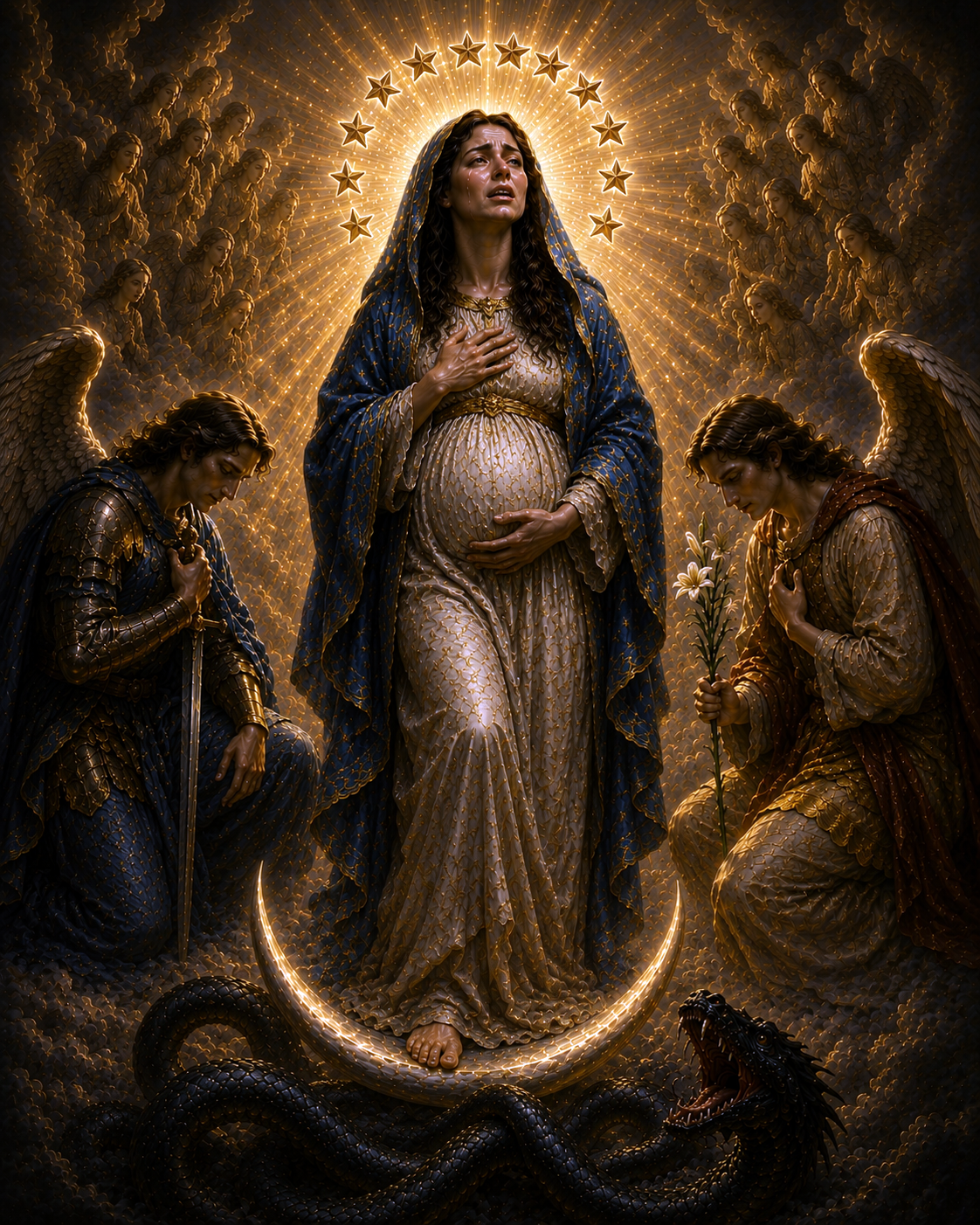
The promise of Eden returns at the close of Scripture — the Woman, her child, and the serpent, gathered into one final cosmic vision.
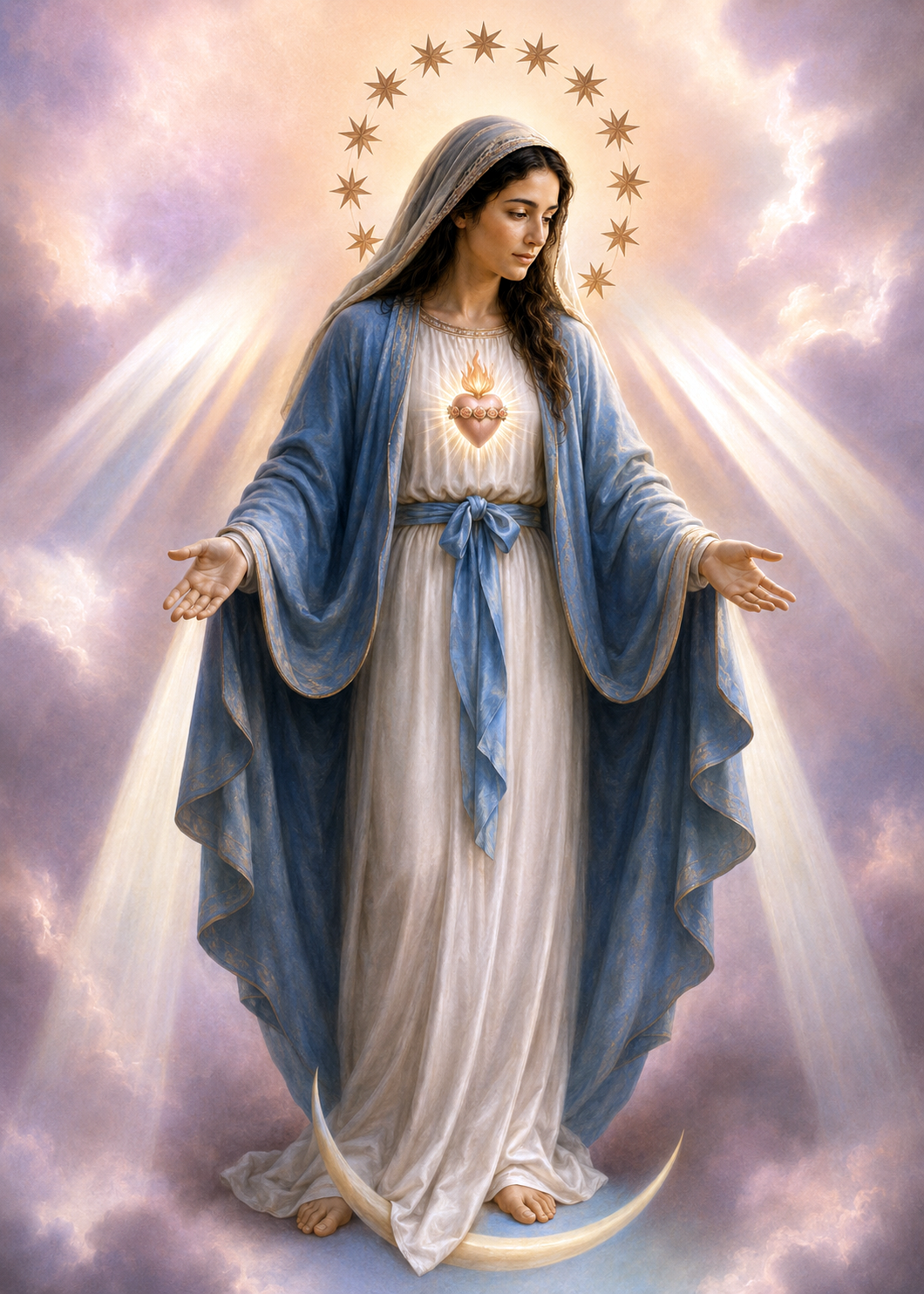
"A great sign appeared in the sky, a woman clothed with the sun, with the moon under her feet, and on her head a crown of twelve stars. She was with child… She gave birth to a son, a male child, destined to rule all the nations with an iron rod." Revelation 12:1, 5 (NABRE)
The Book of Revelation closes the great arc that Genesis opened. Here once more are the three figures of the Protoevangelium: the Woman, her male child who will rule the nations (clearly Christ, cf. Psalm 2:9), and the dragon identified explicitly as "the ancient serpent… called the Devil and Satan" (Revelation 12:9). The enmity promised in Eden is now shown in its final triumph.
The Church reads the Woman on multiple levels at once — and these readings reinforce rather than exclude one another:
The Woman as the People of God
The crown of twelve stars evokes the twelve tribes of Israel and the twelve Apostles; on this level the Woman is the People of God, Israel and the Church, bringing forth the Messiah and persecuted by the dragon.
The Woman as Mary
Because she gives birth to the individual male child who is Christ, the Woman is also Mary personally. The vision immediately follows the unveiling of the heavenly Ark (11:19) — and Mary is the New Ark. Her royal crown confirms the Queen Mother typology; her cosmic clothing (sun, moon, stars) recalls Joseph's dream in Genesis 37:9, the imagery of the whole house of Israel now gathered into one woman.
Mary, the type of the Church
This is the point at which the personal and the corporate readings meet, and it is the fourth great Marian typology — alongside the New Eve, the Ark, and the Queen Mother — and the one most easily missed:
As St. Ambrose taught, the Mother of God is a type of the Church in the order of faith, charity and perfect union with Christ. Second Vatican Council — Lumen Gentium §63 (November 21, 1964)
The Catechism puts the same point in a phrase: Mary is the "exemplary realization" — typus — of the Church (CCC §967). What is true of her personally is what the Church is called to be corporately: virgin in the integrity of her faith, mother in bringing forth Christ's life in others. This is why the two readings of the Woman cannot finally be separated — the Church, in the Council's phrase, is "itself rightly called mother and virgin," and Mary is what that looks like in one person.
The dragon, and the Mother of all who follow Christ
The vision continues: the dragon, "that ancient serpent, who is called the Devil and Satan" (Revelation 12:9), having failed to devour the child, "went off to wage war against the rest of her offspring, those who keep God's commandments and bear witness to Jesus" (Revelation 12:17). Here Mary's motherhood widens: she is mother not only of Christ the Head but of all His members — every Christian who keeps God's commandments is named her "offspring." This is the same gift Christ gave from the cross when He said to the beloved disciple, "Behold, your mother" (John 19:27). The Church calls this Mary's spiritual motherhood: "Jesus is Mary's only Son, but her spiritual motherhood extends to all" whom He came to save (Catechism §501).
Jericho and the seventh trumpet — the liturgy of the end
There is a remarkable structural echo between the fall of Jericho and the climax of Revelation, and it frames Mary's appearance. Recall that at Jericho the Ark was carried in procession while seven priests blew seven trumpets, and on the seventh day, after the seventh circuit and a great shout, the walls fell and Israel entered the Promised Land (Joshua 6). Revelation stages the end of history as just such a liturgy: seven seals, then seven angels with seven trumpets; and when the seventh trumpet sounds, "loud voices in heaven" cry, "The kingdom of the world has become the kingdom of our Lord and of his Christ" (Revelation 11:15) — and immediately the heavenly temple opens, the Ark appears, and the Woman is revealed (Revelation 11:19–12:1).
The pattern is the same: as the Ark led Israel across the Jordan and around Jericho into the earthly Promised Land, so the New Ark — Mary — appears at the threshold as God's people enter the eternal Promised Land. Just as the old covenant gave way to the new at the fall of Jericho (and, historically, at the destruction of the Temple in A.D. 70, when "not one stone" was left on another, Matthew 24:2), so the new covenant gives way to eternity through this final liturgical act, with the Ark of the New Covenant going before the redeemed. The Woman of Revelation is thus the hinge between fulfillment and consummation — the Queen Mother leading her children home.
The Four Marian Dogmas
Defined Dogma — the four Marian dogmas require Catholic assent.
Behind the typology stands the Church's formal teaching. These four truths are held by Catholics as divinely revealed.
Mary's whole identity is bound to the Holy Trinity in a threefold relationship: she is the Daughter of God the Father, the Mother of God the Son, and the Spouse of the Holy Spirit, by whose power she conceived. From this flow the four dogmas — truths the Church holds as divinely revealed. And the governing principle, throughout, is that everything the Church teaches about Mary serves to safeguard the truth about Christ: many Marian doctrines were defined precisely in answer to heresies that attacked Him.
Conciliar landmarks
Marian doctrine developed within the Church's confession of Christ. The Council of Ephesus (431) defended Mary as Theotokos because Jesus is one divine Person. The Second Council of Constantinople (553) used the title Aeiparthenos, Ever-Virgin. The Lateran Synod of 649 articulated Mary's virginity before, during, and after birth. Trent guarded the doctrine of original sin in a way that left Mary's singular privilege intact, while Vatican II placed Marian teaching within the mystery of Christ and the Church in Lumen Gentium chapter VIII.
1. Mother of God (Theotokos)
Defined at the Council of Ephesus in A.D. 431, this title affirms that Mary is truly the mother of the one Person, Jesus Christ, who is God. It is first a statement about Christ: because He is one divine Person, the one she bore is God. The Greek Theotokos means "God-bearer." Elizabeth proclaims it already in Luke 1:43, calling Mary "the mother of my Lord" — the Greek Kyrios, the word used for God. The dogma was defined to defend Jesus' true divinity against Nestorius, who would have divided Him into two persons.
The conciliar acts preserve the objection in Nestorius' own words:
The holy virgin is more accurately termed mother of Christ than mother of God. Nestorius — Second Letter to Cyril, preserved in the Acts of the Council of Ephesus
And Cyril's answer, from the letter the council approved:
So have they dared to call the holy virgin, mother of God, not as though the nature of the Word or his godhead received the origin of their being from the holy virgin, but because there was born from her his holy body. St. Cyril of Alexandria — Second Letter to Nestorius, approved at Ephesus
The charge that the title was a fifth-century invention was answered directly by St. John Henry Newman in his Letter to Pusey (1866), written to an Anglican. He observes that even Alexander, "one of the fiercest partisans of Nestorius," conceded the word was already in use, and then names those who had used it before Ephesus: "Archelaus of Mesopotamia, Eusebius of Palestine, Alexander of Egypt, in the third century; in the fourth, Athanasius, who uses it many times with emphasis, Cyril of Palestine, Gregory Nyssen and Gregory Nazianzen of Cappadocia, Antiochus of Syria, and Ammonius of Thrace." He adds that Constantine used the fuller form, "the Virgin Mother of God," in his address to the bishops at Nicaea.
It is worth noting that the earliest written reference to Mary in the New Testament is not in a Gospel at all. Some years before Mark was written, St. Paul had already fixed the Incarnation in a single clause:
"When the fullness of time had come, God sent his Son, born of a woman, born under the law." Galatians 4:4 (NABRE)
Paul names no Marian title and tells no infancy narrative; what he asserts is precisely what Ephesus would later define — that the Son God sent was born of a woman. The one whom the Father sent and the one she bore are the same Person. The dogma of the Theotokos is the unfolding of that clause, not an addition to it.
2. Perpetual Virginity
The constant teaching of the Church — held by the early Fathers and affirmed in the Catechism (§499–501) — that Mary was a virgin "before, during, and after" the birth of Christ. The title Aeiparthenos — Greek for "Ever-Virgin" — is well attested from the fourth century onward, and this was solemnly affirmed at the Second Council of Constantinople (A.D. 553) and clarified in its threefold sense at the Lateran Synod of 649 under Pope Martin I.
The threefold meaning: she conceived Jesus virginally by the Holy Spirit (Matthew 1:18; Luke 1:34–35); she remained a virgin in giving birth, her "virginal integrity" not diminished but, as Lumen Gentium §57 says, "sanctified"; and she remained a virgin for the whole of her life, never having other children.
Against this, the "brothers" of Jesus named in Scripture (e.g., Mark 6:3) are sometimes raised as an objection. The Church has always read these passages as not referring to other children of Mary — and the ancient tradition offers two explanations: that they were Joseph's children from a prior marriage (the Eastern, Epiphanian view), or close kinsmen, since Hebrew and Aramaic used "brother" broadly for cousins and relatives (the Western, Hieronymian view of St. Jerome). Notably, two of those named "brothers," James and Joseph, are elsewhere identified as sons of another Mary (Matthew 27:56; cf. CCC §500). Tellingly, the dying Christ entrusts His mother to the apostle John (John 19:26–27) — unthinkable in that culture had she other sons to care for her. This doctrine was so firmly rooted that Luther and Zwingli retained it outright, and Calvin refused to read the "brothers" of Jesus as further sons of Mary.
Of the two ancient explanations, the Catechism follows the Hieronymian line, identifying James and Joseph as sons of "the other Mary" (CCC §500). The Epiphanian explanation — that they were Joseph's children by an earlier marriage — comes to us from the Protoevangelium of James, the same apocryphon that gives us the names of Joachim and Anne. Both are ancient; they are not the same answer, and should not be blended.
3. The Immaculate Conception
Defined by Pope Pius IX on December 8, 1854, in the Apostolic Constitution Ineffabilis Deus. The dogma teaches that Mary, "in the first instant of her conception, by a singular grace and privilege of almighty God, in view of the merits of Jesus Christ… was preserved immune from every stain of original sin" (CCC §491-492).
That preventive redemption was famously clarified by Blessed John Duns Scotus around the turn of the fourteenth century. Scotus answered the objection that Mary could not be both sinless and redeemed by distinguishing two modes of redemption: one may be rescued after falling into a pit, or preserved from falling into it in the first place. Mary was redeemed in the more perfect way, by Christ's merits applied beforehand.
The Catechism compresses the whole of that answer into one clause. Quoting the Council's constitution on the liturgy, it calls Mary "the most excellent fruit of redemption" (CCC §508, citing Sacrosanctum Concilium §103). Not the exception to redemption — its finest product. Whoever objects that Mary needed a Saviour too has stated Catholic doctrine, not refuted it.
4. The Assumption
Defined by Pope Pius XII on November 1, 1950, in the Apostolic Constitution Munificentissimus Deus — the only formally ex cathedra definition made since the First Vatican Council. It declares that "the Immaculate Mother of God, the ever Virgin Mary, having completed the course of her earthly life, was assumed body and soul into heavenly glory." This flows directly from the New Ark typology: the Ark belongs in the heavenly sanctuary (Revelation 11:19). Psalm 132:8 prays, "Arise, Lord, come to your resting place, you and your mighty ark," and Revelation shows the Ark in heaven immediately before the Woman clothed with the sun (Revelation 11:19-12:1). If Mary is the New Ark, the Assumption is the fitting completion of that typology.
The wording repays attention: "having completed the course of her earthly life." The definition does not say that Mary died. The question of the Dormition — whether she died before being assumed — is deliberately left open, and remains open.
The obvious historical difficulty is that clear patristic attestation of the Assumption appears comparatively late. Munificentissimus Deus does not evade this. It argues from the ancient liturgy — "since ancient times, there have been both in the East and in the West solemn liturgical offices commemorating this privilege" — from the testimony of the Fathers and Doctors who drew on that liturgy, and from the consensus of the bishops of the whole world, whom Pius XII had formally consulted in the 1946 letter Deiparae Virginis Mariae and who gave "an almost unanimous affirmative response." The argument is one of doctrinal development attested in the Church's worship before it was articulated in her definitions.
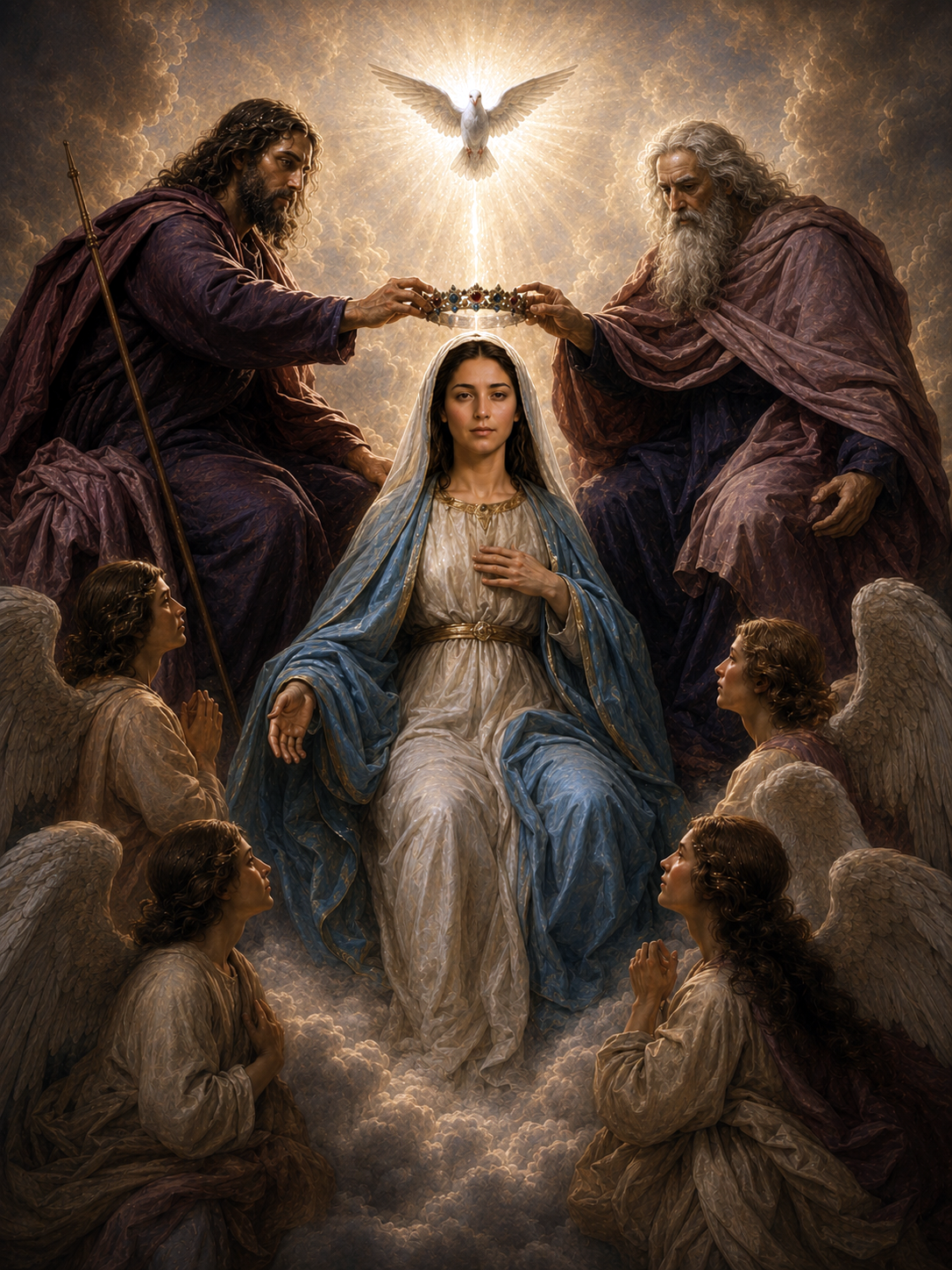
The Catechism adds that "the Assumption of the Blessed Virgin is a singular participation in her Son's Resurrection and an anticipation of the resurrection of other Christians" (CCC §966) — a sign of the bodily glory that awaits all who are conformed to Christ. The same constitution names her, in that glory, "Queen over all things," which the Church celebrates as her Queenship (the fifth glorious mystery, the Coronation), grounded in the Queen Mother typology.
Two truths often confused are worth distinguishing: the Immaculate Conception is Mary's own conception (free of sin from the start); the virginal conception is Jesus' conception (by the Holy Spirit, without a human father).
Where the Objections Fall Flat
Apologetics — doctrinal answers with ecumenical care.
The most common Protestant objections to Mary spring from a sincere desire to protect the glory of Christ. Examined closely, however, each rests on a premise that Scripture and history do not support.
Most objections to Marian doctrine come from earnest Christians guarding two precious truths: that Christ alone is Savior, and that worship belongs to God alone. Catholics hold both of those truths wholeheartedly. The disagreement is not about whether Christ is the one Mediator, but about whether honoring His mother and asking her prayers somehow violates that. Here are the chief objections, and where each one comes up short.
Objection 1: "Catholics worship Mary — that's idolatry."
This is the most serious charge and the most easily answered, because it mistakes what worship is. In Scripture, worship (Latin latria) means the adoration owed to God alone, supremely expressed in sacrifice. The Church has never offered, and explicitly forbids offering, sacrifice to Mary. Catholic theology carefully distinguishes three things, a distinction developed by St. Augustine and given its classic threefold form by St. Thomas Aquinas, and resting on the difference between adoration and veneration affirmed at the Second Council of Nicaea (787):
- Latria — adoration, due to God alone (Father, Son, Holy Spirit).
- Dulia — the honor given to the saints as friends of God and examples to us.
- Hyperdulia — the higher honor given to Mary as Mother of God — but still infinitely below the worship due to God, differing not in degree but in kind.
Where it falls flat: honoring a holy person is not the same as worshiping God — Scripture itself commands honor (Exodus 20:12; Romans 13:7) without confusing it with adoration. Mary herself directs all honor to God: "He who is mighty has done great things for me." To venerate Mary is to praise God's masterpiece; the honor, as the Council of Nicaea said of images, "passes to the prototype" — to God, who made her what she is.
The Council stated the distinction in its own words, and the sentence is worth having in full:
This cult, as it always existed, although it is altogether singular, differs essentially from the cult of adoration which is offered to the Incarnate Word, as well to the Father and the Holy Spirit, and it is most favorable to it. Second Vatican Council — Lumen Gentium §66 (November 21, 1964)
Two things in that sentence answer the charge. The difference is essential — not a matter of degree, as though Mary received slightly less of what God receives — and the honor given her is "most favorable" to the adoration of God, not a rival to it. The same paragraph also grounds the practice historically: "from earliest times the Blessed Virgin is honored under the title of Mother of God, under whose protection the faithful took refuge in all their dangers and necessities" — the Council's own allusion to the ancient Sub Tuum Praesidium, the oldest known prayer to Our Lady, preserved on a third-century Egyptian papyrus.
Objection 2: "There is one Mediator (1 Timothy 2:5) — so Mary cannot intercede."
St. Paul writes: "There is one God, and one mediator between God and men, the man Christ Jesus" (1 Timothy 2:5). Catholics affirm this completely. But notice what Paul writes just three verses earlier: he urges "that supplications, prayers, intercessions… be made for all men" (1 Timothy 2:1). In the very same breath that he names Christ the one Mediator, Paul commands Christians to intercede for one another.
Where it falls flat: if asking others to pray for us violated Christ's unique mediation, then Paul would be contradicting himself — and every Protestant who asks a friend to pray for them would be guilty too. Christ's mediation is unique and primary; all other intercession (whether a friend's, a pastor's, or Mary's) is wholly derived from and dependent on His, like many candles lit from one flame. The saints in heaven are not dead but alive in Christ (Luke 20:38; the "great cloud of witnesses," Hebrews 12:1), and "the fervent prayer of a righteous person is very powerful" (James 5:16) — none more righteous than the sinless Mother of God.
Objection 3: "It's not in the Bible — so it's a later invention." (Sola Scriptura)
Many objections reduce to the principle of sola scriptura: if a practice is not explicitly in Scripture, it must be rejected.
Where it falls flat: the principle is self-refuting — the Bible nowhere teaches that Scripture alone is the rule of faith. On the contrary, Paul tells the Thessalonians to "hold fast to the traditions" he taught them "either by word of mouth or by letter" (2 Thessalonians 2:15). The canon of Scripture itself — which books belong in the Bible — was discerned by the Church's authority and Tradition; one cannot use the Bible to reject Tradition without sawing off the branch one is sitting on. Moreover, much of Marian doctrine is deeply scriptural (the New Eve, the Ark, the Queen Mother, the Woman of Revelation, "all generations will call me blessed"), and the rest is the organic unfolding of what is contained in the deposit of faith.
Objection 4: "Honoring Mary detracts from Jesus."
Where it falls flat: this assumes glory is a fixed quantity, so that honor given to Mary is somehow subtracted from Christ. But Mary's entire existence points away from herself and toward her Son — her last recorded words in Scripture are "Do whatever he tells you" (John 2:5). Every Marian dogma is, at root, a statement about Christ: "Mother of God" defends His divinity; the virgin birth defends that He has God alone as Father; her sinlessness magnifies the holiness of the One she bore. As the Catechism puts it, "What the Catholic faith believes about Mary is based on what it believes about Christ, and what it teaches about Mary illumines in turn its faith in Christ" (CCC §487). A son is honored, not diminished, when his mother is honored.
Objection 5: "Jesus had brothers — so Mary had other children."
This objection, and its full answer, is treated in detail in the section "Virgin Before, During & After" above. In brief: the Aramaic and Hebrew of Jesus' world had no separate word for "cousin," using "brother" for a range of relatives; Scripture identifies two of these "brothers" as sons of another Mary; and the dying Christ entrusts His mother to John (John 19:26–27) — unthinkable had she other sons. The objection collapses on the language and the text alike.
Objection 6: "Jesus called Mary 'woman,' not 'mother.'"
Where it falls flat: in John's Gospel, "woman" is not a cold dismissal but a deliberate biblical title. Jesus uses it at Cana (John 2:4) and again at the Cross (John 19:26), the two moments when Mary's maternal role is most publicly revealed. The word echoes the Woman of Genesis 3:15 and anticipates the Woman clothed with the sun in Revelation 12. At Calvary, far from distancing Himself from Mary, Jesus gives her to the beloved disciple as mother: "Behold, your mother."
Objection 7: "The Hail Mary is vain repetition."
Where it falls flat: Christ condemns empty babbling, not all repeated prayer (Matthew 6:7). He Himself prayed the same words three times in Gethsemane (Matthew 26:44), and the heavenly liturgy repeats "Holy, holy, holy" without ceasing (Revelation 4:8). The Hail Mary is not empty phrasing: its first half is Scripture, joining Gabriel's greeting (Luke 1:28) to Elizabeth's blessing (Luke 1:42), and its second half is a simple request for Mary's intercession.
Objection 8: "Mary's question means she expected ordinary married life."
Where it falls flat: Mary's question, "How can this be, since I have no relations with a man?" (Luke 1:34), is striking precisely because she is already betrothed to Joseph. If she expected ordinary marital relations, the angel's announcement that she would bear a son would not naturally prompt "How?" The Fathers, including St. Augustine, saw in her question evidence of a prior resolve of virginity, honored by Joseph and fulfilled by the Holy Spirit's overshadowing.
Objection 9: "Jesus corrected a woman who blessed His mother — Luke 11:27–28."
"While he was speaking, a woman from the crowd called out and said to him, 'Blessed is the womb that carried you and the breasts at which you nursed.' He replied, 'Rather, blessed are those who hear the word of God and observe it.'" Luke 11:27–28 (NABRE)
Where it falls flat: the Greek menoun rendered "rather" does not negate what precedes it; it corrects the ground of the blessing while affirming it — closer to "yes, and still more." Jesus moves the woman from a blessing based on physical kinship to one based on hearing and keeping God's word. That is not a demotion of Mary. Luke has already shown her as the supreme instance of exactly what Jesus praises: "Blessed are you who believed that what was spoken to you by the Lord would be fulfilled" (Luke 1:45), and "Behold, I am the handmaid of the Lord. May it be done to me according to your word" (Luke 1:38). She is blessed on the very ground He names.
Objection 10: "Jesus set His family aside — 'Who is my mother?'"
"'Who are my mother and my brothers?'… 'Here are my mother and my brothers. For whoever does the will of God is my brother and sister and mother.'" Mark 3:33–35 (NABRE)
Where it falls flat: the saying widens the family; it does not expel anyone from it. The criterion Jesus gives is doing the will of God — and the one person in Scripture who is recorded saying "may it be done to me according to your word" is His mother. If the test is obedience to God's will, Mary passes it first and most completely. The passage makes discipleship the ground of nearness to Christ, and by that measure she is nearest.
The Council itself declined to close the questions it had not settled. Lumen Gentium §54 states that it does "not… have it in mind to give a complete doctrine on Mary, nor does it wish to decide those questions" the theologians had not yet fully illuminated.
Eastern Orthodox and Islamic points of contact
Eastern Orthodoxy shares a profound devotion to Mary as Theotokos, celebrates her Dormition, and preserves a rich tradition of Marian hymnography and iconography. The main divergence is not love for Mary but the Roman definition of the Immaculate Conception, which the Orthodox usually approach differently because of distinct ways of explaining ancestral sin. Islam also honors Maryam with unusual prominence — she is the only woman named in the Qur'an — while rejecting the Incarnation and therefore differing radically from Christian faith. These points of contact can support dialogue, but they cannot replace the Catholic confession that Mary's greatness comes wholly from her Son, true God and true man.
The Council itself noted this with gratitude, and it is the nearest thing in Lumen Gentium to an ecumenical hand extended over Marian doctrine: "It gives great joy and comfort to this holy and general Synod that even among the separated brethren there are some who give due honor to the Mother of our Lord and Saviour, especially among the Orientals, who with devout mind and fervent impulse give honor to the Mother of God, ever virgin" (Lumen Gentium §69). Where devotion to the Theotokos is shared, the Council treats it as common ground rather than as a boundary marker.
St. Louis de Montfort & True Devotion
Devotional Theology — not a separate sacrament or dogma.
"To Jesus through Mary." No saint has shaped Marian spirituality more than the missionary priest whose motto a future pope would make his own.
St. Louis-Marie Grignion de Montfort (1673–1716) was a French missionary priest, canonized by Pope Pius XII on July 20, 1947. His masterwork, True Devotion to the Blessed Virgin — written in 1712, lost, and rediscovered by chance in 1842 — is widely regarded as the most influential book of Marian spirituality ever written. Pope St. John Paul II took his papal motto, Totus Tuus ("Totally Yours"), directly from de Montfort and called reading the book a "decisive turning point" in his life.
The heart of his teaching
De Montfort's central insight is that the surest, easiest, shortest, and most perfect path to Jesus Christ is through His Mother. Since Mary is the creature most perfectly conformed to Christ, the more a soul is consecrated to her, the more it is consecrated to Him. He summarized the goal as doing all things "through Mary, with Mary, in Mary, and for Mary, in order to do them more perfectly through Jesus, with Jesus, in Jesus, and for Jesus."
His method is the Total Consecration, often called "Holy Slavery of Love" — a complete gift of oneself (body, soul, merits, and possessions) to Christ through Mary's hands. He devised a famous 33-day preparation of prayer and reading, culminating in an act of consecration made on a Marian feast. It is essentially, in his words, "a perfect renewal of the vows and promises of Holy Baptism."
Mary has produced, together with the Holy Spirit, the greatest thing which has been or ever will be — a God-Man; and she will consequently produce the greatest things that there will be in the latter times. St. Louis de Montfort — True Devotion to Mary, §35 (Faber translation)
The "Reign of Mary"
De Montfort prophesied a coming age in which devotion to Mary would spread mightily and form great saints for the final battle against Satan — a flowering he tied directly back to the enmity of Genesis 3:15. He saw the present era as the time of Mary's heel, set against the serpent's head.
Marian Devotions
Devotional Practice — approved means to deepen life in Christ.
From the typology and the dogmas flows a life of devotion. These are the great Marian practices of the Church — each to be understood in its proper place, some as defined teaching, others as approved or pious tradition.
The Holy Rosary
The Rosary is the most beloved of Marian devotions — a meditation on the mysteries of Christ's life, death, and glory, prayed through the eyes of His Mother. Dominican tradition links the Rosary to St. Dominic and his preaching against the Albigensian heresy, though the devotion as we know it developed gradually over the following centuries. This is the Catechism's own account: "Medieval piety in the West developed the prayer of the rosary as a popular substitute for the Liturgy of the Hours" (CCC §2678). It is structured in mysteries — the Joyful, Sorrowful, and Glorious, to which Pope St. John Paul II added the Luminous mysteries in 2002. Each set is prayed across five decades of Hail Marys, framed by the Our Father and the Glory Be. Its power comes from meditative prayer on the mysteries of Christ's life, not from mechanical recitation (John Paul II, Rosarium Virginis Mariae [2002], §12).
Blessed Alain de la Roche (also known by the Latinized name Alanus de Rupe, c. 1428–1475), who revived the devotion, recorded Our Lady calling the Rosary (the "Angelic Psalter," patterned on the 150 Psalms) "the foundation stone of the New Testament." The popes have endorsed it repeatedly, and Leo XIII alone wrote eleven encyclicals on it.
The Brown Scapular of Our Lady of Mount Carmel
According to Carmelite tradition, in 1251 at Aylesford, England, the Blessed Virgin appeared to St. Simon Stock and gave him the brown woolen scapular, promising that "anyone dying in this habit shall not suffer eternal fire." The Church later extended this devotion to all the faithful, who may be enrolled (by any priest) in the Scapular Confraternity. The scapular is worn over the shoulders, one panel front and one back, and is a quiet, continual sign of consecration to Mary and trust in her protection.
Marian feasts in the liturgical year
The Church's calendar teaches Marian doctrine by returning to it year after year. These principal celebrations give readers a simple way to pray with Mary inside the rhythm of the liturgical year:
Traditional Marian prayers
The Church's Marian prayer is drawn above all from Scripture and from ancient Christian devotion. The Hail Mary joins Gabriel's greeting (Luke 1:28), Elizabeth's blessing (Luke 1:42), and the Church's plea for Mary's intercession.
The Angelus
The Angelus is prayed traditionally morning, noon, and evening, sanctifying the day by returning again and again to the Incarnation: the angel's message, Mary's fiat, and the Word made flesh. In Eastertide, the Regina Caeli replaces it, turning the same Marian devotion toward the joy of the Resurrection.
The Memorare
The Memorare is a beloved prayer of petition, traditionally associated with St. Bernard of Clairvaux though its exact authorship is uncertain. Its force is confidence: the sinner flees to Mary not because she replaces Christ, but because her intercession brings the needy soul to Him with motherly care.
Other ancient prayers
The Salve Regina and the ancient Sub Tuum Praesidium train the heart to seek Mary's help without forgetting that every grace she obtains comes from Christ. Their language is bold because Christian prayer is bold: it asks the Mother of the Redeemer to pray for those still on pilgrimage.
How to make a Marian consecration
De Montfort's consecration is usually made after thirty-three days of preparation: twelve days turning away from the spirit of the world, one week growing in knowledge of self, one week growing in knowledge of Mary, and one week growing in knowledge of Jesus Christ. The act is commonly made on a Marian feast, after confession and Mass when possible, and renewed regularly. The point is not a second baptism or a private vow of superstition, but a deliberate renewal of baptismal promises: belonging more completely to Christ by placing oneself in the care of His Mother.
Approved Marian apparitions
Approved apparitions do not add new doctrine; they call the faithful back to the Gospel. They should be received gratefully and soberly, never as a fifth gospel and never as a substitute for Scripture, Tradition, the sacraments, or obedience to the Church.
Our Lady of Guadalupe (1531)
At Tepeyac, near present-day Mexico City, the Blessed Virgin appeared to St. Juan Diego and left her image on his tilma. Guadalupe stands at the heart of the evangelization of the Americas: Mary appears as a mother close to the poor and indigenous, bearing Christ to a wounded people. Her image, rich with biblical and local symbolism, remains one of the most venerated Marian signs in the world and is especially beloved as patroness of the Americas and of unborn children.
Our Lady of Lourdes (1858)
At Lourdes, France, the Virgin appeared to St. Bernadette Soubirous and identified herself with the words, "I am the Immaculate Conception," only four years after the dogma was defined. The spring associated with the apparitions became a place of pilgrimage, penance, and healing, with reported cures examined by medical review. Lourdes is not proof of a new doctrine; it is a maternal summons to prayer, conversion, and trust in the mercy of Christ.
The Miraculous Medal (1830)
In the Rue du Bac apparitions to St. Catherine Labouré in Paris, Mary was shown standing upon the globe with rays streaming from her hands and the prayer, "O Mary conceived without sin, pray for us who have recourse to thee." The medal's imagery expresses Mary's Immaculate Conception and maternal intercession; its widespread use belongs to approved devotional life, not to dogma.
Our Lady of Fátima
In 1917, at Fátima, Portugal, three shepherd children reported apparitions of the Blessed Virgin over six months. Fátima is a Church-approved private revelation (approved by the local bishop in 1930 and honored by many popes). Its message was a call to prayer — especially the Rosary — penance, and conversion of sinners, with a particular emphasis on devotion to the Immaculate Heart of Mary. The apparition is also associated with the Miracle of the Sun on October 13, 1917, the request for the consecration of Russia, the First Saturday devotion, and the so-called Three Secrets: a vision of hell, a warning bound up with war and Russia, and a symbolic vision of persecution and martyrdom later published by the Holy See.
The titles of Our Lady
The Church honors Mary under a great multitude of titles, each illuminating a facet of her role. Some name her place in salvation history; others praise her virtues; still others come from approved apparitions or local devotion. Each is meant to deepen love for Christ through love for His Mother.
The Litany of Loreto gathers many of these invocations into one prayer, moving from Mary's divine motherhood to her virginity, virtues, biblical images, and queenship. The titles should never be read as rival honors set against Christ; each one is a lens for seeing what His grace accomplished in her.
Sister Mary of Ágreda
Private Revelation — approved for devotional use; not binding.
A cloistered Spanish abbess whose visions of the Virgin's life fill four volumes — read by popes, scrutinized for centuries.
The Mystical City of God
Sister María de Jesús de Ágreda was abbess of the Conceptionist convent in Ágreda, Spain, and counselor by correspondence to King Philip IV. Over roughly forty years she recorded extensive visions concerning the life of the Blessed Virgin — from the eternal decree of her creation, through her conception, infancy, the Incarnation, and her glorious Assumption and coronation. These were published as The Mystical City of God (Spanish: Mística Ciudad de Dios), in four parts.
The work offers a sweeping mystical narrative of salvation history seen through Mary, including richly detailed accounts of the hidden years of the Holy Family and a mystical reading of the Book of Revelation. Her cause for beatification was opened after her death but later suspended and has not been resumed. She was declared Venerable in 1673, and that title stands, though the cause has not advanced since. Her body is reported incorrupt, but that report, like the visions themselves, does not make the work binding on the faithful.
Few private works have been examined so intensively. After the work was placed on the Roman Index in 1681, Pope Innocent XI suspended that condemnation the same year, issuing a decree permitting its publication and reading (dated November 9, 1681 in some accounts and July 3, 1686 in the preface bound with the Blatter translation), followed by similar decrees under Alexander VIII, Clement XI, and Benedict XIII. (A later condemnation by some Sorbonne theologians in 1696 — after Innocent XI's death — was prompted by a faulty French translation of the work rather than the original.) The future Benedict XIII, as archbishop, even preached a series of Marian sermons drawn from it.
Blessed Anne Catherine Emmerich
Private Revelation — beatification does not verify every textual detail.
A bedridden German stigmatist whose visions led, a century later, to the discovery of Mary's house near Ephesus.
The Life of the Blessed Virgin Mary
Anne Catherine Emmerich was a poor German peasant who became an Augustinian nun, bore the stigmata, and spent her final years bedridden, offering her sufferings for others. Her visions of the lives of Christ and His Mother were recorded by the Romantic poet Clemens Brentano, who sat with her for years. From these notebooks came The Life of the Blessed Virgin Mary (published 1852) and The Dolorous Passion of Our Lord (1833) — the latter a major inspiration for Mel Gibson's film The Passion of the Christ.
She was beatified by Pope St. John Paul II on October 3, 2004. Her visions are remarkable for their concrete, eyewitness vividness; among their most famous fruits, the description of Mary's last home led explorers in 1891 to the House of the Virgin Mary near Ephesus, a site the Holy See has favored ever since: Leo XIII named it a place of pilgrimage in 1896, Pius XII raised it to the status of a Holy Place in 1951, and John XXIII confirmed that privilege in perpetuity in 1961, while Paul VI (1967), John Paul II (1979), Benedict XVI (2006), and Francis (2014) each traveled there to celebrate Mass. The Church has never pronounced on the authenticity of the house itself.
On Private Revelation
Defined Teaching — public revelation is complete; private revelation is subordinate.
How the Church weighs the visions of the mystics — and why this matters for everything above.
The teaching of the Church draws a firm line between two kinds of revelation. Public Revelation — the deposit of faith contained in Scripture and Tradition — was completed with the death of the last Apostle; nothing can be added to it. Private revelations (the visions of saints and mystics, approved apparitions, and similar graces) do not belong to this deposit. As the Catechism (§67) teaches, their role "is not to improve or complete Christ's definitive Revelation, but to help live more fully by it in a certain period of history."
Even when the Church approves a private revelation, she declares only that it contains nothing contrary to faith and morals and may be believed with human (not divine) faith. The faithful are never obliged to believe any private revelation — including those of de Montfort's "Reign of Mary," Ágreda, or Emmerich. Beatification and canonization honor the holiness of a person's life; they do not authenticate that person's visions.
The same discipline the Church applies to private revelation, the Council applied to Marian teaching itself — and it warned in both directions at once:
But it exhorts theologians and preachers of the divine word to abstain zealously both from all gross exaggerations as well as from petty narrow-mindedness in considering the singular dignity of the Mother of God. … Let them assiduously keep away from whatever, either by word or deed, could lead separated brethren or any other into error regarding the true doctrine of the Church. Let the faithful remember moreover that true devotion consists neither in sterile or transitory affection, nor in a certain vain credulity … Second Vatican Council — Lumen Gentium §67 (November 21, 1964)
Both errors are named, and neither is treated as the safer one. Exaggeration and minimizing are both failures of truth about her; and the Council's own remedy is the method followed on this page — Scripture, the Fathers, the doctors and the liturgy, read under the guidance of the magisterium, with a care not to lead the separated brethren into error about what the Church actually holds.
Joy in Honoring Mary
Pastoral Meditation — devotional conclusion.
All true devotion to Mary is Christ-centered, and leads to a deeper love of Jesus. One of its greatest fruits is joy.
From the first promise in Eden to the Woman crowned with stars, the whole of Scripture has been quietly preparing us to know the Mother God chose for His Son — and, from the cross, for us. To honor her is never to turn away from Christ; it is to be drawn closer to Him, for she points only ever to Him: "Do whatever he tells you." A deep awareness of Mary as our spiritual mother is itself a gift of the Holy Spirit, and it bears the fruit of joy:
There is joy in relationship — in being a brother or sister of Jesus and a child of Mary; joy in security — in being wrapped in her maternal love; joy in blessings received through her intercession; joy in learning, as she teaches us to rely on her Son; joy in sharing her with others; and joy in growing in the love of Jesus under her guidance. To honor His mother is, in the end, to bring joy to Christ Himself.
To give Jesus the delightful joy of loving Mary on earth, through me and in me — and to give Mary the joy of seeing her Son live again in me. A summary of the spirit of true Marian devotion
And the Church's own last word on Mary is not about her alone. Having spoken of the Church's origin, mission and destiny, the Catechism concludes by looking at her, because she is what the Church is becoming:
In her we contemplate what the Church already is in her mystery on her own "pilgrimage of faith," and what she will be in the homeland at the end of her journey. Catechism of the Catholic Church §972, gathering Lumen Gentium §68
That is why she "shines forth on earth, until the day of the Lord shall come, a sign of certain hope and comfort to the pilgrim People of God" (Lumen Gentium §68). To honor her is to look at the end of our own road and see that God has already brought one of us all the way home.
Ad Jesum per Mariam — To Jesus, through Mary.